Ted-Livingston on Definition Spends & Earns #152

Replies: 2 comments 11 replies

-
|
Thank you for responding, Ted. Your first question is How to define EARN and SPEND. Users can only do 4 things with their user wallets.
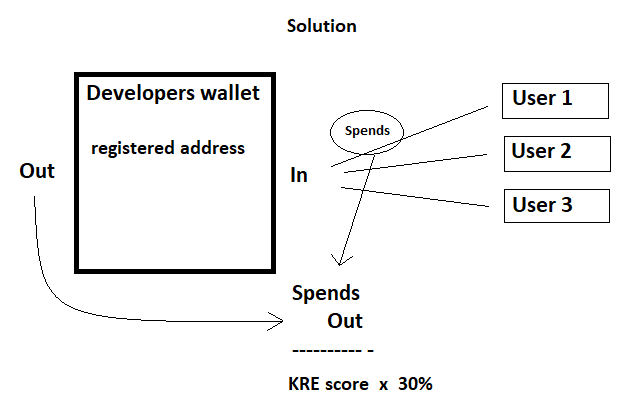
We also know the wallet address of the app. What counts are numbers 1 + 2. A SPEND always lowers the user balance. Transactions (tx) seen from user point of view: A user to user tx falls under 3 and 4. This way we can see the difference between real SPENDS / EARNS and all other transactions. That means that if we pull P2P tx into the KRE you open the door for massive gaming. The only way to stop gaming is to just reward SPENDS minus EARNS. Is a buy through an in app buy module an EARN? Is a deposit from an exchange an EARN? Is a SPEND anything that lowers the user balance? Is a User to User transaction a SPEND? Is a withdrawal to an exchange a SPEND? Is a tranfer from one app to another a SPEND? Your example of potential gaming
Not one time a number 1 or 2 ( SPEND or EARN ) was made. The next is your variation that instead of tipping in step 3, something is bought in app.
We don't have to rely on what a developer passes on to the KRE. We don't need a memo field. Everything is automatically arranged from the transactions on the blockchain. The memo field can again be used for what it is intended for... a memo. .................. What you get with this system is that you only reward the actual Economic Activity. That's why we need a 2nd fund for apps that are very important, but don't have Economic Activity. A buy module is very very important, but it in itself is no exchange of goods or services. It is a tool. Opening up the KRE for buy modules would mean rewarding deposits....and that, as shown above, opens the door for gaming. So the only logical thing to do is to make a 2nd fund and determine on a case by case base whether an app qualifies for it. In case of CODE it is very simple. However, we don't need e.g. 20 different buy modules. I admit it all sounds very strict, but for now it is necessary. |
Beta Was this translation helpful? Give feedback.

-
|
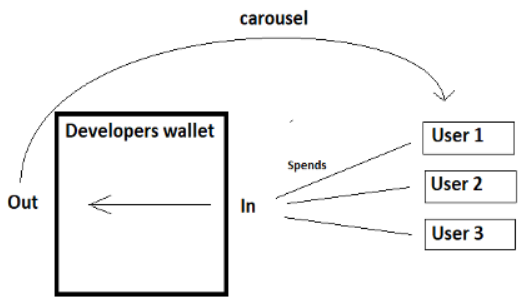
Good point. This possibility has been discussed with the KF before, I called it the carousel. It's like taking money out of your own cash register, buying another item and repeating this over and over. No entrepreneur would do such a stupid thing. KRE 4.0 rewards with 30%. 1300 / 120 * 20 = 216 (VAT) Total tax 216 + 379 = 595 But now you tripple your net turnover by gaming your spends. 3900 / 120 * 20 = 650 (VAT) Total tax 650 + 1137 = 1787 However, you didn't really got 3000 turnover, that was fake. Net income is now What prevents a developer from simply not reporting this turnover to the tax authorities? We must make our 'weakness' our strength. It should not be difficult to produce an annual overview of this data. It's nice when governments keep everyone honest. It has more advantages. Think about it. If those developers declare too little on their tax returns, and the KF paid them in full, who do you think they will turn to? Who made all this possible? They just have to come up with the accusation...how is the KF going to defend itself? If you lived here in the Netherlands, the judge could rule that all those developers are bogus self-employed. The judge may rule that they are deemed to be in paid employment of the KF because this corresponds more with reality. Each country will judge this in its own way, but it gives you an idea what I mean. With KRE 4.0 we reward with 30%, which means that they also generate their own income, which is a characteristic of self-employed entrepreneurs. In addition, if we show that we work with governments in every possible way, by having the revenue data available, lawyers will be very grateful to you later. Again, this is a unique feature of the KRE. I am curious how other cryptos will solve this problem with governments. |
Beta Was this translation helpful? Give feedback.

-
|
Hi Freedom. I agree that we want to be onside with governments, and that we should aspire to work with them to promote the adoption and growth of this amazing technology. My concern is on the accounting side. Just because something “looks like” a sale to the KRE, I’m not sure it means a developer would have to book it as such when calculating their sales tax. I’m not an accountant so it would be interesting to get one to weigh in, but I would assume a developer could book this as some sort of “promotion” or “investment” and not an actual sale, because the truth is, it wouldn’t be a sale. On the income tax side, this only comes into play if the developer produces a net profit. It seems like a developer could use their fraudulent KRE income to hire more developers or buy more ads and never pay income tax on it. Given these two things it feels like it would be pretty easy for a malicious developer to game a spend based KRE, without needing to break any laws to do so. What do you think? |
Beta Was this translation helpful? Give feedback.
-
|
Hi Ted, First I would like to mention that there will probabelly be no system that is 100% not gamable. So what I'm looking for is a system that at least promotes Economic Activity by making Kin flow through the system AND is least gameble. The problem you see is that Kin that is spent is withdrawn from the app's wallet by the dev and deposited to a user account that is under his control and than spends it again in the app, thus producing more and more SPENDS without deductable EARNS.
In any case, you break the carousel that you can repeat many times a day. However, we do have a system that stimulates Economic Activity and that is always better than the current system. As a side note, I'm still a proponent of making annual statements for both the developer and tax collectors...if only to protect the KF from legal problems. We may not count on their help, but every little bit helps. If developers want to game the system, they will have to do so very consciously, both with the KRE and in their accounting. The advantage is that since we only reward spends, there are no other attack factors to worry about. And if there is someone who is gaming the system, it will not have any negative effect on other developers. |
Beta Was this translation helpful? Give feedback.
-
|
Hi Freedom. I like how you are iterating through the options. To me that is how design is best done. I think your proposal is a step in the right direction. The question I’m asking myself is “is it enough?” For example it seems like with this latest version a developer would get no KRE the day they do the withdrawal, but would get it the rest of the days. So they couldn’t do the carousel every day, but it seems they could perhaps do it every other day. One option might be to increase the length of the calculation window (calculated weekly for example?) so that they could only do it every other week. That said I worry that they could just use larger amounts of Kin because the carousel would have “a guaranteed return on investment”. What do you think? Another thing I’m thinking about is if spends are the right thing to focus on generally, from a strategic point of view. I’m going to start a separate thread on this to keep it focused, but would appreciate your thoughts Freedom. |
Beta Was this translation helpful? Give feedback.
-
|
Surely there will be a way to game this. I will certainly continue to investigate how we can tackle this problem. Suppose we can make this system (almost) watertight, could this be a system that you would support? From a strategic point of view, I think KRE must meet the following requirements:
|
Beta Was this translation helpful? Give feedback.

-
|
Hello Freedom. I think undermining the huge risks that comes with the flaws and gaming potentials of the spend based KRE would be a huge mistake. Just relying on the government and tax authorities to deal with bad actors is not smart. You mentioned no smart entrepreneur would do such a thing but we all know that in the history of the KRE there have been developers who have gamed the formula. These developers had ways to avoid taxes so its safe to assume they would do the same thing with the new KRE formula specially now that the new spend-based formula makes is SUPER easy to be gamed. |
Beta Was this translation helpful? Give feedback.
-
|
Hi Amiralia, Let's asume for a moment that you are right and KRE 4.0 can be gamed. The same reason you give for disapproving KRE 4.0 can also be used to disapprove 3.0. KRE 4.0 however pays you exactly what is due. There is another good reason. Even if KRE 4.0 is gamed as much as 3.0, we're better off. With 4.0 there is at least an incentive for Economic Activity. KRE money is being used for what it is intended for....promoting the flow of Kin through the economy. That's something 3.0 definitely doesn't do. What strikes me is the kind of developers that are apparently attracted to KRE 3.0. The biggest problem always seems to be that they cheat. In fact it is the only concern I hear so far on the proposal. Unfortunately free money also attracts people who are actually not real entrepreneurs. It is not an easy job. You have to make an effort to offer good products that people are willing to pay for. You have to take risks, advertise and invest money yourself. So the idea that a KRE fully provides your income is very attractive. But even that is just appearance. Only the top 3 in the KRE may be able to live on that income. The rest absolutely not. But back to the gaming possibilities. Is that what you mean, or do you see other dangers? My 2nd question is: And if you don't like that, how do you see KRE 3.0 providing the income of 50 or more developers? Should we increase the KRE from 250MM to 500MM per day? And above all....who is going to pay for all those incomes? |
Beta Was this translation helpful? Give feedback.
-
|
One thought reading your comment amiraliaaa and your reply Freedom - what if the payout was based on "AUB growth” versus "AUB total"? Such that developers get rewarded for how much they increase their AUB, versus total AUB they have? This way big devs need to keep growing, and small devs can compete too. Their growth would have to be compared to their high water mark. This could be daunting as all their revenue would go to zero as soon as their AUB stopped growing. In such a case we couldn’t just reset their high water mark, as that would be easy to game, but perhaps there could be some “cooling off” function where their high water mark would slowly get lowered if they weren’t hitting it anymore until they were hitting it once again. What do you two think of something like that? |
Beta Was this translation helpful? Give feedback.
-
|
The problem with rewarding AUB in any form is that once again it keeps Kin IN the wallets. Instead, we need to encourage it to come out and flow through the economy. Measuring AUB growth is just measuring how much more Kin has NOT been spent. It does not measure the growth of the economy. It feels like building a race car where you build a powerful engine into it to move forward quickly...but then you hang a block of concrete behind it that acts like an anchor. The wheels turn but don't move forward, digging themselves more and more into the sand, until you're stuck. Kin doesn't move forward. KRE is a powerful engine...but most of its power is used, and lost, dragging the AUB. |
Beta Was this translation helpful? Give feedback.

-
|
I think relying on AUB encourages users to hold their Kin and not to liquidate their assets which helps the price to increase. I understand that a healthy trading volume is also needed and thats where spends come into play. Thats why I think the KRE formula should include both AUB and spends as the main parameters with perhaps more focus on AUB to allow established apps to benefit from the KRE and big apps to join the ecosystem. |
Beta Was this translation helpful? Give feedback.
-
|
Ameralia, AUB encourages developers to ensure that users keep their Kin in their wallet. Their pay check depents on it. That Kin is not spent, so it impedes the flow of Kin through the economy, while that is what drives Economic Activity. The claim that it prevents users from liquidating their Kin and that it helps increase the price of Kin is hopelessly outdated. Selling on exchanges is big and the price is extremely low. This despite more than a year rewarding AUB. Measuring AUB growth is measuring how much more Kin is NOT spent. |
Beta Was this translation helpful? Give feedback.


Uh oh!
There was an error while loading. Please reload this page.
-
Hi Ted, I've taken the liberty of copying your comments into this discussion.
ted-livingston
3 days ago
Hey Freedom. I appreciate you taking the time to put this proposal together. It gets me excited to see you and others leaning in on this, as I agree the KRE is the most important part of Kin. I hope we can all work together to explore these ideas and find the best solutions.
I have a few thoughts on your proposal, but I wonder if it might be helpful to take them one at a time. My goal isn’t to be pedantic, but to keep the discussion focused so that we aren’t trying to tackle multiple topics at once.
Perhaps my first question is around how you define “earn” and “spend”.
For example, is a buy through an in app buy module an earn? Is a deposit from an exchange?
For a spend, is it anything that lowers a user’s balance? If not does a user to user transaction within an app count? Does a withdraw to an exchange? What about a transfer from one app to another?
I think these definitions are important to both reduce gaming and create the right incentives.
For example, one way how I see gaming could potentially occur:
In this scenario it seems like user_account1 might look like it had a net spend of 1,000 Kin, resulting in a 300 Kin bonus for the developer, even though they are just moving money around programmatically. Perhaps even simpler, instead of tipping user_account2, the developer could perhaps just have user_account1 buy a digital good from the app. There likely wouldn't be any sales tax, as just because an app tells the KRE it made a sale, it seems they could tell their accountant they were just moving money around, which I don't think would be breaking any accounting rules.
What are your thoughts on this and how your proposal might protect against it?
Beta Was this translation helpful? Give feedback.
All reactions