In this assignment I implemented the logic of building the shapes by using the data provided by the
CS123XMLSceneParser.
As described in the algo, I created a class in CS123SceneData.h called CS123TransfromPrimitive,
which has the following three member variables.
    glm::mat4x4 transform;
    CS123ScenePrimitive primitive;
The "transform" matrix is the "aggregated" transform matrix of the primitive, which is the product of all its parent nodes' transforms as well as its own transforms, multiplied in a top first order. We store such a matrix for each primitive in the scene so that we don't have to re-traverse the tree again in the future. We only create such an object for primitives because those are what ultimately gets drawn. Nodes' like "master" are only relevant because they apply transforms to their children nodes. Once we've computed all the "aggregated" transform matrix for all the leaf node (i.e. primitives), we no longer need their parents.
So, each Scene contains a std::vector<CS123TransformPrimitive> called transPrim, and we build this
via calling the function parseNode recursively in Scene.cpp. This function accepts a Scene
pointer, a node, and a transform matrix. It will first compute the local transform matrix and then
the product of the "inherited" transform matrix with it. If this node is primitive, it will add a
primitive to transPrim. Then for every child it has, we call parseNode again.
To avoid repeated vertices computation, we store the following 5 primitives in the SceneviewScene
class:
    std::unique_ptr<Cube> m_cube;
    std::unique_ptr<Cone> m_cone;
    std::unique_ptr<Sphere> m_sphere;
    std::unique_ptr<Cylinder> m_cylinder;
    std::unique_ptr<Torus> m_torus;
During geometry rendering, we determine which primitives to use depending on the primitive's type. We only reset those shapes when settings are changed. Thus regardless of the complexity of the scene, we never need to compute vertices for more than 5 primitives.
To implement texture map, we must store extra 2 floating point values in each vertex. Thus I created
a new class OpenGLVertex to hold all the data that a vertex needs.
class OpenGLVertex {
public:
    glm::vec4 position;
    glm::vec4 normal;
    glm::vec2 texcoord;

    OpenGLVertex(glm::vec4 position, glm::vec4 normal, glm::vec2 texcoord);
    OpenGLVertex rotate(glm::mat4x4 rot);
    OpenGLVertex sphericalRotate(glm::mat4x4 rot);
    OpenGLVertex normAvgWithRotation(glm::mat4x4 rot);
};
I also indicates that there are 2 more floating point values for each vertex when populating the vertex data to OpenGL.
static constexpr int kFloatsPerVertex = 8;
m_numVertices = m_coords.size() / kFloatsPerVertex;
setVertexData(m_coords.data(), m_coords.size(), VBO::GEOMETRY_LAYOUT::LAYOUT_TRIANGLE_STRIP, m_numVertices);
setAttribute(ShaderAttrib::POSITION, 3, 0, VBOAttribMarker::DATA_TYPE::FLOAT, false);
setAttribute(ShaderAttrib::NORMAL, 3, 12, VBOAttribMarker::DATA_TYPE::FLOAT, false);
setAttribute(ShaderAttrib::TEXCOORD0, 2, 24, VBOAttribMarker::DATA_TYPE::FLOAT, false);
For efficient use of textures, I used the class Texture2D provided by the stencil code, and built
a hashmap from the filename of the texture to the Texture2D object. That way when multiple
primitives shares one texture, we can reuse the texture and save both space and I/O time.
std::map<std::string, CS123::GL::Texture2D> m_textures;
The process of building UVs varies from shape to shape. In a high-level, I replaced all the old
ShapeUtil function calls with a version that also computes the UV for each vertex. The methods
ranges from
sphericalUV(from the formula)rectangleUVcircularUV
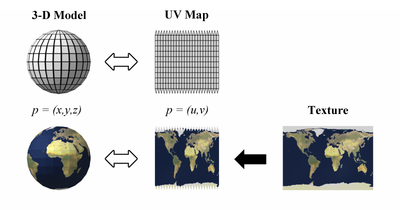

My implementation of LOD only depends on the number of primitives in the scene. I used the following code to compute LOD.
void Scene::computeLOD() {
    int sz = m_transPrims.size();
    if (sz < 10)
        m_lod_coef = 1;
    else if (sz < 100)
        m_lod_coef = 0.75;
    else if (sz < 200)
        m_lod_coef = 0.5;
    else if (sz < 500)
        m_lod_coef = 0.25;
    else m_lod_coef = 0.1;
}
Thus m_lod_coef is always less than or equal to 1 and greater than or equal to 0. I then
multiplied m_lod_coef with p1, p2 and p3 from settings when setting up the 5 primitives.
No known bugs