


Natrix is a framework-free browser runtime experiment built around a playable local two-player Snake game.
Compact runtime showcase: command-driven input, fixed-timestep simulation, deterministic replay, explicit lifecycle state, replaceable DOM/Canvas renderers, and live runtime metrics.
No any framework. No game engine. Just browser APIs, JavaScript modules, tests, and a small game surface that makes the runtime behavior easy to inspect.
You can switch the renderer at runtime from the control below the game. The Canvas mode is also addressable through ?renderer=canvas; missing or invalid renderer values fall back to DOM rendering.
- Framework-free browser runtime: the game runs on plain JavaScript, Webpack, DOM, Canvas, and browser timing APIs.
- Command-driven input: keyboard events are translated into logical commands before they reach simulation state.
- Fixed-timestep simulation: gameplay advances at a stable logical tick rate instead of depending on display refresh rate.
- Explicit lifecycle state: start, pause, resume, finish, and reset are handled by a runtime state machine.
- Deterministic simulation and replay: seeded RNG, tick-indexed command logs, replay payloads, and state hashes make gameplay reproducible.
- Renderer boundary:
DOMRenderer,CanvasRenderer, andNullRenderershare the sameinit / render / resize / destroycontract. - Runtime telemetry: measured simulation and renderer decorators expose rolling FPS and p50/p95 timing without changing deterministic game state.
- Headless testability: core simulation and replay logic can run without DOM rendering.
- Regression coverage: baseline gameplay, runtime lifecycle, replay, renderer behavior, input buffering, and deterministic fixtures are covered by Jest.
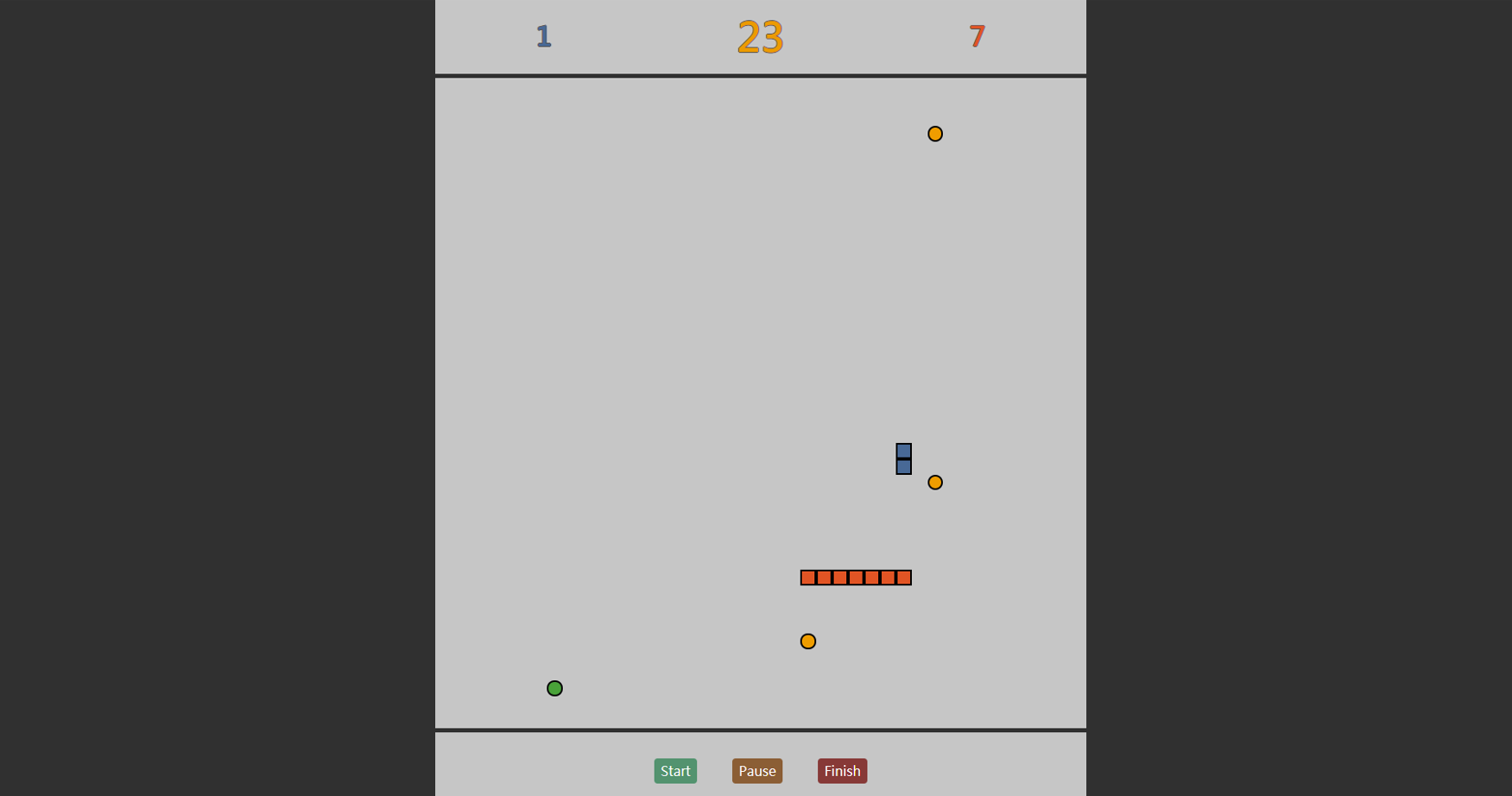
- Local two-player Snake match with red and blue teams.
- Blue snake uses ⬆️, ⬅️, ⬇️, ➡️.
- Red snake uses
W,A,S,D. - Yellow food adds 1 point.
- Green food adds 2 points.
- A snake dies when it collides with the wall or with its own body.
- If every snake on one team dies, the other team wins immediately.
- If time expires, the team with the highest score wins.
KeyboardEvent
    -> KeyboardInput
    -> InputBuffer
    -> GameRuntime
    -> FixedTimestepLoop
    -> Simulation step
    -> Render snapshot
    -> DOMRenderer / CanvasRenderer / NullRenderer
    -> RuntimeMetrics -> PerformancePanel
The runtime separates intent, state, and presentation:
- Input boundary: browser keyboard events become logical commands.
- Runtime boundary:
GameRuntimeowns lifecycle, ticking, command recording, snapshots, and renderer orchestration. - Simulation boundary:
stepGame(state, commands)advances serializable game state and emits domain events. - Replay boundary: recorded commands and seeded configuration can be replayed synchronously without browser APIs.
- Rendering boundary: renderers receive snapshots rather than mutating authoritative game state.
| Path | Responsibility |
|---|---|
src/js/input/ |
Keyboard mapping, command buffering, and input ownership |
src/js/runtime/ |
Runtime facade, fixed-timestep loop, and lifecycle state machine |
src/js/simulation/ |
Movement, scoring, collision, finish rules, and pure state stepping |
src/js/state/ |
Serializable game state, snapshots, canonical state, and state hashing |
src/js/replay/ |
Command recording, replay codec, replay runner, and payload validation |
src/js/render/ |
Renderer contract, DOM renderer, Canvas renderer, HUD, renderer host, and mode selection |
src/js/telemetry/ |
Runtime timing collection, measured simulation decorator, clock adapter, and metrics panel |
test/ |
Unit, integration, renderer, replay, and regression coverage |
docs/baseline/ |
Historical gameplay and performance baseline notes |
npm ci
npm start
Then open http://localhost:8080.
| Command | Purpose |
|---|---|
npm start |
Start the Webpack development server on http://localhost:8080 |
npm run build |
Build the production bundle into dist/ |
npm run preview |
Serve the production build at http://127.0.0.1:4173 |
npm test |
Run the Jest test suite |
npm run test-coverage |
Generate the coverage report |
npm run verify:dev-server |
Smoke-check the development server |
npm run verify:preview |
Smoke-check the production preview after a build |
Use this sequence before publishing or reviewing a runtime change:
npm ci
npm test
npm run test-coverage
npm run build
npm run preview
In another terminal, after npm run preview is running:
npm run verify:previewThis codebase uses patterns only where they describe real boundaries:
- Command for input, replay, and future transport boundaries.
- State Machine for runtime lifecycle rules.
- Facade for the public
GameRuntimeAPI. - Strategy for renderer selection.
- Adapter around browser-specific input and rendering concerns.
- Decorator for simulation and renderer timing without adding measurement code to their core implementations.
- Memento-style replay payloads for reproducible simulation.
GameRuntime.getMetrics() returns a defensive metrics snapshot. The live panel reports FPS, frame time p50/p95, simulation step p50/p95, render time p50/p95, delayed frames, and currently rendered entities.
Timing percentiles and FPS use the latest 300 samples. A frame taking more than 50 ms is counted as delayed. These values are local observations, not published benchmark claims.
MIT