Table of Contents
npm install json-asAdd the --transform to your asc command (e.g. in package.json)
--transform json-asOptionally, for additional performance, also add:
--enable simdAlternatively, add it to your asconfig.json
{
  "options": {
    "transform": ["json-as"]
  }
}
If you'd like to see the code that the transform generates, run the build step with DEBUG=true
Full documentation lives at:
https://docs.jairus.dev/json-as
import { JSON } from "json-as";

@json
class Vec3 {
  x: f32 = 0.0;
  y: f32 = 0.0;
  z: f32 = 0.0;
}

@json
class Player {
  @alias("first name")
  firstName!: string;
  lastName!: string;
  lastActive!: i32[];
  // Drop in a code block, function, or expression that evaluates to a boolean
  @omitif((self: Player) => self.age < 18)
  age!: i32;
  @omitnull()
  pos!: Vec3 | null;
  isVerified!: boolean;
}

const player: Player = {
  firstName: "Jairus",
  lastName: "Tanaka",
  lastActive: [3, 9, 2025],
  age: 18,
  pos: {
    x: 3.4,
    y: 1.2,
    z: 8.3,
  },
  isVerified: true,
};

const serialized = JSON.stringify<Player>(player);
const deserialized = JSON.parse<Player>(serialized);

console.log("Serialized    " + serialized);
console.log("Deserialized " + JSON.stringify(deserialized));This library allows selective omission of fields during serialization using the following decorators:
@omit
This decorator excludes a field from serialization entirely.
@json
class Example {
  name!: string;
  @omit
  SSN!: string;
}

const obj = new Example();
obj.name = "Jairus";
obj.SSN = "123-45-6789";

console.log(JSON.stringify(obj)); // { "name": "Jairus" }
@omitnull
This decorator omits a field only if its value is null.
@json
class Example {
  name!: string;
  @omitnull()
  optionalField!: string | null;
}

const obj = new Example();
obj.name = "Jairus";
obj.optionalField = null;

console.log(JSON.stringify(obj)); // { "name": "Jairus" }
@omitif((self: this) => condition)
This decorator omits a field based on a custom predicate function.
@json
class Example {
  name!: string;
  @omitif((self: Example) => self.age <= 18)
  age!: number;
}

const obj = new Example();
obj.name = "Jairus";
obj.age = 18;

console.log(JSON.stringify(obj)); // { "name": "Jairus" }

obj.age = 99;

console.log(JSON.stringify(obj)); // { "name": "Jairus", "age": 99 }
If age were higher than 18, it would be included in the serialization.
AssemblyScript doesn't support using nullable primitive types, so instead, json-as offers the JSON.Box class to remedy it.
For example, this schema won't compile in AssemblyScript:
@json
class Person {
  name!: string;
  age: i32 | null = null;
}
Instead, use JSON.Box to allow nullable primitives:
@json
class Person {
  name: string;
  age: JSON.Box<i32> | null = null;
  constructor(name: string) {
    this.name = name;
  }
}

const person = new Person("Jairus");
console.log(JSON.stringify(person)); // {"name":"Jairus","age":null}

person.age = new JSON.Box<i32>(18); // Set age to 18
console.log(JSON.stringify(person)); // {"name":"Jairus","age":18}Sometimes it's necessary to work with unknown data or data with dynamic types.
Because AssemblyScript is a statically-typed language, that typically isn't allowed, so json-as provides the JSON.Value and JSON.Obj types.
Here's a few examples:
Working with multi-type arrays
When dealing with arrays that have multiple types within them, eg. ["string",true,["array"]], use JSON.Value[]
const a = JSON.parse<JSON.Value[]>('["string",true,["array"]]');
console.log(JSON.stringify(a[0])); // "string"
console.log(JSON.stringify(a[1])); // true
console.log(JSON.stringify(a[2])); // ["array"]
Working with unknown objects
When dealing with an object with an unknown structure, use the JSON.Obj type
const obj = JSON.parse<JSON.Obj>('{"a":3.14,"b":true,"c":[1,2,3],"d":{"x":1,"y":2,"z":3}}');

console.log("Keys: " + obj.keys().join(" ")); // a b c d
console.log(
  "Values: " +
    obj
      .values()
      .map<string>((v) => JSON.stringify(v))
      .join(" "),
); // 3.14 true [1,2,3] {"x":1,"y":2,"z":3}

const y = obj.get("d")!.get<JSON.Obj>().get("y")!;
console.log('o1["d"]["y"] = ' + y.toString()); // o1["d"]["y"] = 2
Working with dynamic types within a schema
More often, objects will be completely statically typed except for one or two values.
In such cases, JSON.Value can be used to handle fields that may hold different types at runtime.
@json
class DynamicObj {
  id: i32 = 0;
  name: string = "";
  data!: JSON.Value; // Can hold any type of value
}

const obj = new DynamicObj();
obj.id = 1;
obj.name = "Example";
obj.data = JSON.parse<JSON.Value>('{"key":"value"}'); // Assigning an object

console.log(JSON.stringify(obj)); // {"id":1,"name":"Example","data":{"key":"value"}}

obj.data = JSON.Value.from<i32>(42); // Changing to an integer
console.log(JSON.stringify(obj)); // {"id":1,"name":"Example","data":42}

obj.data = JSON.Value.from("a string"); // Changing to a string
console.log(JSON.stringify(obj)); // {"id":1,"name":"Example","data":"a string"}
Working with nullable primitives and dynamic data
const box = JSON.Box.from<i32>(123);
const value = JSON.Value.from<JSON.Box<i32> | null>(box);
const reboxed = JSON.Box.fromValue<i32>(value); // Box<i32> | null
console.log(reboxed !== null ? reboxed!.toString() : "null");
// 123

const value = JSON.parse<JSON.Value>("123");
const boxed = JSON.Box.fromValue<i32>(value);
console.log(boxed !== null ? boxed!.toString() : "null");
// 123Sometimes its necessary to simply copy a string instead of serializing it.
For example, the following data would typically be serialized as:
const map = new Map<string, string>();
map.set("pos", '{"x":1.0,"y":2.0,"z":3.0}');

console.log(JSON.stringify(map));
// {"pos":"{\"x\":1.0,\"y\":2.0,\"z\":3.0}"}
// pos's value (Vec3) is contained within a string... ideally, it should be left alone
If, instead, one wanted to insert Raw JSON into an existing schema/data structure, they could make use of the JSON.Raw type to do so:
const map = new Map<string, JSON.Raw>();
map.set("pos", new JSON.Raw('{"x":1.0,"y":2.0,"z":3.0}'));

console.log(JSON.stringify(map));
// {"pos":{"x":1.0,"y":2.0,"z":3.0}}
// Now its properly formatted JSON where pos's value is of type Vec3 not string!By default, enums with values other than i32 arn't supported by AssemblyScript. However, you can use a workaround:
namespace Foo {
  export const bar = "a";
  export const baz = "b";
  export const gob = "c";
}

type Foo = string;

const serialized = JSON.stringify<Foo>(Foo.bar);
// "a"This library supports custom serialization and deserialization methods, which can be defined using the @serializer and @deserializer decorators.
Custom serializers and deserializers must always speak valid JSON. You can optionally provide the JSON value shape they operate on using one of: "any", "string", "number", "object", "array", "boolean", or "null". If omitted, the shape defaults to "any".
Here's an example of creating a custom data type called Point which serializes to a JSON string:
@json
class Point {
  x: f64 = 0.0;
  y: f64 = 0.0;
  constructor(x: f64, y: f64) {
    this.x = x;
    this.y = y;
  }

  @serializer("string")
  serializer(self: Point): string {
    return JSON.stringify(`${self.x},${self.y}`);
  }

  @deserializer("string")
  deserializer(data: string): Point {
    const raw = JSON.parse<string>(data);
    if (!raw.length) throw new Error("Could not deserialize provided data as type Point");

    const c = raw.indexOf(",");
    const x = raw.slice(0, c);
    const y = raw.slice(c + 1);

    return new Point(f64.parse(x), f64.parse(y)); // NEVER use this in deserializers. Always return a new instance
  }
}

const obj = new Point(3.5, -9.2);

const serialized = JSON.stringify<Point>(obj);
const deserialized = JSON.parse<Point>(serialized);

console.log("Serialized    " + serialized);
console.log("Deserialized  " + JSON.stringify(deserialized));
The serializer function converts a Point instance into a valid JSON string value.
The deserializer function parses that JSON string back into a Point instance.
Custom deserializers should always instantiate and return a new object. They should not assume an existing destination instance will be passed in or reused.
These functions are then wrapped before being consumed by the json-as library:
@inline __SERIALIZE_CUSTOM(): void {
  const data = this.serializer(this);
  const dataSize = data.length << 1;
  memory.copy(bs.offset, changetype<usize>(data), dataSize);
  bs.offset += dataSize;
}

@inline __DESERIALIZE_CUSTOM(data: string): Point {
  return this.deserializer(data);
}
This allows custom serialization while maintaining a generic interface for the library to access.
Undecorated subclasses of built-in container types keep the built-in JSON behavior.
This rule applies consistently across:
JSON.stringify(...)JSON.parse<T>(...)JSON.Value.from(...)JSON.internal.stringify(...)JSON.internal.parse(...)
For example:
class MyBytes extends Uint8Array {}still serializes like a normalUint8Arrayclass MyMap extends Map<string, i32> {}still serializes like a normalMap<string, i32>- the same applies to subclassable built-ins such as
Array,Set, and typed arrays
If you decorate that subclass with @json, it is treated as a normal generated class instead of inheriting the built-in container behavior. That means generated __SERIALIZE / __DESERIALIZE logic and custom serializer/deserializer hooks can take over.
If you want a different wire format, decorate the subclass with @json and provide custom @serializer(...) / @deserializer(...) methods:
function hexDigit(value: u8): string {
  return String.fromCharCode(value < 10 ? 48 + value : 87 + value);
}

function parseHexNibble(code: u16): u8 {
  if (code >= 48 && code <= 57) return <u8>(code - 48);
  if (code >= 97 && code <= 102) return <u8>(code - 87);
  return <u8>(code - 55);
}

@json
class HexBytes extends Uint8Array {
  constructor(length: i32 = 0) {
    super(length);
  }

  @serializer("string")
  serializer(self: HexBytes): string {
    let out = "";
    for (let i = 0; i < self.length; i++) {
      const value = unchecked(self[i]);
      out += hexDigit(value >> 4);
      out += hexDigit(value & 0x0f);
    }
    return JSON.stringify(out);
  }

  @deserializer("string")
  deserializer(data: string): HexBytes {
    const raw = JSON.parse<string>(data);
    const out = new HexBytes(raw.length >> 1);

    for (let i = 0, j = 0; i < raw.length; i += 2, j++) {
      const hi = parseHexNibble(<u16>raw.charCodeAt(i));
      const lo = parseHexNibble(<u16>raw.charCodeAt(i + 1));
      unchecked((out[j] = <u8>((hi << 4) | lo)));
    }

    return out;
  }
}

const bytes = new HexBytes(4);
bytes[0] = 10;
bytes[1] = 20;
bytes[2] = 30;
bytes[3] = 40;

JSON.stringify(bytes);      // "\"0a141e28\""
JSON.parse<HexBytes>("\"0a141e28\"");
This same pattern works for subclassable built-ins like Array, Map, Set, and typed arrays.
ArrayBuffer and String are @final in AssemblyScript, so they cannot be subclassed there.
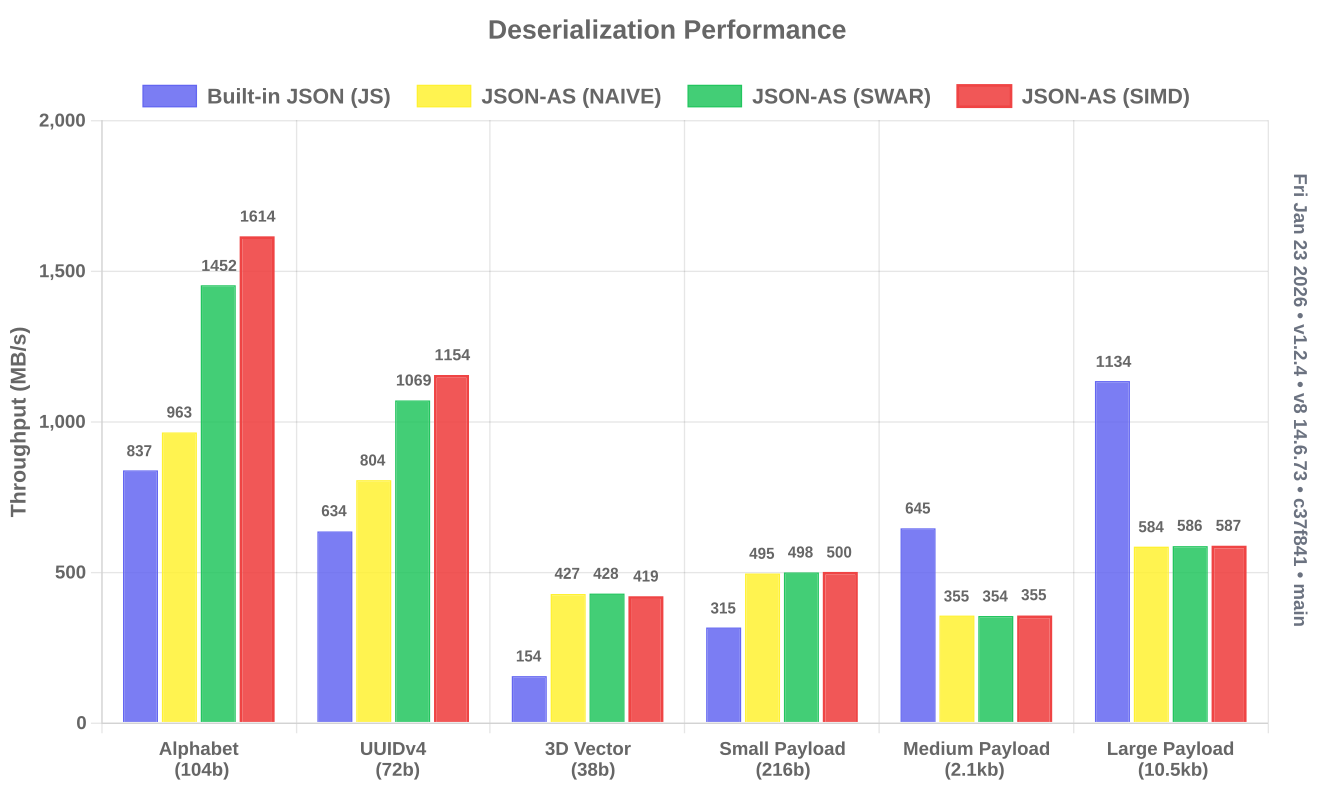
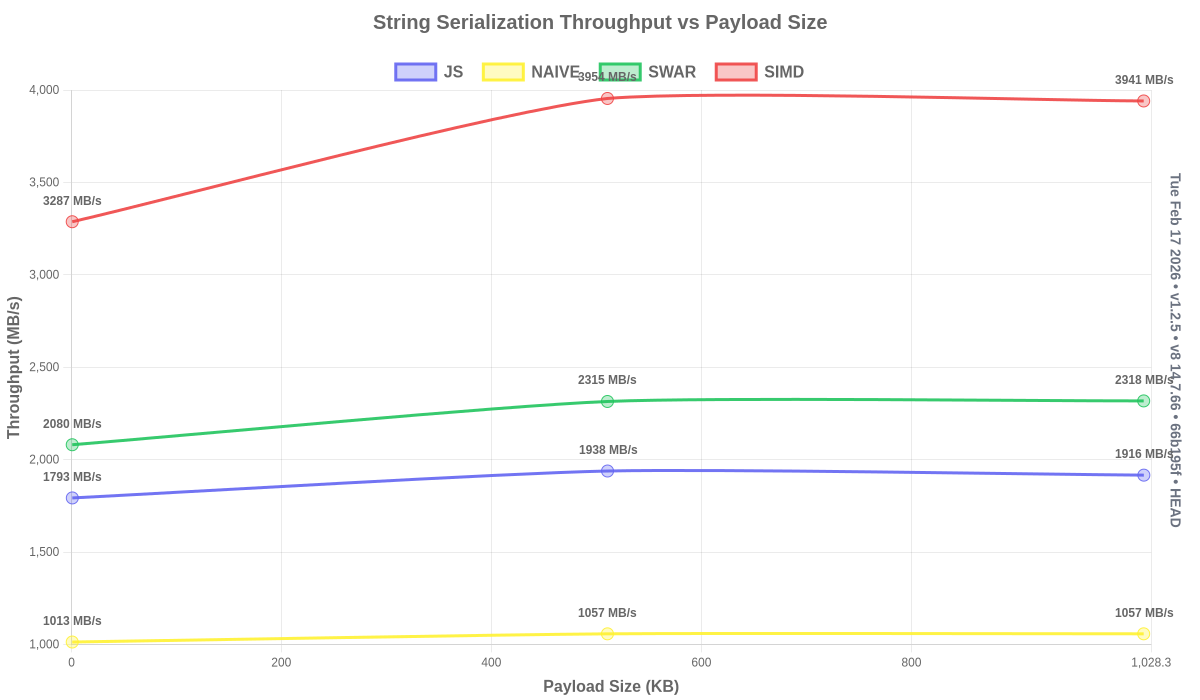
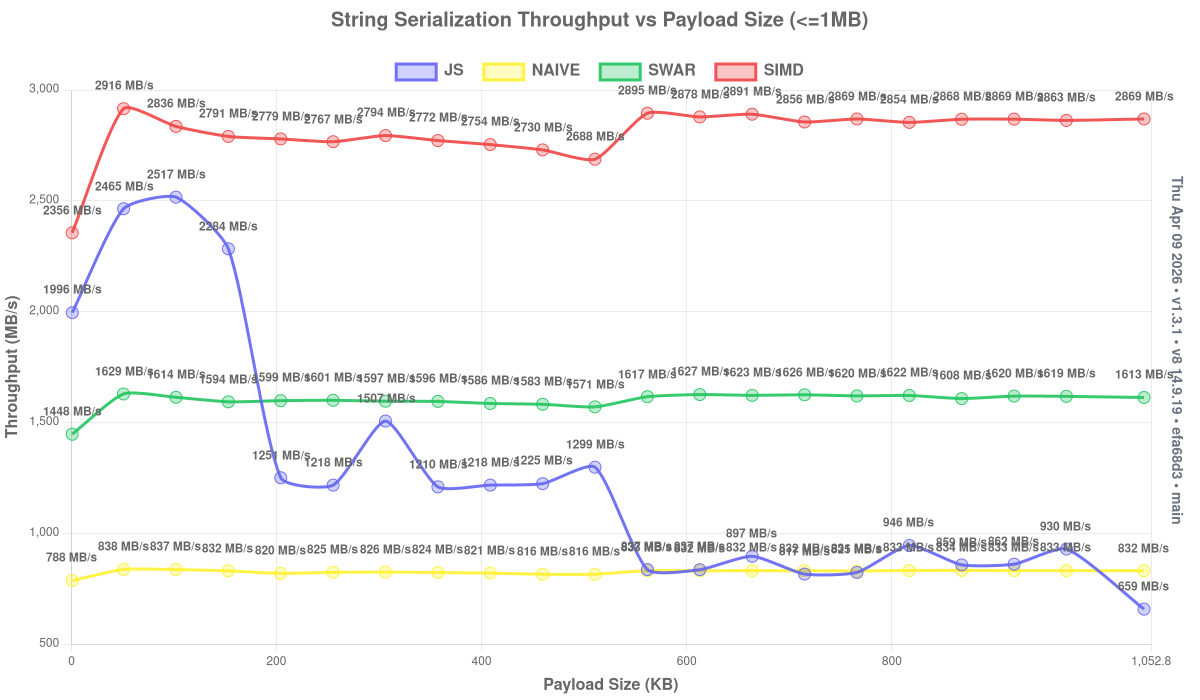
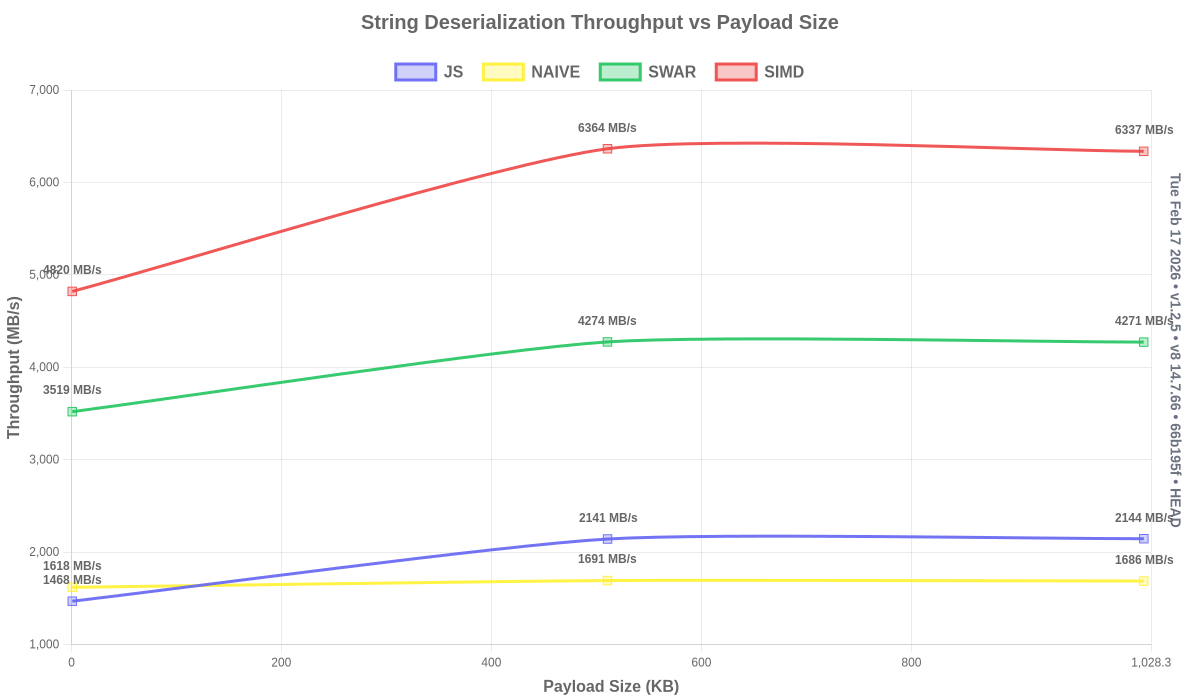
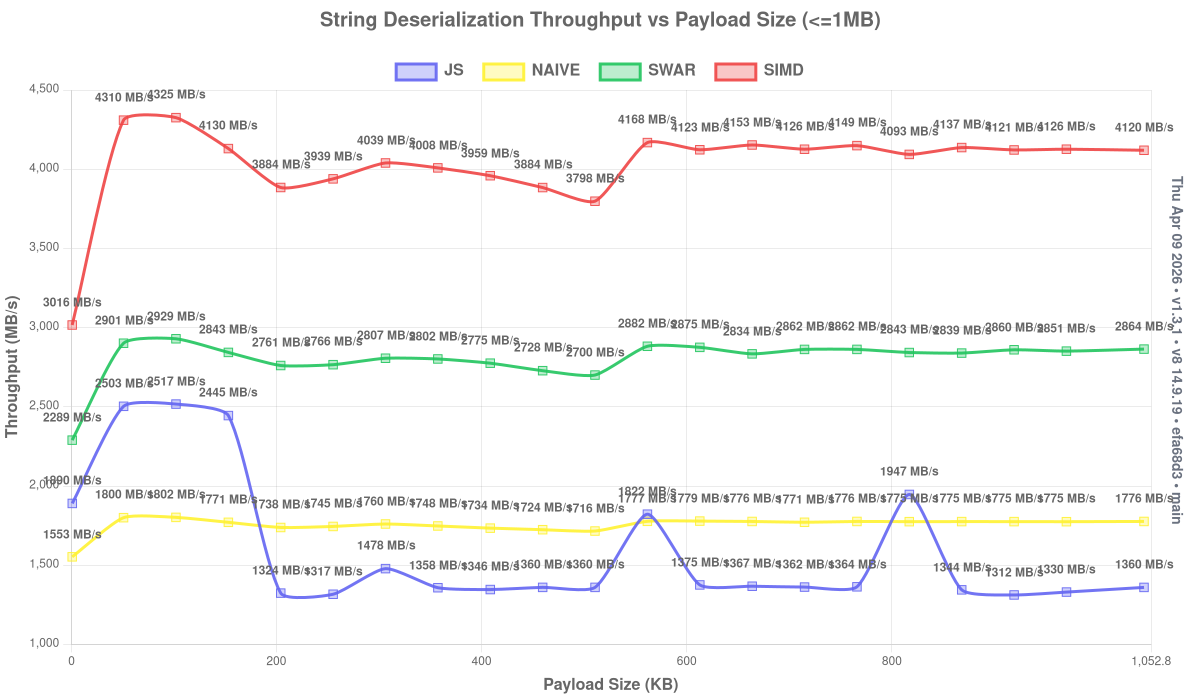
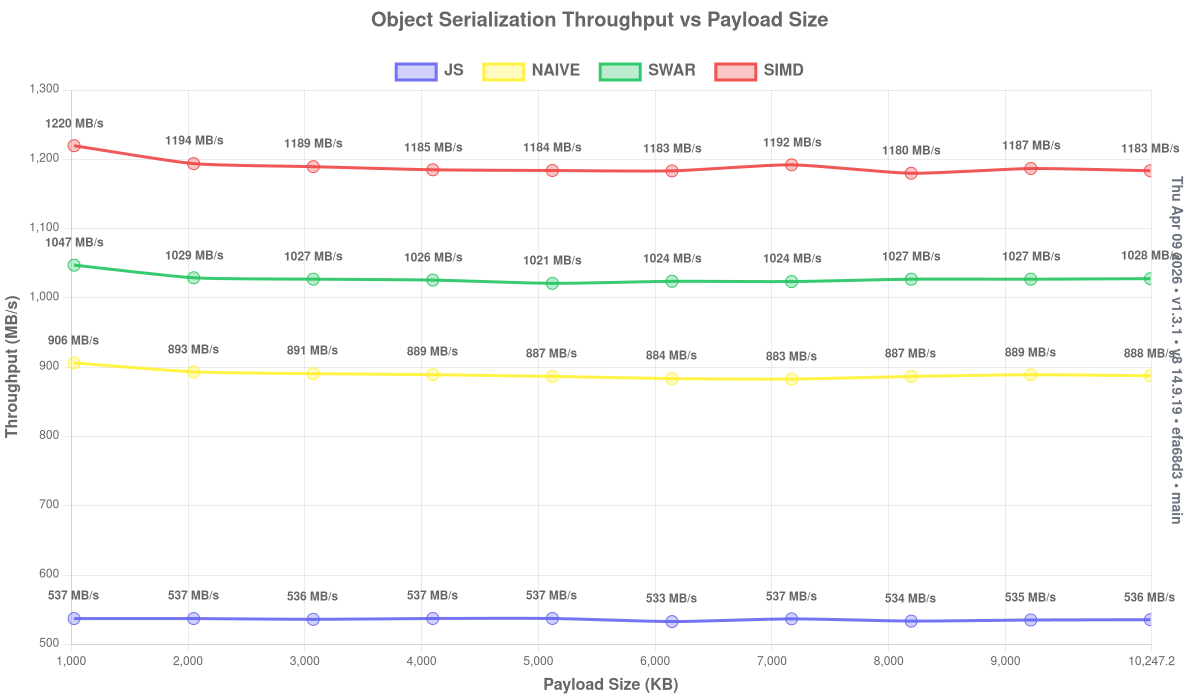
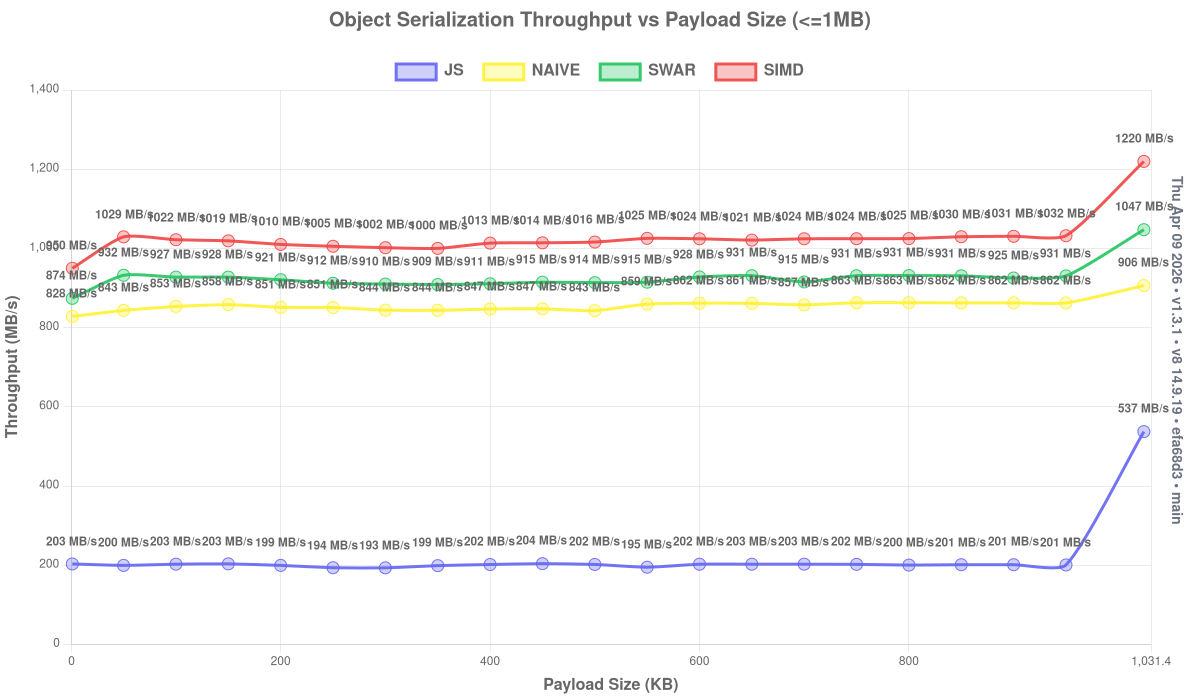
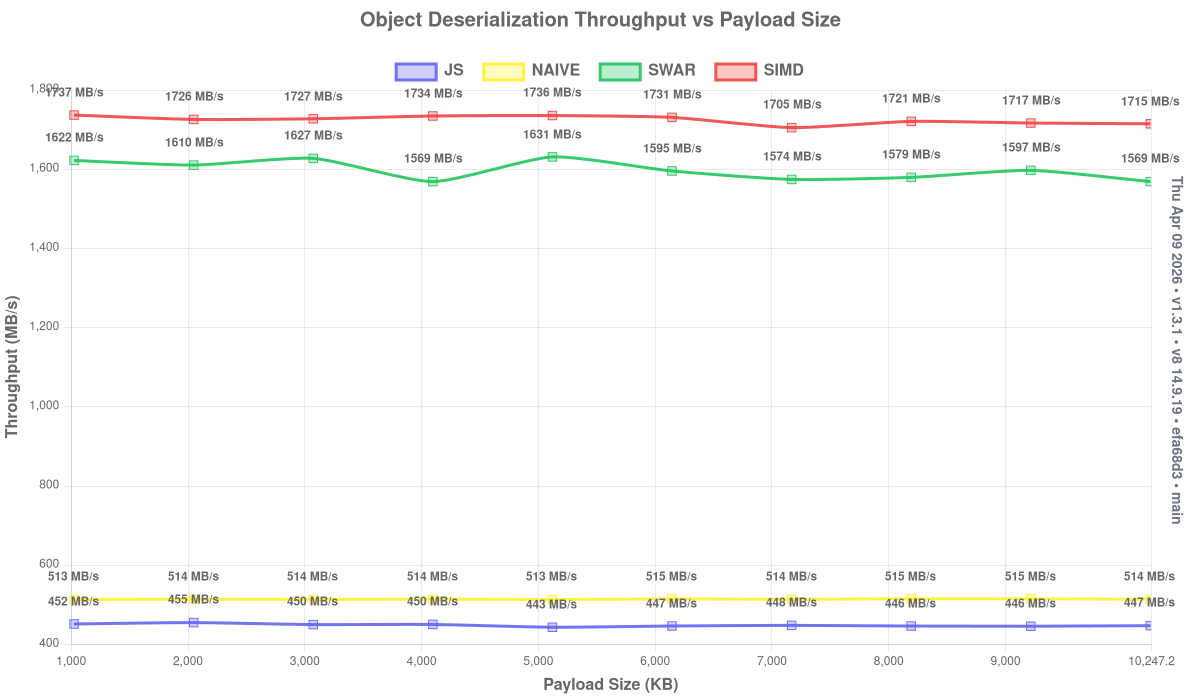
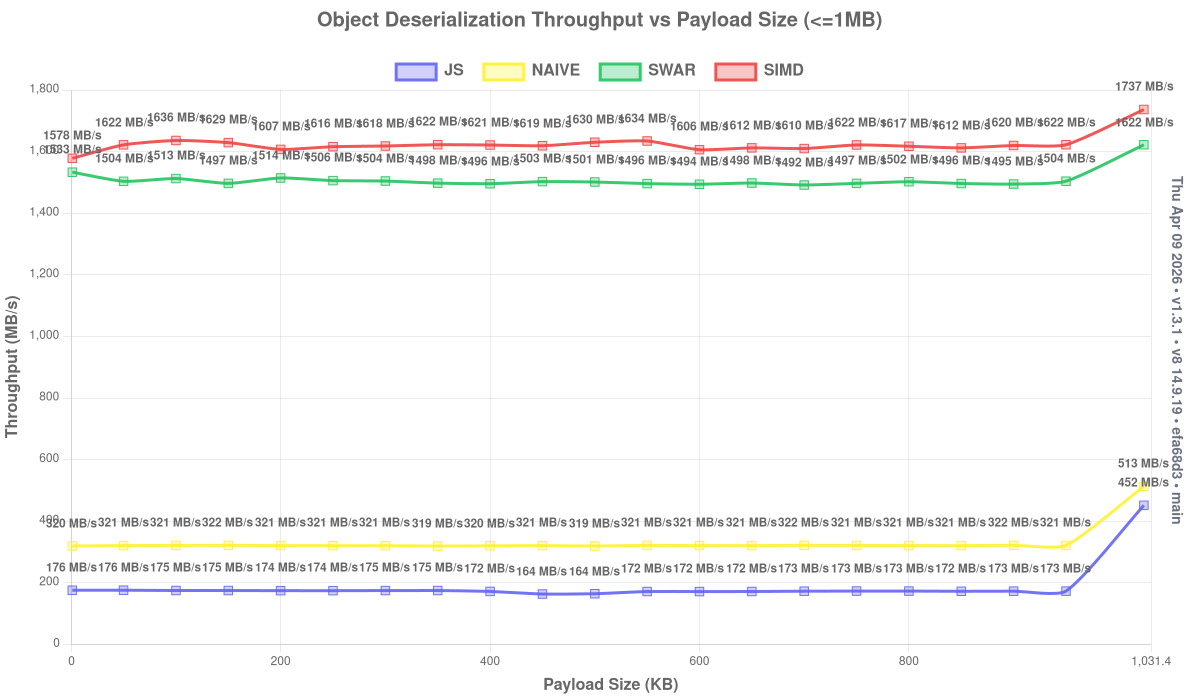
The json-as library is engineered for multi-GB/s processing speeds, leveraging SIMD and SWAR optimizations along with highly efficient transformations. The charts below highlight key performance metrics such as build time, operations-per-second, and throughput.
The following charts compare JSON-AS (both SWAR and SIMD variants) against JavaScript's native JSON implementation. The published charts are generated locally and pushed to the docs branch.
Note: Benchmarks reflect the latest version. Older versions may show different performance.
Current local benchmark machine: AMD Ryzen 7 7800X3D (8 cores, 8 threads), 96 MB L3 cache, 32 GB RAM.
Benchmark results include normal end-to-end work such as allocating the destination object or array before deserializing into it. Raw parser throughput is higher than the published figures because these numbers intentionally include that allocation/setup cost.
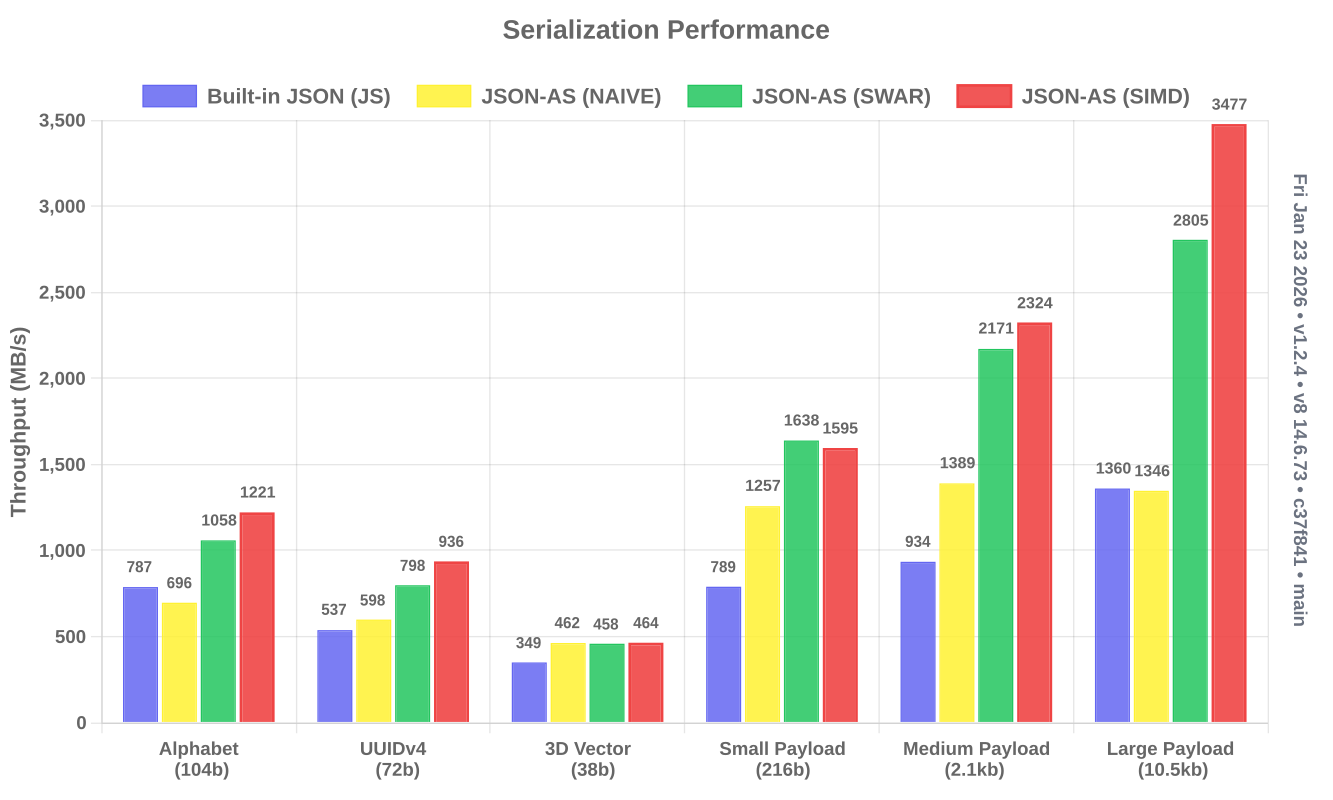
String serialize charts (click to expand)
String deserialize charts (click to expand)
Object serialize charts (click to expand)
Object deserialize charts (click to expand)
Instead of using flags for setting options, json-as is configured by environmental variables.
Here's a short list:
JSON_CACHE (default: 0) - Enables caching costly strings based on hit frequency. May boost string serialization in excess of 22 GB/s.
JSON_DEBUG (default: 0) - Sets the debug level. May be within range 0-3
JSON_MODE (default: SWAR) - Selects which mode should be used. Can be NAIVE,SWAR,SIMD. Note that --enable simd may be required.
JSON_USE_FAST_PATH (default: 0) - When set to 1, the transform emits the fast __DESERIALIZE implementation for generated structs. When unset or 0, it emits only the slow path. See FAST_PATH_DESERIALIZE.md for the current support matrix, known gaps, and dedicated test command.
JSON_WRITE (default: "") - Select a series of files to output after transform and optimization passes have completed for easy inspection. Usage: JSON_WRITE=.path-to-file-a.ts,./path-to-file-b.ts
Benchmarks are run directly on top of v8 for tighter control over the engine configuration.
- Install the local benchmark prerequisites:
npm install -g jsvu
jsvu --engines=v8- Add
~/.jsvu/binto yourPATHand make surewasm-optis installed:
export PATH="${HOME}/.jsvu/bin:${PATH}"
sudo apt-get install -y binaryen- Install project dependencies:
npm install- Run either benchmark suite directly:
npm run bench:as
npm run bench:js- Build charts from the latest local logs:
npm run charts:buildOr run the full local benchmark flow in one step:
npm run benchJSON_DEBUG=1 - Prints out generated code at compile-time
JSON_DEBUG=2 - The above and prints keys/values as they are deserialized
JSON_WRITE=path-to-file.ts - Writes out generated code to path-to-file.json.ts for easy inspection
For a deep dive into how json-as works internally, including the transform system, optimization modes (NAIVE, SWAR, SIMD), and buffer management, see ARCHITECTURE.md.
For a code-oriented repository walkthrough that maps the runtime, transform, tests, and benchmark files to their concrete responsibilities, see PROJECT_WALKTHROUGH.md.
We welcome contributions! Please see CONTRIBUTING.md for guidelines on:
- Setting up your development environment
- Running tests and benchmarks
- Code style and commit conventions
- The pull request process
A few companies and open-source projects use json-as!
| Company/Project | Description |
|---|---|
| Impart Security | API security platform |
| Hypermode | AI infrastructure |
| Steer Finance | DeFi protocol |
| Secretarium | Confidential computing |
| Klave | Privacy-first platform |
| Bifrost | Open source project by Maxim HQ |
| Massa Labs | Massa blockchain tooling |
| Seda Protocol | Wasm-based blockchain VM |
This project is distributed under an open source license. Work on this project is done by passion, but if you want to support it financially, you can do so by making a donation to the project's GitHub Sponsors page.
You can view the full license using the following link: License
Please send all issues to GitHub Issues and to converse, please send me an email at me@jairus.dev
- Email: Send me inquiries, questions, or requests at me@jairus.dev
- GitHub: Visit the official GitHub repository Here
- Website: Visit my official website at jairus.dev
- Discord: Contact me at My Discord or on the AssemblyScript Discord Server


