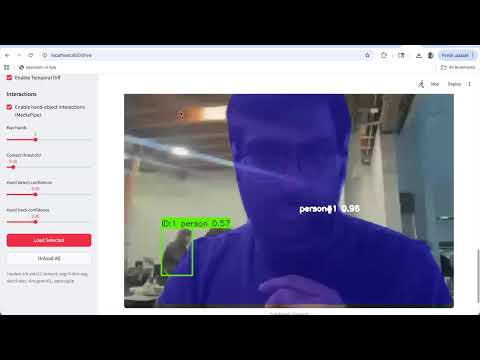
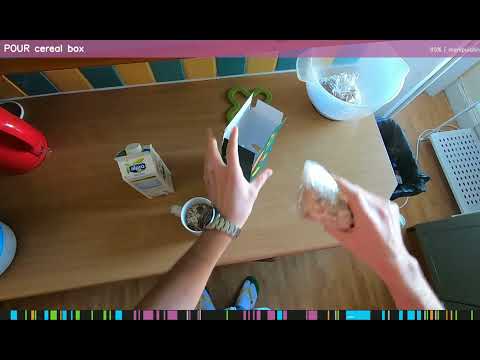
AI-powered pipeline that converts raw video into structured, navigation-relevant ground truth for humanoid robots. Detects objects, tracks them across frames, classifies navigation states (open/closed/blocked), and exports temporal ground truth with accuracy evaluation.
uv sync
streamlit run app.py
If uv is not installed:
python -m venv .venv
source .venv/bin/activate
pip install -e .
streamlit run app.py
Requires GPU with >=8GB VRAM (sequential offload) or >=16GB (all models loaded).

- Object tracking with persistent IDs across frames
- Zero-shot state classification via SigLIP — 200x faster than VLM for open/closed/ajar labels
- Navigation state classification via VLM (doors, drawers, handles → open/closed/ajar/blocked)
- Temporal diff — VLM compares consecutive frames to detect state transitions
- Navigation timeline — per-object state timeline with colored bars and transition events
- Hand-object interactions via MediaPipe
- Ground truth export — structured JSON with per-frame annotations
- Accuracy evaluation — compare predictions against manual labels
- Live perception — real-time webcam inference with auto-recording and post-analysis
- H.264 video export — browser-playable annotated videos with in-app preview
- Per-frame timing — inference latency breakdown per model stage
| Page | Description |
|---|---|
app.py |
Upload video → run multi-model pipeline → browse results → export ground truth |
pages/live.py |
Live webcam stream via WebRTC → real-time overlay → auto-record → post-stop analysis |
| Category | Model | Sizes | Notes |
|---|---|---|---|
| Detection | YOLOv8 | n/s/m/l/x | Ultralytics |
| Detection | YOLO11 | n/s/m/l/x | Ultralytics |
| Detection | RF-DETR | n/s/b/m/l | DINOv2 backbone, real-time transformer |
| Segmentation | SAM 3 | — | Text-prompted, streaming video sessions |
| Segmentation | FastSAM | — | Ultralytics, segment-everything mode |
| Segmentation | RF-DETR Seg | s/m/l | Instance segmentation with COCO classes |
| Tracking | YOLO Tracker | n/s/m/l/x | ByteTrack/BotSORT with persistent IDs |
| State Classifier | SigLIP | — | Zero-shot state classification (~50ms/crop vs ~10s VLM) |
| VLM | LFM2.5-VL | — | Transformers backend (CUDA/CPU) |
| VLM | LFM2.5-VL ONNX | — | ONNX Runtime (fp16 encoder + q4 decoder) |
| VLM | LFM2.5-VL MLX | — | Apple Silicon (mlx-vlm, 8-bit) |
core/             — types, ABCs, registry, video I/O
models/           — one file per model variant, registered via @register
  detection/      — yolov8, yolo11, rf-detr
  segmentation/   — sam3, fastsam, rf-detr-seg
  vlm/            — lfm2.5-vl (transformers, onnx, mlx backends in one file)
  tracking/       — yolo-tracker (bytetrack, botsort)
  state/          — siglip zero-shot classifier
pipeline/
  runner.py       — frame-by-frame orchestration, parallel inference, timing
  visualizer.py   — OpenCV drawing for all modalities
  interactions.py — MediaPipe hand-object interaction detection
  nav_state.py    — builds NavigationTimeline from tracker + VLM/state results
  exporter.py     — structured JSON ground truth export
  evaluator.py    — accuracy measurement against manual labels
app.py            — Streamlit UI (upload workflow)
pages/live.py     — Streamlit UI (live webcam workflow)
- Create
models/<category>/<name>.py - Implement the ABC with
load(),predict()/update()/classify(),unload() - Decorate with
@register("category", "name")and import inmodels/__init__.py
from core.base import Detector
from core.registry import register

@register("detector", "my-detector")
class MyDetector(Detector):
    VALID_SIZES = ("s", "l")  # optional, enables size selector in UI
    def __init__(self, model_size="s"): ...
    def load(self): ...
    def predict(self, frame): ...
def unload(self): ...Two container images:
| Image | Base | GPU Support |
|---|---|---|
world2data.sif |
nvidia/cuda:12.4.1-runtime |
CUDA |
world2data-trt.sif |
nvcr.io/nvidia/tensorrt:24.12-py3 |
CUDA + TensorRT |
# Build image (after dep changes)
singularity build --fakeroot world2data.sif world2data.def
# or TensorRT variant:
singularity build --fakeroot world2data-trt.sif world2data-trt.def

# Deploy
source .env && scp -r . ${CLUSTER_USER}@${CLUSTER_HOST}:${CLUSTER_PATH}

# Submit
sbatch start_app.sbatch        # standard
sbatch start_app_trt.sbatch    # TensorRT

# Tunnel to access UI
ssh -L 8501:localhost:8501 -J ${CLUSTER_USER}@${CLUSTER_HOST} -p 7665 ${CLUSTER_USER}@<compute-node>
Source code is bind-mounted at runtime — no rebuild needed for code changes, only for dependency changes.
Copy .env.example to .env and fill in:
HF_TOKEN=...           # HuggingFace token (for model downloads)
CLUSTER_HOST=...       # SLURM cluster hostname
CLUSTER_USER=...       # SSH user
CLUSTER_PATH=...       # Remote working directory
SSH_KEY_PATH=...       # SSH key for cluster
See CLAUDE.md for full architecture details, compatibility notes, and development guidelines.