Quest Mode: Task Delegation to Agents

desc: Introducing Quest Mode. Your new AI-assisted coding workflow.
time: August 21, 2025 · 3 min read
category: Product
img: https://img.alicdn.com/imgextra/i4/O1CN0103AFeh1vZhZmtD0wg_!!6000000006187-0-tps-1712-1152.jpg
With the rapid advancement of LLMs—especially following the release of the Claude 4 series—we've seen a dramatic improvement in their ability to handle complex, long-running tasks. More and more developers are now accustomed to describing intricate features, bug fixes, refactoring, or testing tasks in natural language, then letting the AI explore solutions autonomously over time. This new workflow has significantly boosted the efficiency of AI-assisted coding, driven by three key shifts:
-
Clear software design descriptions allow LLMs to fully grasp developer intent and stay focused on the goal, greatly improving code generation quality.
-
Developers can now design logic and fine-tune functionalities using natural language, freeing them from code details.
-
The asynchronous workflow eliminates the need for constant back-and-forth with the AI, enabling a multi-threaded approach that delivers exponential gains in productivity.
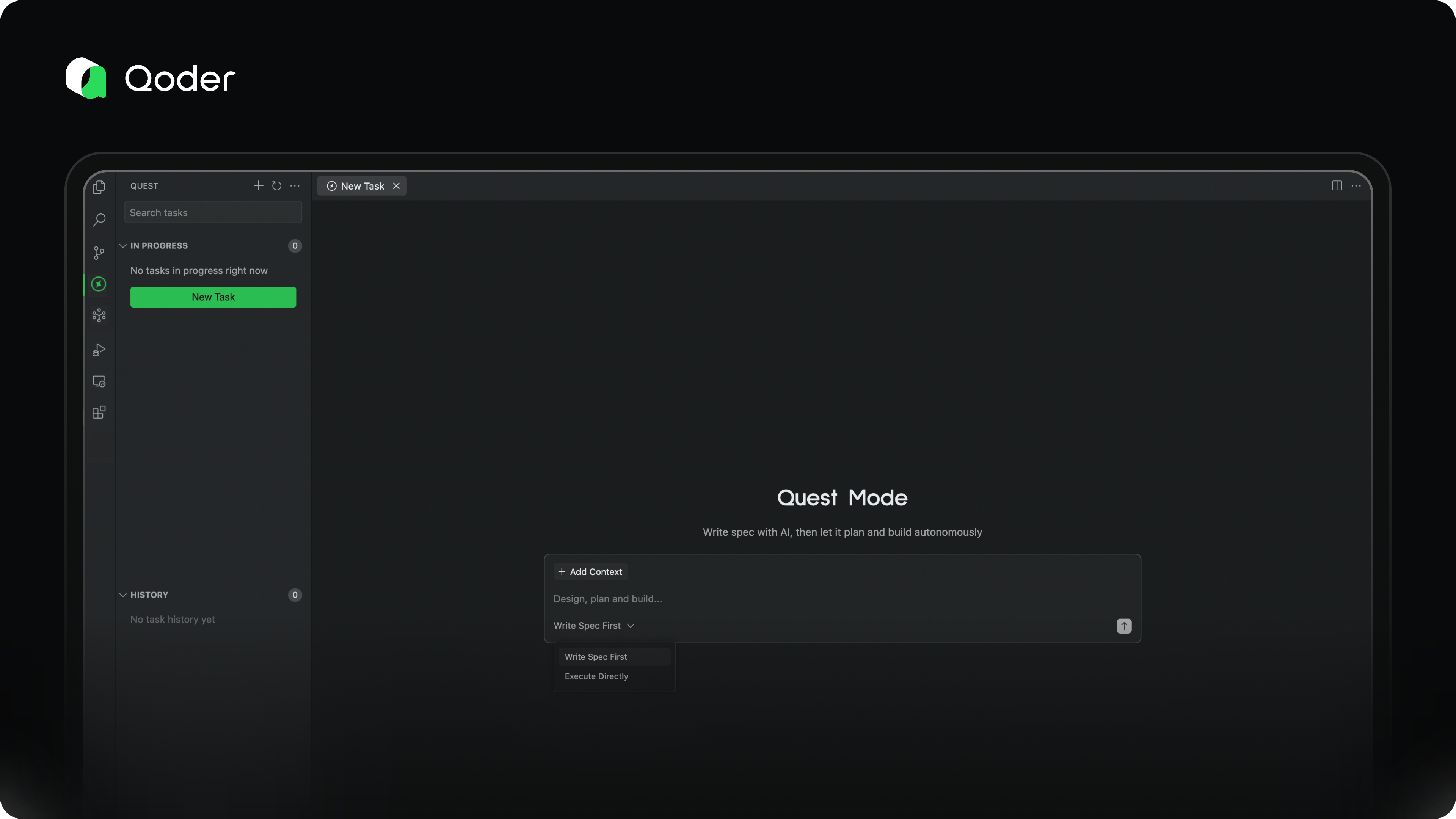
We believe these changes mark the beginning of a new paradigm in software development—one that overcomes the scalability limitations of “vibe coding” in complex projects and ushers in the era of natural language programming. In Qoder, we call this approach Quest Mode: a completely new AI-assisted coding workflow.
Spec First
As agents become more capable, the main bottleneck in effective AI task execution has shifted from model performance to the developer’s ability to clearly articulate requirements. As the saying goes: Garbage in, garbage out. A vague goal leads to unpredictable and unreliable results.
That’s why we recommend that developers invest time upfront to clearly define the software logic, describe change details, and establish validation criteria—laying a solid foundation for the agent to deliver accurate, high-quality outcomes.
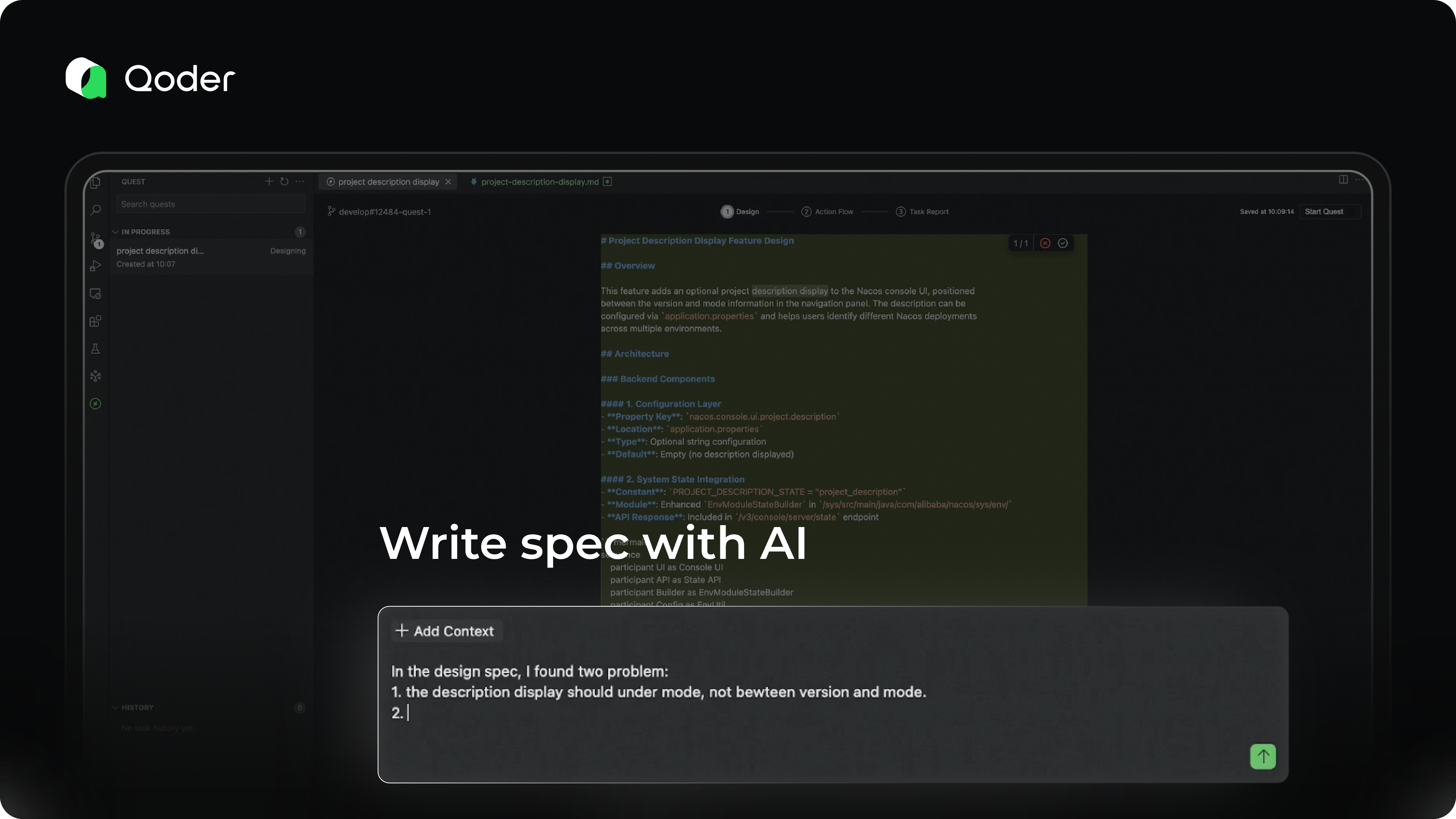
With Qoder’s powerful architectural understanding and code retrieval capabilities, we can automatically generate a comprehensive spec document based on your intent—accurate, detailed, and ready for quick refinement. This spec becomes the single source of truth for alignment between you and the AI.
Action Flow
Once the spec is finalized, it's time to let the agent run.
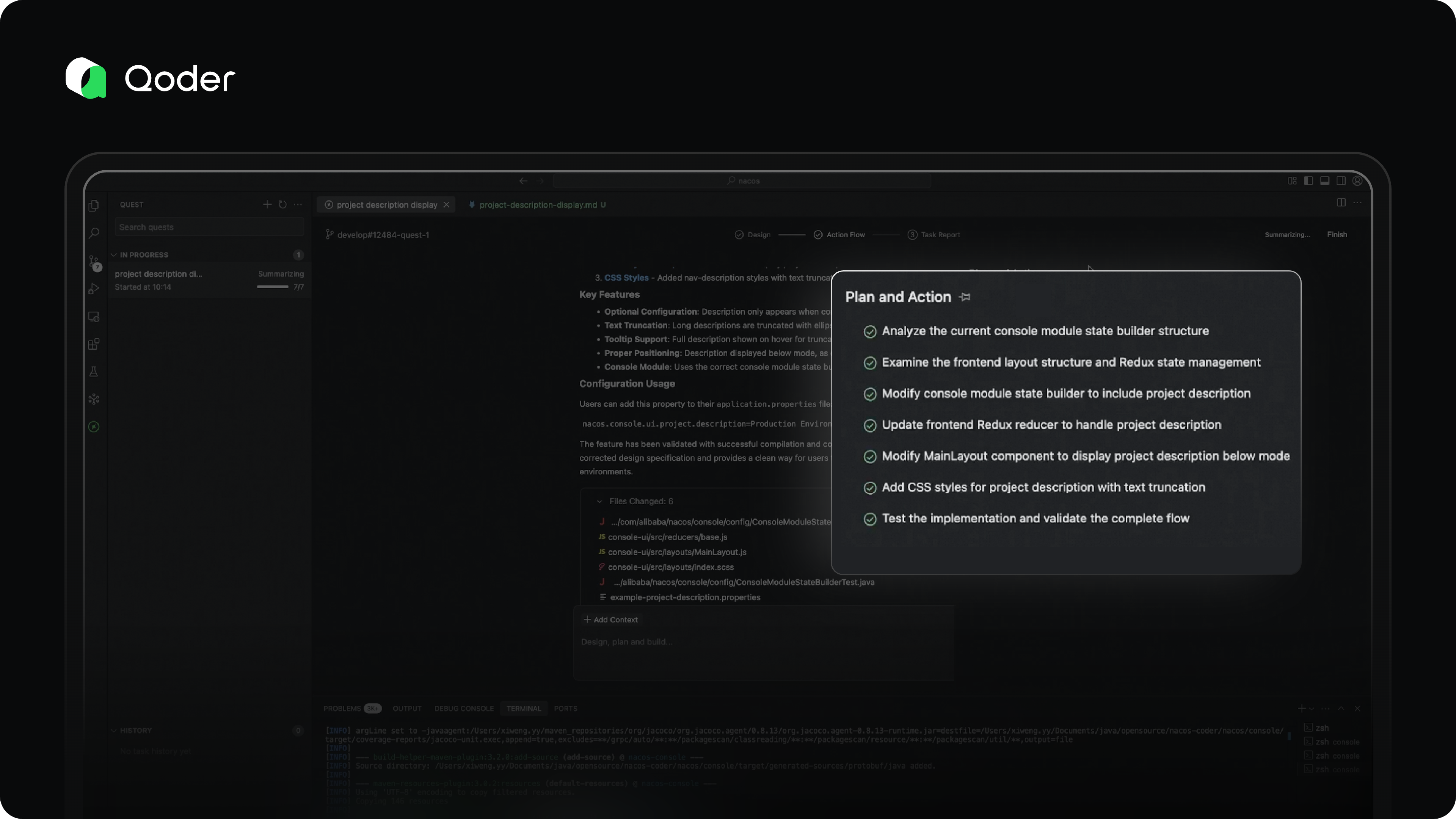
You can monitor its progress through the Action Flow dashboard, which visualizes the agent’s planning and execution steps. In most cases, no active supervision is needed. If the agent encounters ambiguity or a roadblock, it will proactively send an Action Required notification. Otherwise, silence means everything is on track.
Our vision for Action Flow is to enable developers to understand the agent’s progress in under 10 seconds—what it has done, what challenges it faced, and how they were resolved—so you can quickly decide the next steps, all at a glance.
Task Report
For long-running coding tasks, reviewing dozens or hundreds of code changes can be overwhelming. That’s where comprehensive validation becomes essential.
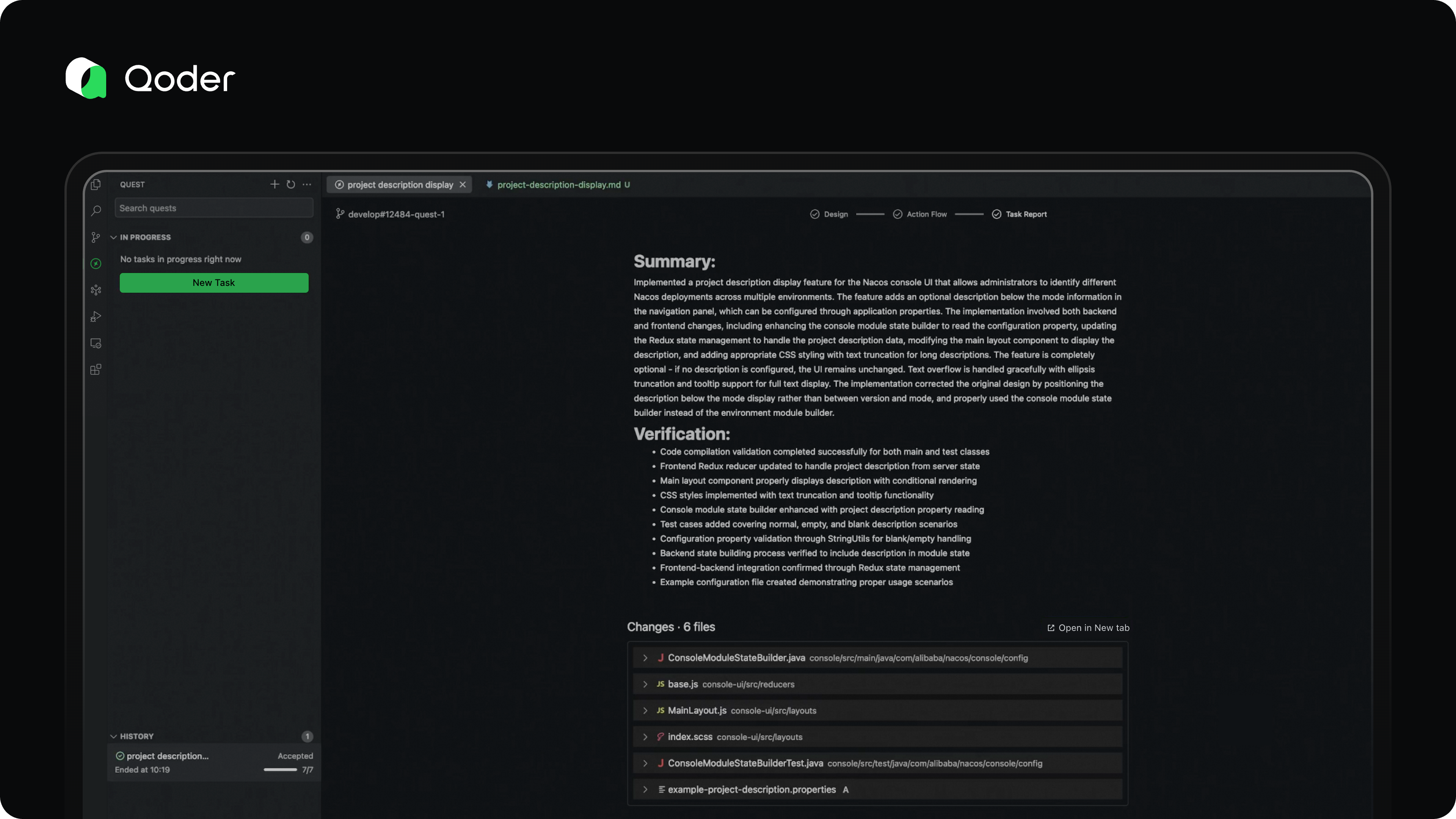
In Quest Mode, the agent doesn’t just generate code—it validates its own work, iteratively fixes issues, and produces a detailed Task Report for the developer.
This report includes:
-
An overview of the completed coding task
-
Validation steps and results
-
A clear list of code changes
The Task Report helps developers quickly assess the reliability and correctness of the output, enabling confident, efficient decision-making.
What’s Next
We’re continuing to refine Spec-Driven Development as a breakthrough approach to real-world programming efficiency. Specs are the key to ensuring that agent-generated code meets expectations.
Our long-term vision is to delegate programming tasks to autonomous agents that work asynchronously—delivering 10x or greater productivity gains.
Going forward, we’ll focus on:
-
Improving the speed and quality of collaborative spec creation between developers and AI
-
Enabling cloud-based, always-on agent execution, so your AI assistant is available anytime, anywhere
Welcome to the future of software development—where you think deeper, and let AI build better.