Status: Proposed
Target: post-v0.1.0 community roadmap
Related: #386, #415
Reference Qwen3-8B Dense track: #180, #204, #228, #230, #240, #243, #280, #315, #322, #336, #338, #343, #352, #360, #361, #377.
Upstream checkpoint pinned for this draft: MiniMaxAI/MiniMax-H3@42ed227ee7df40d41602854ae760620d6eb651fe.
1. Motivation
RL-Kernel has closed the Qwen3-8B Dense consistency loop from deterministic WS1 operators through WS2 TP/CP/SP execution, runtime provenance, ablation, VIME/vLLM integration, and an end-to-end distributed experiment.
MiniMax-H3 is a different consistency target. It is a 33B dense, single-stream audio-video flow model rather than an autoregressive language model. The released model packs text, video, and audio rows into one full-attention document, applies a 50-layer Omni-Transformer, predicts video and audio velocities, and advances two deterministic rectified-flow schedules.
The strict H3 objective is therefore:
Given the same checkpoint, encoded conditions, latent inputs, packed-row identity, modality tags, timestep table, three-axis positions, sigma schedules, and initial noise, training and rollout must execute the same declared arithmetic contract and produce exactly equal video/audio velocities and denoising trajectories in strict mode.
Selected-token log-probability is not the primary acceptance surface for the released H3 sampler. The public scheduler uses eta = 0, so it defines a deterministic ODE update and does not by itself define a non-degenerate Gaussian transition log-probability. A future stochastic RL sampler may add a transition-logprob contract, but that work must declare the SDE/noise law first and must not label an ODE trajectory score as a log-probability.
The roadmap is split into independently closable phases:
- Phase A - Omni-Transformer core: pre-encoded text, video latents, and audio latents; packed-sequence construction; WS1 operators; WS2 distribution; deterministic dual-scheduler trajectory.
- Phase B - released end-to-end pipelines: Qwen3-VL text encoder, VisualVAE, AudioVAE, FL2VA and Ref2VA integration, and media decode validation.
- Phase C - RL integration: training/rollout adapters, LoRA/full-parameter gradient validation, trajectory-level reward experiments, and an optional stochastic transition-logprob path after its probability model is specified.
This ordering keeps the arithmetic core unblocked by the much larger encoder/VAE and task-orchestration surface.
Scope boundary
The open-source release does not include H3-Context-IR, H3-Regenerate-2K, or the announced native sparse-attention implementation. Those components are out of scope until reproducible public code and weights exist. The initial strict attention target is the released full-attention path.
2. Checkpoint fingerprint
Every validation artifact must record the exact checkpoint revision, runtime revision, task family, scheduler settings, dtype policy, and backend identities. This draft is based on MiniMaxAI/MiniMax-H3@42ed227ee7df40d41602854ae760620d6eb651fe.
Omni-Transformer fingerprint
| Item |
Value |
| Architecture |
MiniMaxH3Transformer3DModel |
| Model family |
33B dense single-stream audio-video flow transformer |
| Transformer dtype |
BF16, with declared FP32 modules listed below |
| Residual hidden size |
5376 |
| Attention heads / head dim |
56 / 128 |
| Attention inner dimension |
7168 |
| Transformer layers |
50 |
| Text-refiner layers |
2 |
| FFN hidden size |
14336 |
| FFN activation |
SwiGLU |
| Attention |
full bidirectional self-attention, no cross-attention |
| Q/K preprocessing |
per-head RMSNorm, epsilon 1e-5 |
| Position encoding |
three-axis (t, h, w) MM-RoPE |
| RoPE frequencies |
16 per axis, theta 10000 |
| Rotary channels |
96 of 128 head channels; remaining 32 pass through |
| Block norm |
RMSNorm, epsilon 1e-5 |
| AdaLN modalities |
3: video=0, text=1, audio=2 |
| AdaLN conditioning |
row = timestep_index * 3 + token_tag |
| AdaLN projection |
2688 -> 6 * 3 * 5376 = 96768 per block |
| Dropout |
0 |
Input, output and conditioning fingerprint
| Item |
Value |
| Text encoder |
full Qwen3-VL-32B weights; layer-50 hidden state |
| Text feature width |
5120 |
| Text projection |
5120 -> 5376, then 2-layer token refiner |
| Visual VAE latent |
24 channels, spatial factor 16, temporal factor 4 |
| Transformer video patch |
(1, 2, 2), flattened input width 96 |
| Effective visual token compression |
spatial factor 32, temporal factor 4 |
| Video input/output heads |
96 -> 5376 and 5376 -> 96 |
| Audio VAE latent |
32 channels at 40 Hz per stereo channel path |
| Audio input/output heads |
32 -> 5376 and 5376 -> 32 |
| Timestep sinusoid width |
256 |
| Timestep MLP |
256 -> 5376 -> 2688 |
| Packed layout |
text, video, and audio rows scattered by explicit index tensors |
| Batch semantics |
pure replication axis; one structural layout shared by all batch rows |
| Output selection |
video_indices and audio_indices after both heads run over the packed sequence |
Mixed-precision fingerprint
The checkpoint is intentionally mixed precision. Strict mode must preserve these boundaries rather than normalizing the whole graph to BF16:
| FP32 module/path |
BF16 module/path |
| video input projection |
text projection and token refiner |
| audio input projection |
50-block transformer stack |
| timestep MLP |
per-block AdaLN projections |
| video output projection |
Q/K/V/O and FFN projections |
| audio output projection |
RMSNorm and Q/K norm outputs after declared casts |
| RoPE frequency construction |
packed residual stream |
Scheduler fingerprint
| Item |
Value |
| Sampler family |
deterministic rectified-flow Euler, eta = 0 |
| Video shift |
12.0 by default |
| Audio shift |
3.0 by default |
| Sigma transform |
s * sigma / (1 + (s - 1) * sigma) |
| Timestep convention |
t = 1 - sigma, with t = 1 clean |
| Velocity convention |
data-ward, x0 = xt + sigma * v |
| Euler update |
x_next = r * xt + (1 - r) * x0, r = sigma_next / sigma |
| Grid |
shifted linspace(1, 0, steps), consecutive FP32 duplicates removed |
| Model evaluations |
len(sigmas) - 1 |
Released variants
| Variant |
Transformer |
Input mode |
| FL2VA |
transformer/ |
text with zero, first, last, or first-and-last frame conditioning |
| Ref2VA |
transformer_ref/ |
text plus reference image, video, and/or audio inputs |
Upstream references
Upstream runtime status as of 2026-09-17
- Diffusers provides the executable model, scheduler, modular pipeline, context-parallel plan, and released component mappings. It is the initial reference runtime.
- The MiniMax model card recommends SGLang, vLLM, Diffusers, and ComfyUI. Exact H3 versions, supported task families, and injection/readback hooks must be fingerprinted again when each adapter PR starts.
- RL-Kernel currently has no MiniMax-H3 semantic operator plan, checkpoint mapper, trajectory comparator, or training provider. These are new integration items rather than assumed reuse.
3. Architecture map
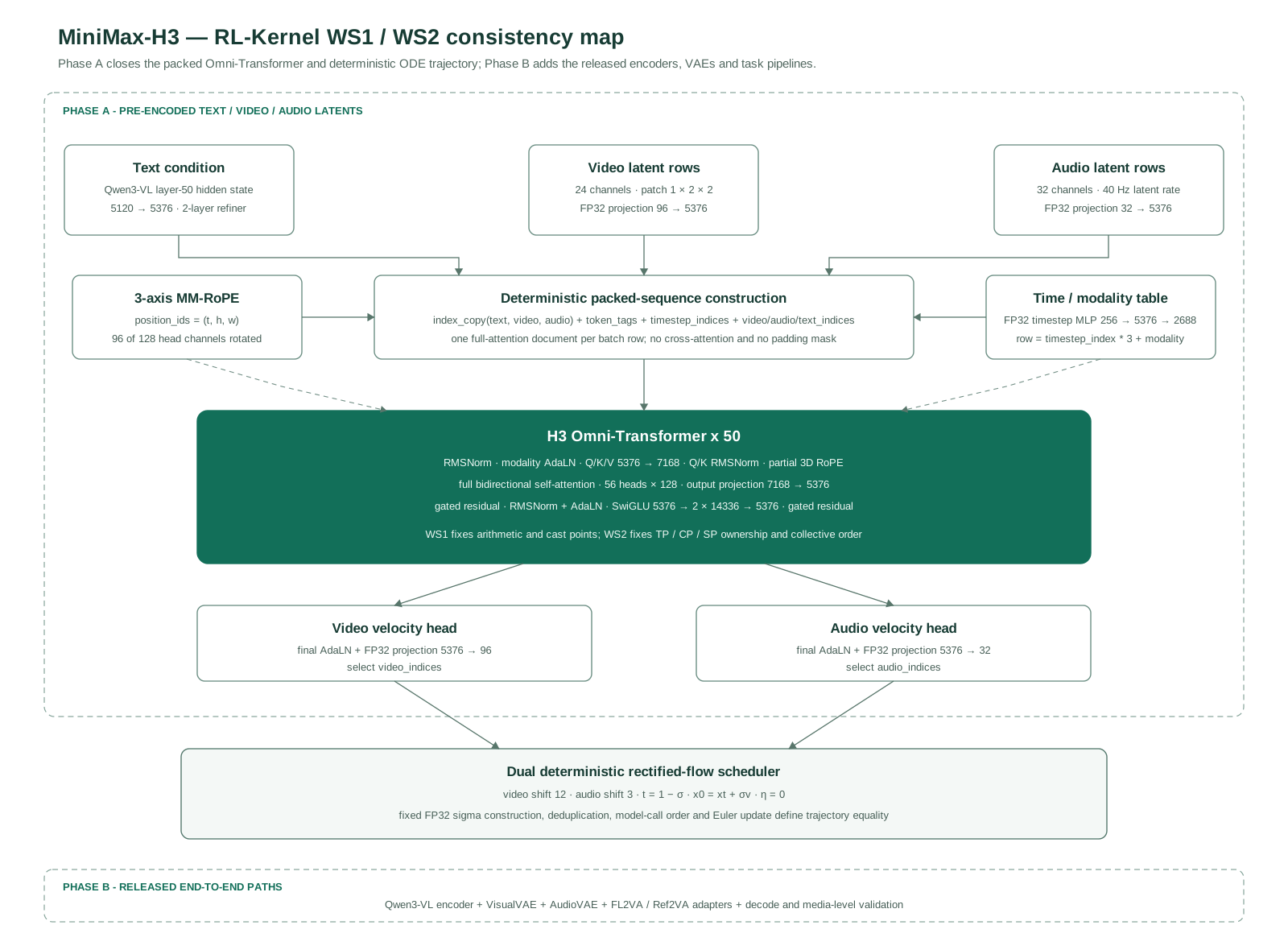
Figure 1 - MiniMax-H3 released path and consistency boundaries. Phase A begins after the text encoder and VAEs, closes the packed Omni-Transformer and both deterministic schedules, and produces exact latent trajectories. Phase B connects the released encoders, VAEs, task adapters, and decoders.
The central difference from Qwen3-8B is that one model call processes three modalities and potentially several distinct timesteps in one sequence. Logical row identity is the tuple:
(batch item, packed row, modality, timestep table row, t/h/w coordinate, source index, output-selection index).
Every member of that tuple must remain aligned under packing, batching, TP, CP, SP, checkpointing, and runtime adaptation.
One Omni-Transformer block
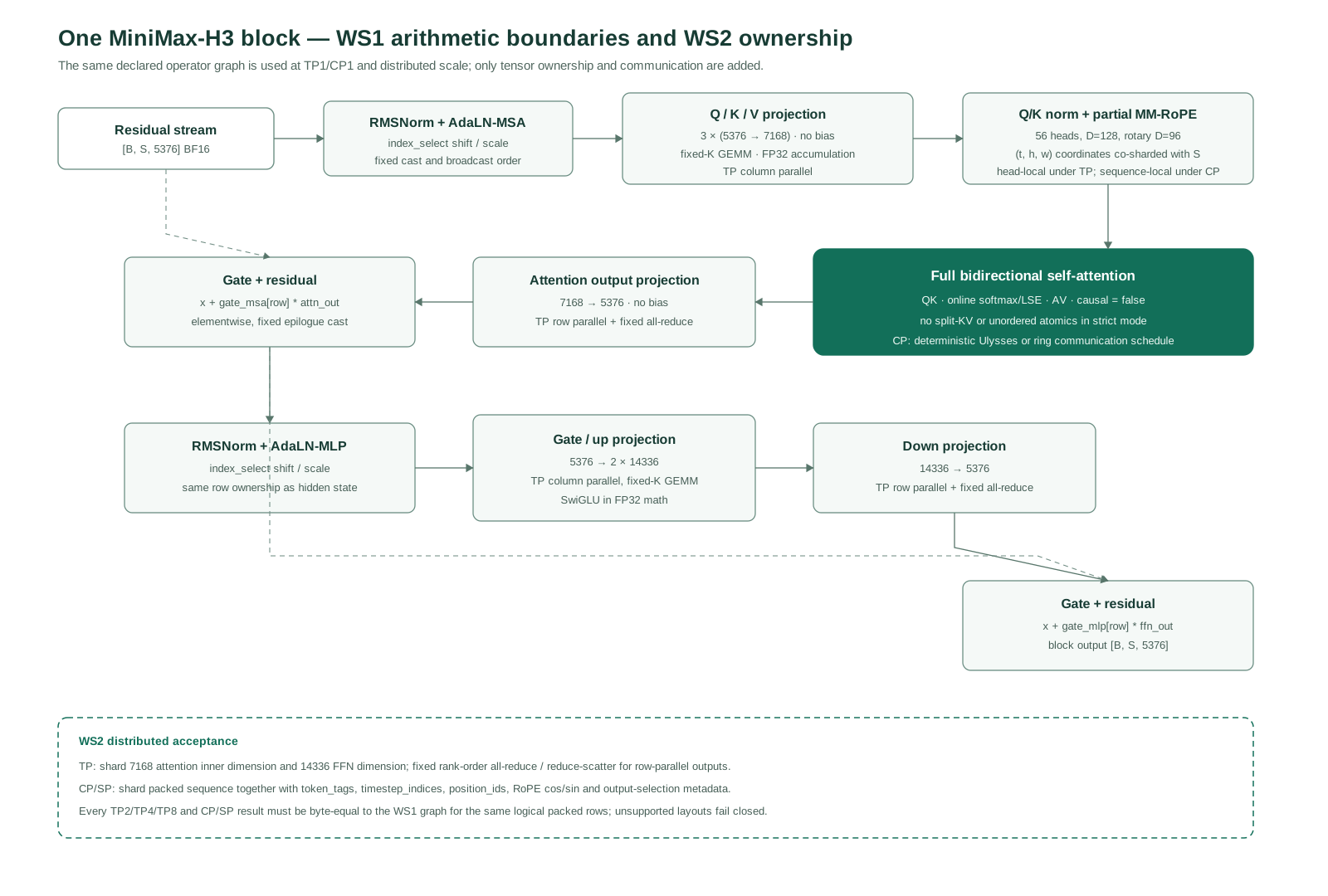
Figure 2 - One H3 block. WS1 qualifies the arithmetic at each boundary. WS2 preserves the same graph while sharding attention heads, FFN channels, AdaLN output channels, and packed sequence rows with deterministic communication.
Two details require dedicated validation rather than generic transformer coverage:
56 * 128 = 7168, so attention projections expand beyond the 5376-wide residual stream and the TP plan cannot assume num_heads * head_dim == hidden_size.- MM-RoPE rotates only 96 head channels. Applying standard full-head RoPE is a plausible implementation error that may remain numerically stable while producing a different trajectory.
4. Numerical contract
The existing RL-Kernel WS1 numerical standard remains authoritative. MiniMax-H3 does not get a weaker definition because it is a flow model.
For every strict reduction-bearing boundary:
- accumulator precision is declared and fixed;
- reduction and addition order is independent of batch size, batch position, packed-row count, launch geometry, SM/CU count, runtime occupancy, checkpointing, and distributed rank placement;
- Split-K, Stream-K, split-KV, and cross-CTA atomics are forbidden unless the split and merge tree is itself part of the contract;
- TF32, fast-math reassociation, approximate transcendental substitutions, and compiler-dependent contraction are disabled in strict mode;
- casts occur only at declared epilogue or checkpoint-compatible boundaries;
- one batch row is invariant to unrelated batch rows and batch permutation;
- a logically equivalent permutation of packed rows, together with the same permutation of positions and metadata, produces the corresponding output permutation;
- TP/CP/SP implementations are byte-equal to the WS1 result for the same logical rows;
- unsupported strict geometry fails closed rather than silently using a production/native path;
- runtime provenance records requested backend, actual backend, kernel ID, schedule ID, split policy, accumulator dtype, topology, checkpoint revision, task family, shape fingerprint, and fallback state.
H3-specific arithmetic rules
- FP32 modules remain FP32. Their inputs are cast at the same point as the pinned reference implementation.
adaln_indices, timestep_indices, token_tags, position_ids, and modality-selection indices are semantic inputs, not incidental metadata.- Q/K RMSNorm happens before MM-RoPE.
- MM-RoPE constructs frequencies in FP32 and rotates exactly 96 channels.
- Full attention is non-causal and unmasked over one packed document in the released path.
- AdaLN projection activation runs at the timestep embedding precision, then casts for the BF16 projection.
- Residual gates are applied in the declared order:
residual + gate[row] * sublayer_output.
- Video and audio schedulers have separate sigma grids and must not share a step index implicitly.
- Sigma construction, duplicate removal, timestep conversion, velocity sign, denoised estimate, and Euler blending are all part of the strict trajectory contract.
Comparison hierarchy
| Level |
Required comparison |
| Operator accuracy |
candidate versus independent FP32 reference under the shared tolerance profile |
| Operator invariance |
byte equality across batch placement, shape-preserving layout changes, and repeated execution |
| WS1 chain |
byte-equal selected intermediate tensors and first-drift localization |
| WS2 chain |
byte equality against WS1 for identical logical rows |
| One-step model |
byte-equal video and audio velocity outputs |
| Full trajectory |
byte-equal latent state after every scheduler step |
| End-to-end media |
latent equality is the hard gate; decoded media hashes/metrics are recorded as secondary evidence |
Platform acceptance:
- CUDA: exact strict-path equality within a pinned CUDA architecture/runtime profile.
- ROCm: exact strict-path equality within a pinned ROCm architecture/runtime profile.
- CUDA versus ROCm: byte equality is tested and reported but not assumed. Any unavoidable platform transcendental/compiler difference requires an explicit named comparator profile and provenance.
5. Kernel and work-item table
Status: OPEN -> IN PROGRESS -> IN REVIEW -> MERGED.
To claim a task, put your handle in the GitHub column and open a PR. A row is not complete until implementation, an independent reference, invariance tests, runtime provenance, and row-specific acceptance evidence land together.
Reuse legend:
- Reuse - existing Qwen3 arithmetic can be used after H3 shape and dtype qualification.
- Extend - infrastructure is reusable, but H3-specific semantics or shapes are required.
- New - a new operator, contract, or integration boundary is required.
- Contingent - blocked on an explicit design decision or unreleased upstream component.
| Work item |
What it does |
Track |
Platform |
Reuse / dependency |
GitHub |
PR |
Status |
h3_arch_fingerprint |
Freeze revision, variants, 50-layer graph, refiner, mixed precision, scheduler and component hashes |
foundation |
CUDA + ROCm |
New |
|
|
OPEN |
h3_packed_layout_schema |
Machine-readable row identity, index tensors, modality/timestep tags and legal permutations |
foundation |
CPU |
New |
|
|
OPEN |
h3_operator_trace |
Per-layer requested/actual operator trace consumed by WS1/WS2 gates |
foundation |
CUDA + ROCm |
Extend #315, #338, #360 |
|
|
OPEN |
h3_trajectory_artifact |
Seal initial noise, sigma grids, per-step velocities, latent hashes and first drift |
foundation |
CUDA + ROCm |
Extend #230 artifact discipline |
|
|
OPEN |
video_patch_pack_unpack |
(B,C,T,H,W) to (B,S,96) patch permutation and exact inverse |
WS1 |
CUDA + ROCm |
Extend #386 latent_pack_unpack |
|
|
OPEN |
video_input_projection_fp32 |
FP32 96 -> 5376 projection and backward |
WS1 |
CUDA + ROCm |
Extend #180/#343 deterministic GEMM |
|
|
OPEN |
audio_input_projection_fp32 |
FP32 32 -> 5376 projection and backward |
WS1 |
CUDA + ROCm |
Extend #180/#343 |
|
|
OPEN |
text_context_projection |
BF16 5120 -> 5376 projection and backward |
WS1 |
CUDA + ROCm |
Reuse #180/#343 |
|
|
OPEN |
packed_index_copy |
Deterministic zero-init and text/video/audio row scatter, including backward gather |
WS1 |
CUDA + ROCm |
New |
|
|
OPEN |
packed_index_select |
Deterministic video/audio row selection and gradient scatter-add with fixed order |
WS1 |
CUDA + ROCm |
New |
|
|
OPEN |
timestep_sinusoid_h3 |
FP32 256-channel H3 timestep features with pinned sin/cos convention |
WS1 |
CUDA + ROCm |
Extend embedding infra |
|
|
OPEN |
timestep_mlp_fp32 |
FP32 256 -> 5376 -> 2688 timestep MLP |
WS1 |
CUDA + ROCm |
Extend #180 and elementwise kernels |
|
|
OPEN |
adaln_projection_3mod |
SiLU + 2688 -> 96768 projection and six-way/three-modality table layout |
WS1 |
CUDA + ROCm |
Extend #180/#280; H3 layout is new |
|
|
OPEN |
adaln_row_gather |
timestep_index * 3 + token_tag lookup for six modulation tensors |
WS1 |
CUDA + ROCm |
New |
|
|
OPEN |
h3_rmsnorm |
Block, refiner and final RMSNorm with exact epsilon/cast order |
WS1 |
CUDA + ROCm |
Reuse existing RMSNorm infra |
|
|
OPEN |
h3_qk_rmsnorm_d128 |
Per-head Q/K RMSNorm for 56 heads and D=128 |
WS1 |
CUDA + ROCm |
Extend Qwen QK-norm infra |
|
|
OPEN |
h3_qkv_gemm |
Three deterministic 5376 -> 7168 projections |
WS1 |
CUDA + ROCm |
Extend #180/#343 |
|
|
OPEN |
h3_mm_rope_3axis_partial |
FP32 (t,h,w) frequencies and rotate-half on 96/128 channels |
WS1 |
CUDA + ROCm |
Extend #228; H3 partial layout is new |
|
|
OPEN |
h3_full_attention |
Non-causal MHA, 56 heads, D=128, full packed document |
WS1 |
CUDA + ROCm |
Extend #240 |
|
|
OPEN |
h3_attention_o_gemm |
Deterministic 7168 -> 5376 output projection |
WS1 |
CUDA + ROCm |
Extend #180/#343 |
|
|
OPEN |
adaln_gate_residual |
Fixed x + gate[row] * y for attention and MLP branches |
WS1 |
CUDA + ROCm |
Extend #386 |
|
|
OPEN |
h3_ffn_gate_up_gemm |
Deterministic 5376 -> 2x14336 projection |
WS1 |
CUDA + ROCm |
Extend #180/#322/#343 |
|
|
OPEN |
h3_swiglu |
FP32-math SwiGLU forward/backward at H3 shapes |
WS1 |
CUDA + ROCm |
Reuse #280 after qualification |
|
|
OPEN |
h3_ffn_down_gemm |
Deterministic 14336 -> 5376 projection |
WS1 |
CUDA + ROCm |
Extend #180/#322/#343 |
|
|
OPEN |
token_refiner_block |
Two pre-norm attention/FFN blocks without AdaLN or RoPE |
WS1 chain |
CUDA + ROCm |
Compose qualified WS1 ops |
|
|
OPEN |
final_adaln_out |
Final RMSNorm plus FP32 SiLU/projection shift-scale path indexed by timestep |
WS1 |
CUDA + ROCm |
Extend AdaLN rows above |
|
|
OPEN |
video_output_projection_fp32 |
FP32 5376 -> 96 projection and row selection |
WS1 |
CUDA + ROCm |
Extend #180/#343 |
|
|
OPEN |
audio_output_projection_fp32 |
FP32 5376 -> 32 projection and row selection |
WS1 |
CUDA + ROCm |
Extend #180/#343 |
|
|
OPEN |
h3_sigma_schedule |
Shifted FP32 sigma grid, terminal zero, duplicate collapse and timestep conversion |
WS1 |
CUDA + ROCm |
Extend #386 flow_sigma_table |
|
|
OPEN |
h3_ode_step |
Data-ward x0 and deterministic FP32 Euler blend for video/audio |
WS1 |
CUDA + ROCm |
New H3 sign/convention |
|
|
OPEN |
conditioning_noise_mix |
Deterministic t*x0 + (1-t)*noise for conditioning anchors |
WS1 |
CUDA + ROCm |
New |
|
|
OPEN |
ws1_one_h3_block |
One real block, forward/backward, all intermediates and first-drift report |
WS1 closeout |
CUDA + ROCm |
Extend #315 chain harness |
|
|
OPEN |
ws1_full_h3_transformer |
2-layer refiner + 50 blocks + both heads with real weights |
WS1 closeout |
CUDA + ROCm |
Extend #315 |
|
|
OPEN |
ws1_dual_trajectory |
Full video/audio multi-step trajectory with per-step byte equality |
WS1 closeout |
CUDA + ROCm |
New trajectory gate |
|
|
OPEN |
tp_attention_7168 |
Head/inner-dimension ownership for QKV and O projection |
WS2 |
CUDA + ROCm |
Extend Qwen3 TP and fixed collectives |
|
|
OPEN |
tp_ffn_14336 |
Column/row-parallel H3 FFN with fixed reductions |
WS2 |
CUDA + ROCm |
Extend #322/#343/#360 |
|
|
OPEN |
tp_adaln_3mod |
Shard 96768-wide AdaLN projection while preserving six tensors and modality rows |
WS2 |
CUDA + ROCm |
New H3 ownership contract |
|
|
OPEN |
cp_full_attention |
Deterministic Ulysses/ring full attention over packed H3 sequence |
WS2 |
CUDA + ROCm |
Extend #240/#360 |
|
|
OPEN |
cp_metadata_coshard |
Co-shard positions, tags, timestep indices, RoPE tables and selection metadata |
WS2 |
CUDA + ROCm |
New |
|
|
OPEN |
cp_arbitrary_length |
Strict behavior for sequence lengths not divisible by CP size |
WS2 |
CUDA + ROCm |
Extend runtime CP plans |
|
|
OPEN |
sp_norm_adaln |
Sequence-parallel RMSNorm/AdaLN/gated residual acceptance |
WS2 |
CUDA + ROCm |
Extend Qwen3 WS2 |
|
|
OPEN |
distributed_packed_io |
Distributed input scatter and final video/audio gather without row-identity drift |
WS2 |
CUDA + ROCm |
New |
|
|
OPEN |
ws2_tp2_tp4_tp8 |
Exact TP2/TP4/TP8 equivalence against WS1 |
WS2 closeout |
CUDA + ROCm |
Extend #361 |
|
|
OPEN |
ws2_tp4_cp2 |
Exact TP4/CP2 equivalence including metadata ownership |
WS2 closeout |
CUDA + ROCm |
Extend #361/#377 |
|
|
OPEN |
ws2_tp4_cp2_sp |
Sequence-parallel acceptance on top of TP4/CP2 |
WS2 closeout |
CUDA + ROCm |
Extend #361/#377 |
|
|
OPEN |
ws2_pipeline_parallel |
Optional PP2/PP4 layer partition with exact activation handoff |
WS2 follow-up |
CUDA + ROCm |
Extend distributed runtime |
|
|
OPEN |
h3_ablation_overlay |
Preserve #230 A0-A7/C0-C2 and add H3-specific factors below |
ablation |
CUDA + ROCm |
Extend #230 |
|
|
OPEN |
diffusers_runtime_adapter_h3 |
Bind strict ops into the pinned Diffusers H3 transformer and scheduler |
integration |
CUDA + ROCm |
Extend #338/#360 runtime pattern |
|
|
OPEN |
h3_checkpoint_mapper |
HF/Diffusers weights to training runtime, including mixed-dtype and FL2VA/Ref2VA keys |
integration |
CUDA + ROCm |
New |
|
|
OPEN |
h3_training_provider |
Model-neutral structural context and strict operator injection for training |
integration |
CUDA + ROCm |
Extend #352 provider pattern |
|
|
OPEN |
vllm_runtime_adapter_h3 |
Bind and read back actual strict H3 operators in pinned vLLM support |
integration |
CUDA + ROCm |
Extend #338; verify upstream support first |
|
|
OPEN |
sglang_runtime_adapter_h3 |
Bind and read back actual strict H3 operators in pinned SGLang support |
integration |
CUDA + ROCm |
Extend #338; verify upstream support first |
|
|
OPEN |
h3_runtime_modes |
Strict/audit/auto/off with fail-closed strict behavior |
integration |
CUDA + ROCm |
Reuse #361 |
|
|
OPEN |
qwen3vl_layer50_contract |
Tokenizer/special tokens, multimodal processor and exact layer-50 hidden-state extraction |
Phase B |
CUDA + ROCm |
New; separate model family |
|
|
OPEN |
visual_vae_contract |
Encode/decode, latent normalization, f16t4d24 layout and tiling |
Phase B |
CUDA + ROCm |
Extend #386 latent infra |
|
|
OPEN |
audio_vae_contract |
Stereo encode/decode and 40 Hz latent layout |
Phase B |
CUDA + ROCm |
New |
|
|
OPEN |
fl2va_pipeline_contract |
Zero/first/last/first-last frame preprocessing and packed-layout construction |
Phase B |
CUDA + ROCm |
New |
|
|
OPEN |
ref2va_pipeline_contract |
Reference image/video/audio preprocessing and transformer_ref mapping |
Phase B |
CUDA + ROCm |
New |
|
|
OPEN |
phase_b_full_chain |
End-to-end encoded inputs through decoded video/audio with first drift |
Phase B |
CUDA + ROCm |
Depends on Phase A + encoders/VAEs |
|
|
OPEN |
stochastic_transition_contract |
Declare SDE, noise law and exact transition logprob before implementing RL logp |
Phase C |
CUDA + ROCm |
Contingent; #204/#336 methodology only |
|
|
OPEN |
h3_lora_gradient_gate |
Base frozen, LoRA gradients finite/nonzero and invariant across train/rollout layout |
Phase C |
CUDA + ROCm |
Extend training adapters |
|
|
OPEN |
final_e2e_diffusers_cuda |
Pinned Diffusers versus RL-Kernel full trajectory and performance experiment |
final |
CUDA |
Extend #377 methodology |
|
|
OPEN |
final_e2e_diffusers_rocm |
Pinned Diffusers versus RL-Kernel full trajectory and performance experiment |
final |
ROCm |
Extend ROCm closeout methodology |
|
|
OPEN |
final_distributed_h3_run |
Multi-step TP4/CP2 run with sealed per-step trajectory evidence |
final |
CUDA + ROCm |
Extend #377 |
|
|
OPEN |
cuda_perf_closeout |
Optimize strict path after correctness closeout |
perf |
CUDA |
Extend #343 and existing perf workflow |
|
|
OPEN |
rocm_perf_closeout |
Optimize strict path after correctness closeout |
perf |
ROCm |
Extend ROCm strict kernels |
|
|
OPEN |
6. Ablation matrix
The matrix is a diagnostic taxonomy, not a Cartesian product and not a second runtime-knob surface. Each row changes one factor while all other replay inputs remain sealed. Reports must identify the first operator, layer, denoising step, packed row, and modality that drifts.
6.1 Base A0-A7/C0-C2 taxonomy from #230
The established attention taxonomy remains stable so evidence is comparable across model families. H3-specific factors are added as an overlay rather than renumbering the base rows.
| Row |
Factor |
H3 interpretation |
Expected result |
| A0 |
Strict shared replay |
identical weights, packed rows, positions, timesteps, schedules and strict operators |
PASS, byte-equal |
| A1 |
Position / RoPE |
perturb one (t,h,w) coordinate or MM-RoPE convention |
EXPECTED DRIFT at first affected attention layer |
| A2 |
Q/K preprocessing |
perturb Q/K RMSNorm epsilon, cast, order or backend |
EXPECTED DRIFT at Q/K norm or QK |
| A3 |
Mask / sequence boundary |
split one packed document, inject a mask, or merge documents |
EXPECTED DRIFT at attention |
| A4 |
TP/CP logical ownership |
give a row/head/metadata item to the wrong rank |
REJECTED as non-comparable |
| A5 |
KV-cache identity / layout |
no KV cache exists in the released H3 full-attention path |
N/A; fail if a runtime silently introduces cache semantics |
| A6 |
Precision / rounding policy |
change FP32 module, accumulator, cast point, TF32 or fast math |
EXPECTED DRIFT at changed boundary |
| A7 |
KV block plan / merge order |
interpreted as CP attention block plan and merge order |
EXPECTED DRIFT when order changes |
| C0 |
TP partition preserving head mapping |
change TP degree while preserving logical head/channel ownership |
PASS, byte-equal |
| C1 |
Sample alone vs packed batch row |
same request alone and at different batch positions |
PASS, byte-equal |
| C2 |
Prefill tail vs decode tail |
no autoregressive cache handoff in released H3 |
N/A; replaced by H-C2 trajectory control below |
6.2 H3-specific mismatch probes
| Row |
Single changed factor |
Strict arm |
Probe arm |
Expected first-drift signature |
| H1 |
Packed row order |
canonical order with aligned metadata |
permute rows but leave one metadata tensor unpermuted |
packed_index_copy or first MM-RoPE/AdaLN use |
| H2 |
Modality tag |
correct video/text/audio tag |
flip one row's tag |
first block AdaLN modulation |
| H3 |
Timestep-table index |
correct distinct-timestep lookup |
offset one row's index |
first block AdaLN modulation |
| H4 |
AdaLN table layout |
[t0m0,t0m1,t0m2,...] |
modality-major or six-chunk mismatch |
first block AdaLN gather |
| H5 |
Partial MM-RoPE |
rotate 96/128 channels |
rotate all 128 or wrong axis concatenation |
first layer Q/K after RoPE |
| H6 |
Q/K norm and RoPE order |
Q/K norm then RoPE |
RoPE then Q/K norm |
first layer Q/K |
| H7 |
Mixed precision |
declared FP32 input/time/output modules |
cast one path to BF16 early |
corresponding projection or timestep MLP |
| H8 |
Attention document |
one non-causal full document |
causal mask, padding mask or per-modality documents |
first attention softmax/output |
| H9 |
Velocity sign |
x0 = xt + sigma*v |
subtract velocity |
first scheduler step |
| H10 |
Timestep convention |
t = 1 - sigma |
t = sigma or scaled 0..1000 |
timestep embedding before first block |
| H11 |
Sigma grid |
H3 shifted grid with terminal zero and dedup |
generic flow-matching grid |
scheduler construction or first differing step |
| H12 |
Dual scheduler ownership |
video shift 12, audio shift 3 |
share one grid/index |
first modality whose sigma differs |
| H13 |
Euler arithmetic |
FP32 ratio/blend and declared cast |
sample-dtype blend or reordered expression |
scheduler step |
| H14 |
Output-row selection |
correct video/audio indices |
stale or locally sharded global index |
output selection |
| H15 |
Conditioning augmentation |
sealed noise and t*x0+(1-t)*noise |
different seed/order/formula |
input latent before transformer |
| H16 |
Variant identity |
matching FL2VA or Ref2VA weights/layout |
mix transformer or preprocessing variant |
checkpoint mapping or packed input |
| H17 |
Distributed metadata |
hidden rows and all metadata co-sharded |
shard hidden state only |
first local AdaLN/MM-RoPE use |
6.3 Invariant controls
| Row |
Control |
Required result |
| H-C0 |
Repeat identical one-step model call |
bitwise zero drift |
| H-C1 |
Request alone vs same batch row |
bitwise zero drift |
| H-C2 |
Same initial noise and complete video/audio trajectory |
bitwise zero drift at every step |
| H-C3 |
Canonical packed order vs fully consistent row permutation |
outputs equal after inverse permutation |
| H-C4 |
TP1 vs TP2/TP4/TP8 |
bitwise zero drift |
| H-C5 |
CP1 vs accepted CP topology |
bitwise zero drift |
| H-C6 |
Gradient checkpointing off vs on |
byte-equal forward and accepted gradient profile |
| H-C7 |
FL2VA/Ref2VA repeated preprocessing |
identical packed-layout artifact and component hashes |
6.4 Minimum experiment arms
| Arm |
Train/runtime operators |
Scheduler |
Purpose |
| P/P |
pinned production/reference path |
pinned production/reference |
baseline behavior and performance |
| R/P |
RL-Kernel training, production rollout |
same sealed schedules |
localize integration mismatch |
| P/R |
production training, RL-Kernel rollout |
same sealed schedules |
localize integration mismatch |
| R/R |
RL-Kernel strict on both sides |
RL-Kernel strict on both sides |
target exact consistency arm |
For the deterministic public sampler, the primary reported quantities are velocity drift, latent drift, first-drift location, reward, and performance. Transition logprob/KL fields remain absent until stochastic_transition_contract is approved and implemented.
7. Acceptance gates
Per-operator gate
- Forward and backward match an independent FP32 reference under the declared profile.
- Batch position, batch size, repeated execution, and unrelated batch-row mutation do not change a logical row's bytes.
- Shape coverage includes short synthetic sequences, non-power-of-two sequence lengths, realistic 768p token layouts, and the largest supported task layout that fits the validation device.
- Empty, non-contiguous, mixed-device, wrong-dtype, wrong-index and unsupported-topology cases fail clearly.
- Requested and actual backend/kernel identities are persisted.
WS1 exit criteria
- All Phase A WS1 rows are merged for CUDA or an explicitly named platform subset.
- One real H3 block passes forward/backward and first-drift validation.
- The two-layer text refiner and full 50-layer transformer pass with real checkpoint weights.
- Video and audio velocity outputs are byte-equal between the two compared strict executions.
- A complete dual-scheduler trajectory is byte-equal after every model evaluation and Euler update.
- Gradient validation covers input latents, text conditions, all trainable model parameters in the selected training mode, and LoRA parameters where enabled.
WS2 exit criteria
- TP2, TP4 and TP8 are byte-equal to WS1 for accepted shapes.
- TP4/CP2 and TP4/CP2/SP preserve packed-row identity and all row metadata.
- Actual collective algorithm, rank order, topology and fallback state are read back from runtime.
- No production/native attention, GEMM, norm, activation, scatter/gather, or scheduler path appears in a strict trace.
- First-drift tooling works across rank boundaries and identifies the owning rank and logical row.
Phase B exit criteria
- Qwen3-VL layer-50 features, VisualVAE latents, AudioVAE latents, and packed-layout artifacts are reproducible under pinned preprocessing.
- FL2VA and Ref2VA each have at least one sealed end-to-end fixture.
- Latent trajectory equality is the hard gate. Decoded media hashes and quality metrics are recorded but do not replace latent evidence.
Final experiment gate
- Matched workload, initial noise, component revisions, scheduler grids, prompts/reference media and hardware topology.
- No missing or non-finite required metrics and no deleted failed steps.
- Per-step sealed artifacts include runtime provenance and latent hashes.
- Performance comparisons separate model time, scheduler time, communication, VAE/text encoding, and media decode.
- Claims distinguish single-seed trajectory evidence from multi-seed reward generalization.
8. Recommended claim order
For contributors, the recommended order is:
h3_arch_fingerprint, h3_packed_layout_schema, h3_operator_trace, h3_trajectory_artifactvideo_patch_pack_unpack, input projections, packed_index_copy, packed_index_selecttimestep_sinusoid_h3, timestep_mlp_fp32, adaln_projection_3mod, adaln_row_gatherh3_rmsnorm, h3_qk_rmsnorm_d128, h3_qkv_gemmh3_mm_rope_3axis_partial, h3_full_attention, h3_attention_o_gemmadaln_gate_residual, H3 FFN projection/SwiGLU rowstoken_refiner_block, final_adaln_out, video/audio output projectionsh3_sigma_schedule, h3_ode_step, conditioning_noise_mixws1_one_h3_block, ws1_full_h3_transformer, ws1_dual_trajectory- TP attention/FFN/AdaLN, CP attention, metadata co-sharding, SP
ws2_tp2_tp4_tp8, then ws2_tp4_cp2, then ws2_tp4_cp2_sph3_ablation_overlay and H1-H17 mismatch signatures- Diffusers adapter, checkpoint mapper, training provider, then vLLM/SGLang adapters
- Phase B Qwen3-VL/VAE/FL2VA/Ref2VA rows
- Final end-to-end experiments and performance closeout
stochastic_transition_contract only when an RL algorithm requires transition logprob and the sampler probability model is explicit
9. Contribution notes
- A work item is not complete until implementation and its validation contract land together.
- Do not claim "H3 attention done" with a generic D=128 kernel. H3 requires 56 heads, 7168 inner width, Q/K RMSNorm, partial 3-axis RoPE, non-causal full attention, and packed-row invariance.
- Do not claim "H3 AdaLN done" without the three-modality table layout, per-row timestep indices, six outputs, mixed-precision activation/projection boundary, and WS2 ownership.
- Do not use decoded pixels or audio as the first numerical comparator. Compare packed inputs, per-layer tensors, velocities, and latent trajectories first.
- Do not reuse language-model KV-cache or selected-token-logprob acceptance language for a path that has neither semantic object.
- Correctness precedes performance. Optimized sparse attention, fused AdaLN, CUDA Graph capture, sequence padding, and scheduler fusion land only after they reproduce the unfused strict graph.
- Full attention and future sparse attention are separate runtime identities and separate acceptance rows.
- FL2VA and Ref2VA are separate pipeline identities even when their transformer configs match.
- Strict mode fails closed. Audit mode may observe production fallbacks but must report them as fallbacks.
- Every evidence bundle records checkpoint, code revisions, model variant, scheduler shifts, sigma hashes, hardware, driver/runtime, topology, dtype policy, actual kernels and comparator profile.
PR deliverables
Each kernel/operator PR should include:
- Python reference, portable GPU implementation, and platform-specific implementation where applicable;
- binding, semantic registry entry, hardware gating, clean fallback policy, and strict fail-closed behavior;
- forward/backward correctness, invariance, invalid-input, and realistic-shape tests;
- benchmark with exact environment and actual backend readback;
- operator documentation describing reduction order, accumulator precision, cast points, split policy, and known unsupported shapes;
- a reproducible command and machine-readable evidence artifact.
If you are interested
Claim one row below and link the implementation PR. Closely coupled rows may be claimed together, but broad claims such as "all attention" or "all WS2" should be split into reviewable arithmetic, ownership, integration, and evidence PRs.
Status: Proposed
Target: post-v0.1.0 community roadmap
Related: #386, #415
Reference Qwen3-8B Dense track: #180, #204, #228, #230, #240, #243, #280, #315, #322, #336, #338, #343, #352, #360, #361, #377.
Upstream checkpoint pinned for this draft:
MiniMaxAI/MiniMax-H3@42ed227ee7df40d41602854ae760620d6eb651fe.1. Motivation
RL-Kernel has closed the Qwen3-8B Dense consistency loop from deterministic WS1 operators through WS2 TP/CP/SP execution, runtime provenance, ablation, VIME/vLLM integration, and an end-to-end distributed experiment.
MiniMax-H3 is a different consistency target. It is a 33B dense, single-stream audio-video flow model rather than an autoregressive language model. The released model packs text, video, and audio rows into one full-attention document, applies a 50-layer Omni-Transformer, predicts video and audio velocities, and advances two deterministic rectified-flow schedules.
The strict H3 objective is therefore:
Selected-token log-probability is not the primary acceptance surface for the released H3 sampler. The public scheduler uses
eta = 0, so it defines a deterministic ODE update and does not by itself define a non-degenerate Gaussian transition log-probability. A future stochastic RL sampler may add a transition-logprob contract, but that work must declare the SDE/noise law first and must not label an ODE trajectory score as a log-probability.The roadmap is split into independently closable phases:
This ordering keeps the arithmetic core unblocked by the much larger encoder/VAE and task-orchestration surface.
Scope boundary
The open-source release does not include H3-Context-IR, H3-Regenerate-2K, or the announced native sparse-attention implementation. Those components are out of scope until reproducible public code and weights exist. The initial strict attention target is the released full-attention path.
2. Checkpoint fingerprint
Every validation artifact must record the exact checkpoint revision, runtime revision, task family, scheduler settings, dtype policy, and backend identities. This draft is based on
MiniMaxAI/MiniMax-H3@42ed227ee7df40d41602854ae760620d6eb651fe.Omni-Transformer fingerprint
MiniMaxH3Transformer3DModel1e-5(t, h, w)MM-RoPE1e-5row = timestep_index * 3 + token_tag6 * 3 * 5376 = 96768per blockInput, output and conditioning fingerprint
(1, 2, 2), flattened input width 96video_indicesandaudio_indicesafter both heads run over the packed sequenceMixed-precision fingerprint
The checkpoint is intentionally mixed precision. Strict mode must preserve these boundaries rather than normalizing the whole graph to BF16:
Scheduler fingerprint
eta = 0s * sigma / (1 + (s - 1) * sigma)t = 1 - sigma, witht = 1cleanx0 = xt + sigma * vx_next = r * xt + (1 - r) * x0,r = sigma_next / sigmalinspace(1, 0, steps), consecutive FP32 duplicates removedlen(sigmas) - 1Released variants
transformer/transformer_ref/Upstream references
Upstream runtime status as of 2026-09-17
3. Architecture map
Figure 1 - MiniMax-H3 released path and consistency boundaries. Phase A begins after the text encoder and VAEs, closes the packed Omni-Transformer and both deterministic schedules, and produces exact latent trajectories. Phase B connects the released encoders, VAEs, task adapters, and decoders.
The central difference from Qwen3-8B is that one model call processes three modalities and potentially several distinct timesteps in one sequence. Logical row identity is the tuple:
(batch item, packed row, modality, timestep table row, t/h/w coordinate, source index, output-selection index).Every member of that tuple must remain aligned under packing, batching, TP, CP, SP, checkpointing, and runtime adaptation.
One Omni-Transformer block
Figure 2 - One H3 block. WS1 qualifies the arithmetic at each boundary. WS2 preserves the same graph while sharding attention heads, FFN channels, AdaLN output channels, and packed sequence rows with deterministic communication.
Two details require dedicated validation rather than generic transformer coverage:
56 * 128 = 7168, so attention projections expand beyond the 5376-wide residual stream and the TP plan cannot assumenum_heads * head_dim == hidden_size.4. Numerical contract
The existing RL-Kernel WS1 numerical standard remains authoritative. MiniMax-H3 does not get a weaker definition because it is a flow model.
For every strict reduction-bearing boundary:
H3-specific arithmetic rules
adaln_indices,timestep_indices,token_tags,position_ids, and modality-selection indices are semantic inputs, not incidental metadata.residual + gate[row] * sublayer_output.Comparison hierarchy
Platform acceptance:
5. Kernel and work-item table
Status:
OPEN -> IN PROGRESS -> IN REVIEW -> MERGED.To claim a task, put your handle in the GitHub column and open a PR. A row is not complete until implementation, an independent reference, invariance tests, runtime provenance, and row-specific acceptance evidence land together.
Reuse legend:
h3_arch_fingerprinth3_packed_layout_schemah3_operator_traceh3_trajectory_artifactvideo_patch_pack_unpack(B,C,T,H,W)to(B,S,96)patch permutation and exact inverselatent_pack_unpackvideo_input_projection_fp32audio_input_projection_fp32text_context_projectionpacked_index_copypacked_index_selecttimestep_sinusoid_h3timestep_mlp_fp32adaln_projection_3modadaln_row_gathertimestep_index * 3 + token_taglookup for six modulation tensorsh3_rmsnormh3_qk_rmsnorm_d128h3_qkv_gemmh3_mm_rope_3axis_partial(t,h,w)frequencies and rotate-half on 96/128 channelsh3_full_attentionh3_attention_o_gemmadaln_gate_residualx + gate[row] * yfor attention and MLP branchesh3_ffn_gate_up_gemmh3_swigluh3_ffn_down_gemmtoken_refiner_blockfinal_adaln_outvideo_output_projection_fp32audio_output_projection_fp32h3_sigma_scheduleflow_sigma_tableh3_ode_stepx0and deterministic FP32 Euler blend for video/audioconditioning_noise_mixt*x0 + (1-t)*noisefor conditioning anchorsws1_one_h3_blockws1_full_h3_transformerws1_dual_trajectorytp_attention_7168tp_ffn_14336tp_adaln_3modcp_full_attentioncp_metadata_coshardcp_arbitrary_lengthsp_norm_adalndistributed_packed_iows2_tp2_tp4_tp8ws2_tp4_cp2ws2_tp4_cp2_spws2_pipeline_parallelh3_ablation_overlaydiffusers_runtime_adapter_h3h3_checkpoint_mapperh3_training_providervllm_runtime_adapter_h3sglang_runtime_adapter_h3h3_runtime_modesqwen3vl_layer50_contractvisual_vae_contractaudio_vae_contractfl2va_pipeline_contractref2va_pipeline_contracttransformer_refmappingphase_b_full_chainstochastic_transition_contracth3_lora_gradient_gatefinal_e2e_diffusers_cudafinal_e2e_diffusers_rocmfinal_distributed_h3_runcuda_perf_closeoutrocm_perf_closeout6. Ablation matrix
The matrix is a diagnostic taxonomy, not a Cartesian product and not a second runtime-knob surface. Each row changes one factor while all other replay inputs remain sealed. Reports must identify the first operator, layer, denoising step, packed row, and modality that drifts.
6.1 Base A0-A7/C0-C2 taxonomy from #230
The established attention taxonomy remains stable so evidence is comparable across model families. H3-specific factors are added as an overlay rather than renumbering the base rows.
(t,h,w)coordinate or MM-RoPE convention6.2 H3-specific mismatch probes
packed_index_copyor first MM-RoPE/AdaLN use[t0m0,t0m1,t0m2,...]x0 = xt + sigma*vt = 1 - sigmat = sigmaor scaled 0..1000t*x0+(1-t)*noise6.3 Invariant controls
6.4 Minimum experiment arms
For the deterministic public sampler, the primary reported quantities are velocity drift, latent drift, first-drift location, reward, and performance. Transition logprob/KL fields remain absent until
stochastic_transition_contractis approved and implemented.7. Acceptance gates
Per-operator gate
WS1 exit criteria
WS2 exit criteria
Phase B exit criteria
Final experiment gate
8. Recommended claim order
For contributors, the recommended order is:
h3_arch_fingerprint,h3_packed_layout_schema,h3_operator_trace,h3_trajectory_artifactvideo_patch_pack_unpack, input projections,packed_index_copy,packed_index_selecttimestep_sinusoid_h3,timestep_mlp_fp32,adaln_projection_3mod,adaln_row_gatherh3_rmsnorm,h3_qk_rmsnorm_d128,h3_qkv_gemmh3_mm_rope_3axis_partial,h3_full_attention,h3_attention_o_gemmadaln_gate_residual, H3 FFN projection/SwiGLU rowstoken_refiner_block,final_adaln_out, video/audio output projectionsh3_sigma_schedule,h3_ode_step,conditioning_noise_mixws1_one_h3_block,ws1_full_h3_transformer,ws1_dual_trajectoryws2_tp2_tp4_tp8, thenws2_tp4_cp2, thenws2_tp4_cp2_sph3_ablation_overlayand H1-H17 mismatch signaturesstochastic_transition_contractonly when an RL algorithm requires transition logprob and the sampler probability model is explicit9. Contribution notes
PR deliverables
Each kernel/operator PR should include:
If you are interested
Claim one row below and link the implementation PR. Closely coupled rows may be claimed together, but broad claims such as "all attention" or "all WS2" should be split into reviewable arithmetic, ownership, integration, and evidence PRs.