The Gram-Schmidt process is a key algorithm in linear algebra used to convert a set of linearly independent vectors into an orthogonal or orthonormal set. This process is essential in various mathematical and computational applications, including:
- Solving linear systems: By forming orthogonal bases, it simplifies computations.
- QR decomposition: Often used in numerical methods for decomposing matrices.
- Fourier series analysis: Ensures orthogonality of basis functions.
- Least squares regression: Helps find the best fit in multidimensional spaces.
Let's consider a set of vectors {v₁, v₂, ..., vₙ} in a Euclidean space. The Gram-Schmidt process transforms this set into an orthogonal set {u₁, u₂, ..., uₙ} and orthonormal set {e₁, e₂, ..., eₙ} using the following steps:
-
Start by setting u₁ = v₁.
-
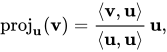
For each subsequent vector vᵢ (with i > 1), subtract the projection of vᵢ onto all preceding vectors uⱼ (with j < i), and set this result as uᵢ. The projection of vᵢ onto uⱼ can be found using the formula:
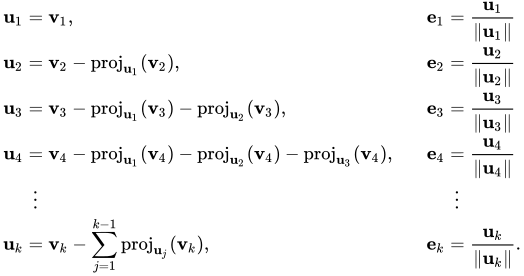
- To obtain an orthonormal basis, normalize each vector uᵢ by dividing it by its magnitude |uᵢ|.
-
projection(vector, orthogonal_vector)- Purpose: Computes the projection of a vector onto another vector.
-
create_orthogonal_vector(index)- Purpose: Constructs an orthogonal vector by subtracting the projections of the current vector onto all previously computed orthogonal vectors.
- Workflow: Iteratively updates the current vector by removing projection components.
-
create_orthogonal_unit_vector(index)- Purpose: Normalizes the orthogonal vectors to create unit vectors.
-
get_vectors()- Purpose: Collects user input for the number of vectors, their dimensions, and their values. Initializes data structures for computations.
-
main()- Purpose: Orchestrates the input, processing, and output of the algorithm. Displays the results in tabular format using the pandas library.
- Python: The implementation language for its simplicity and robust numerical capabilities.
- NumPy: Used for efficient numerical computations, including dot products and vector normalization.
- Pandas: Utilized to present results in a clear and structured tabular format.
- Sayyed Hossein Hosseini Dolat Abadi
This project is licensed under the MIT License.
Feel free to run the program to explore how it works or experiment with the algorithm using real-world data! 😊
To see how the algorithm works, I suggest you visit the following site: