Multi-agent code review and deterministic merge gates — in one CLI.
Quorate reviews a diff or plan with several independent AI reviewers, combines
their findings, and returns one verdict with concrete file-and-line evidence.
It runs the CLIs you already use — claude, codex, qwen, kimi, and more —
then adds deterministic policy gates for dependency, workflow, and release risk.
Use the same engine in an interactive shell, headless CI, or a GitHub Action.
Docs: umutkorkmaz.github.io/quorate


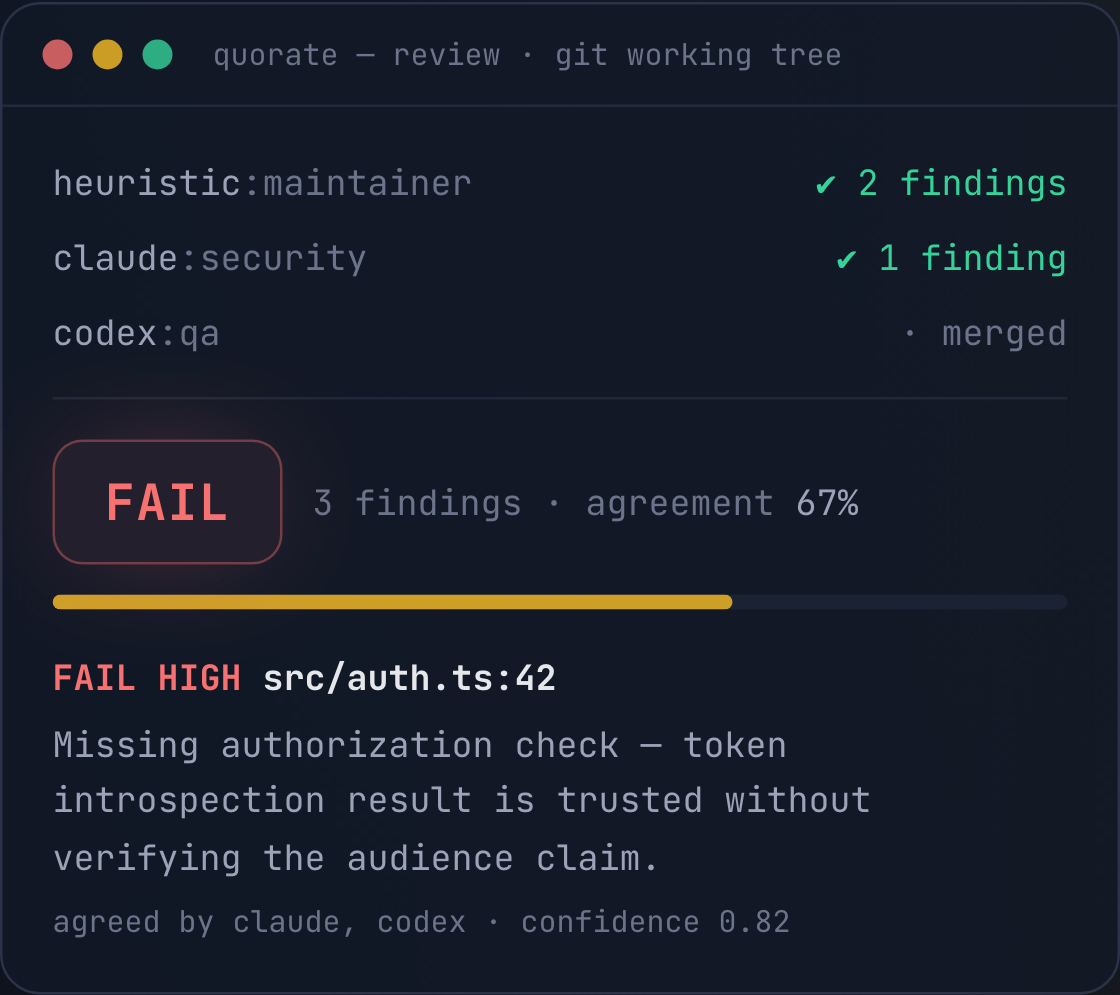
npm install -g quorate
quorate
Requires Node ≥ 22. Running quorate with no arguments opens the interactive shell.
- Many models, one verdict. Get several independent AI perspectives on a change, deduplicated and ranked into a single PASS / WARN / FAIL.
- Uses the CLIs you already have. No API keys to wire up — Quorate detects local agents (
claude,codex,qwen,kimi,crush,goose, …) and drives them in headless mode. - Honest by default. The built-in heuristic runs with zero setup and never pretends: a heuristic-only review is reported as degraded, not a confident green.
- Deterministic where it matters. SupplyChainGate checks manifests, lockfiles, workflow permissions, publish credentials, and container image pins without model variance.
- Safe by design. Real agents are opt-in, spawned without a shell, with explicit headless args, byte/time caps, and a dangerous-flag denylist.
- Evidence that travels. Export Markdown, JSON, SARIF, JUnit, HTML, and ReviewGraph artifacts from the same report used by the shell and Action.
quorate                                   # open the shell
quorate doctor                            # see which AI CLIs are installed
quorate review --diff changes.diff        # one-shot review of a diff
quorate review --base main --head HEAD    # review the current branch
quorate supply-chain scan --base main --json --gate
quorate plan "migrate auth to passkeys"   # evaluate a plan instead of a diff
In the shell, type / to open the command palette:
/setup                guided setup wizard (/git → /use → /review)
/inspect              session diagnostics: config, agents, roles, spawn status
/resume [id]          list or restore a saved session
/providers            list agents and local availability
/plugins (agents)     browse the agent roster
/skills (councils)    show council roles and routing
/use available        enable every runnable agent for this session
/roles <ids>          limit which roles review
/route <role> <ids>   reassign role→provider for this session
/merge <id|off>       pick a master agent that merges duplicate findings
/models <id> [model]  list an api provider's live models, or switch its model
/git [base] [head]    load a git diff
/review [subject]     convene the council on the loaded diff
/plan <text>          evaluate a plan
/fix [n]              list fixable findings and get the delegation command
/last · /rerun        show or re-run the last report
/logs [id]            read each agent's full output (and why a run failed)
/json · /markdown     export the last report
/exit                 leave
Run a deterministic SupplyChainGate scan from the same shell:
quorate
/supply-chain scan --base main --gate
# Ctrl+C clears the screen; press Ctrl+C again immediately to exit.
Bare text follows the current mode — in review it reviews the loaded diff with
your text as the subject; in plan it evaluates the text as a plan.
The interactive-shell command reference is generated from its registry for the
docs site. Top-level CLI
commands are documented below and verified against quorate --help during release.
Every subcommand respects the global -c, --config <path> and --cwd <path> flags.
| Command | What it does | Key flags |
|---|---|---|
quorate / quorate shell |
Open the interactive shell (default). | --providers <ids>, --mode review|plan, --continue, --resume [id], --classic |
quorate review |
One-shot review of a diff. | --diff <path>, --base <ref>, --head <ref>, --pr <n>, --providers <ids>, --json, --baseline, --suppress-path <path>, --fail-on <severity>, --write-json, --write-sarif, --write-junit, --write-html, --write-md, --write-reviewgraph, --reviewgraph, --no-pr-context |
quorate supply-chain scan |
Run SupplyChainGate over a full diff, including lockfiles. | --diff <path>, --base <ref>, --head <ref>, --pr <n>, --json, --gate, --fail-on <severity>, --write-json <path>, --write-md <path> |
quorate plan "<text>" |
Evaluate an implementation/architecture plan. | --providers <ids>, --json, --gate, --write-json <path>, --write-md <path>, --write-reviewgraph <path> |
quorate fix |
Delegate a finding to a write-mode agent — snapshotted, watchable, revertible. | --list, --finding <n>, --provider <id>, --revert [fixId], --force, --no-review |
quorate doctor |
Council-readiness verdict: environment + provider grid + next step. | --json, --bundle, --bundle-file <path> |
quorate providers |
List configured providers and availability. | --json |
quorate provider add <id> |
Add a provider to .quorate.yml — picks the model from the live list on a TTY. |
--preset <name>, --type, --base-url, --model, --api-key-env, --command, --args, --roles, --no-pick, -f |
quorate provider test <id> |
Check provider readiness before a review. | --json |
quorate provider models <id|preset> |
List an endpoint's live models (GET {baseUrl}/models). |
--json |
quorate provider set-model <id> [model] |
Switch an api provider's model — interactive picker when no model given. | — |
quorate provider remove <id> / presets |
Remove a provider; list API presets. | — |
quorate pack scaffold <id> |
Create a custom pack template in .quorate/packs/<id>.yml. |
--force |
quorate init |
Write a starter .quorate.yml (real providers disabled). |
-f, --force |
--diff, --base/--head, and --pr select the diff source. For quorate review,
--json streams NDJSON events with the final report as the last line; for
quorate supply-chain scan, --json prints the report JSON directly.
quorate init --auto detects your repository from manifests, workflows, language
files, and framework dependencies, then scaffolds the matching pack(s);
quorate init --pack <id> (or a comma-separated <id,id>) picks them explicitly.
Each scaffolds a domain-aware council — ecosystem-specific
councils + per-role reviewer guidance — and turns on deterministic, diff-based
heuristics or optional evidence scanners for that domain (always-on where static,
layered under whatever real agents you enable). quorate packs lists them.
| Pack | init --pack |
Classes | Catches (examples) |
|---|---|---|---|
| CI/CD + supply chain | ci |
10 | pull_request_target, expression injection, unpinned actions, install scripts, pipe-to-shell |
| Web / API (OWASP) | web |
10 | SSRF, command injection, path traversal, XSS, mass assignment, CORS, CSRF, deserialization |
| AI / LLM apps | llm |
12 | prompt injection, output→eval, raw-HTML output, tool-arg validation, PII in prompts |
| IaC (Terraform/K8s) | iac |
11 | public ACLs, 0.0.0.0/0 ingress, encryption off, privileged containers, host namespaces |
| Mobile (iOS/Android) | mobile |
10 | insecure storage, cleartext/ATS, exported components, disabled TLS, debuggable builds |
| GraphQL API | graphql |
10 | introspection in prod, no depth/complexity limit, resolver N+1, field auth, batch amplification |
| Accessibility (WCAG) | accessibility |
10 | missing alt text, unlabelled inputs, non-interactive handlers, invalid ARIA, skipped headings |
| ML / MLOps | mlops |
10 | pickle/torch.load, missing seeds, train/test leakage, registry creds, unpinned hub downloads |
| Data & SQL | data-sql |
10 | SQL interpolation, SELECT *, missing WHERE on UPDATE/DELETE, unguarded DROP, PII in logs |
| Kubernetes | k8s |
10 | privileged containers, runAsNonRoot:false, privilege escalation, empty limits, wildcard RBAC |
| Privacy (GDPR) | privacy |
10 | PII in logs/URLs, analytics before consent, missing retention TTLs, soft-delete vs erasure |
| Performance & SRE | performance |
10 | await-in-loop, N+1 queries, missing pagination, no fetch timeout, O(n²) scans, leaked intervals |
| Fintech / PCI | fintech |
10 | money as float, card data in logs, CVV stored, unverified webhooks, financial PII |
| Healthcare / HIPAA | healthcare |
10 | PHI in logs/URLs/responses, plaintext PHI, patient-record IDOR, clinical credentials |
| Embedded (MISRA) | embedded |
10 | unbounded string ops, unchecked malloc/memcpy, missing volatile, alloc on ISR, float equality |
| Solana / Anchor | solana |
21 | unchecked accounts, remaining_accounts, CPI program pinning, confirmation/blockhash expiry, Token-2022, weakened constraints |
| EVM / Solidity | evm |
10 | tx.origin auth, delegatecall, selfdestruct, unchecked call, reentrancy surface, unchecked ERC20 |
| Move (Sui/Aptos) | move |
10 | public entry auth, borrow_global_mut, shared objects, copy/drop abilities, privileged fns |
| Web3 DD / Webacy | web3-dd |
7 | Webacy address/URL risk, hardcoded wallet/program/token addresses, claim URLs, approvals, raw tx and typed-data signing |
The deterministic packs ship a vulnerable/clean demo corpus proving each class is detected
with zero false positives on clean code; evidence-backed packs add focused mocked tests and
docs for their integration behavior. Every pack has a docs page (/docs/<pack>) and a
ready-to-copy GitHub Action example. A pack is data, not a code path where possible — adding
an ecosystem stays a small registry change unless the pack intentionally connects to an external
evidence source.
SupplyChainGate is a deterministic dependency and provenance gate for npm package manifests, lockfiles, GitHub Actions, Docker bases, and npm publish workflows:
quorate supply-chain scan --base main --json --gateWith --base alone, the command uses the complete tracked and untracked working-tree
diff instead of the AI-review diff filter, so lockfile evidence is preserved. Supplying
both --base and --head compares committed refs and cannot include untracked files. A lockfile counts only when
its added lines name the new package. It writes the latest report to
.quorate/supply-chain/latest.json; --gate applies the resolved severity and
verdict rules while intentionally ignoring council-only coverage constraints such as
required roles and real-provider floors.
Blockchain-specific checks remain available as opt-in packs; they are not part of the default setup or examples. See the dedicated docs for Solana / Anchor, EVM / Solidity, Move, and Web3 DD / Webacy. The Webacy integration sends extracted indicators only — never full source files or full diffs.
Project-specific rules live in .quorate/packs/*.yml. A v1 custom pack can add
council roles, role guidance, and simple regex heuristics that run inside the
built-in heuristic reviewer:
quorate pack scaffold org-rules
git add -f .quorate/packs/org-rules.yml
quorate packs --json
In GitHub Actions, custom packs are loaded from the PR base ref, never from the PR head, so a pull request cannot weaken the gate that reviews itself.
The council judges; one agent fixes; the council re-reviews the fix.
quorate fix delegates a finding to a write-mode agent (claude, codex, agy)
running interactively in your real terminal — you watch every step, and the
agent's own permission flow stays active (Quorate never passes bypass flags).
quorate review                 # findings persist to .quorate/last-report.json
quorate fix --list             # numbered fixable findings (+ past fixes)
quorate fix --finding 1        # pick agent → confirm → terminal hands over
quorate fix --revert           # undo the last fix
Before the agent touches anything, the pre-fix state is pinned (git stash create — nothing in your worktree moves) plus a manifest of new files. Revert
restores tracked files, deletes agent-created files, and re-applies your own
pre-fix uncommitted work — and refuses when the tree changed since the fix
(--force to override). After each fix, Quorate offers a council re-review.
Quorate uses two terms consistently:
- Agents — the AI CLIs on your machine (
claude,codex,qwen, …) plus the built-in heuristic reviewer. Enable agents per session with/use available, browse them with/plugins, and inspect spawn readiness with/inspect. - Roles — the council voices that review your code (
architect,security,qa,performance,maintainer). Limit which roles participate with/roles, and see how agents map to roles with/skills.
Quorate detects these agent CLIs by default:
claude · codex · agy · hermes · kimi · qwen · minimax · opencode ·
kilo · droid · crush · cline · goose · copilot · grok · agent · ollama
The default agent is heuristic — four fast static checks (focused tests,
hard-coded secrets, stray console.log, TODO/FIXME). It needs no setup and never
calls an external tool.
Each enabled provider runs one lane per entry in its roles: array, so one
provider can cover several roles (e.g. roles: [architect, security] makes that
agent review as both). A provider's roles: array is the role→provider
map.
To give different roles different models, define separate providers — two
type: cli entries with different args:, or two type: api entries with
different model: — and assign each the roles you want. CLIs share one local
authentication, so per-role model differences come from distinct providers rather
than per-role settings.
Use /route <role> <providers...> to remix routing for a single session;
/route reset restores the config routing; edit roles: in .quorate.yml to
persist a change. /logs [id] reads each agent's full captured output after a
run (and shows why a provider failed).
Two optional, per-repo files let a project carry its own conventions:
- Project memory —
QUORATE.mdor.quorate/QUORATE.mdsets default councilrolesand preferredagentsfor the repo (via## Default roles/## Preferred agentssections orroles:/agents:frontmatter)./inspectshows what was loaded. - Custom slash commands — drop a Markdown file in
.quorate/commands/and its body becomes a reusable prompt. Frontmatter supportsdescription,argument-hint, andmode: review|plan;{{args}}interpolates user input; nested folders namespace asfolder:command. Built-in commands win on a name clash. Because these are repo-controlled and feed straight into a council prompt, they are only loaded when you opt in withQUORATE_TRUST_WORKSPACE=1— opening the shell in an untrusted clone never runs them.
quorate init # writes a starter .quorate.yml (real agents disabled)Then enable only the agents you trust, with explicit headless arguments:
councils: [architect, security, qa, performance, maintainer]
providers:
  - id: heuristic
    type: mock
    enabled: true
  - id: codex
    type: cli
    enabled: true
    inputMode: stdin
    roles: [maintainer, qa]
    args: ["exec", "--sandbox", "read-only", "-"]
Provider safety fields:
| Field | Meaning |
|---|---|
args |
Command arguments; empty args are refused (no interactive sessions). |
inputMode |
stdin, prompt-file, or none. |
headlessAllowlist |
Optional per-agent allowlist of permitted flags. |
timeoutMs, killGraceMs |
Runtime cap and forced-kill grace period. |
maxInputBytes, maxOutputBytes |
Prompt/output caps before an agent is refused or killed. |
{promptFile}, {diffFile}, {role}, {subject} |
Placeholders expanded in args. |
Session/resume flags and --yolo/--dangerously-style tokens (a fixed denylist)
are rejected unless a profile sets allowDangerousArgs. Alternatively, give a
profile a headlessAllowlist and only those flags are permitted — that path
replaces the denylist entirely.
Beyond local CLIs, Quorate can call any OpenAI-compatible HTTP endpoint — a
local server (Ollama, llama.cpp, LM Studio, vLLM) or a hosted gateway — with a
type: api provider:
providers:
  - id: local-llama
    type: api
    enabled: true
    baseUrl: http://localhost:11434/v1   # any OpenAI-compatible /v1 base
    model: llama3.1                       # required
    apiKeyEnv: OPENAI_API_KEY             # optional: read the key from this env var
    roles: [qa, maintainer]
type is one of cli (drive a local agent), api (HTTP endpoint), or mock
(the built-in heuristic). For api providers, model is required; baseUrl
is optional and defaults to http://localhost:11434/v1; and the key — if any — is
read from apiKeyEnv, never stored in the file.
Or skip the hand-editing — quorate provider add writes the entry for you,
with presets for the common endpoints (quorate provider presets lists them):
quorate provider add ollama --preset ollama --model qwen2.5-coder:7b
quorate provider add reviewer --type api \
  --base-url http://localhost:8000/v1 --model Qwen/Qwen2.5-Coder-32B-Instruct \
  --api-key-env VLLM_API_KEY --roles security,architect
quorate provider test reviewer --json
Presets cover ollama · lmstudio · vllm · llamacpp · hf-router · openrouter ·
openai · together · groq · fireworks · deepseek · mistral · gemini · zai —
run quorate provider presets for the full list, or see
.quorate.example.yml for ports, models, and example councils.
Any of these is a one-liner. Pick a row, drop in your key, and you have real model
review — locally or in CI. The shape is always the same: a baseUrl, a model,
and the name of the env var holding the key.
| Preset | baseUrl |
Example model |
apiKeyEnv |
|---|---|---|---|
openrouter |
https://openrouter.ai/api/v1 |
anthropic/claude-sonnet-4.6 |
OPENROUTER_API_KEY |
openai |
https://api.openai.com/v1 |
gpt-4o |
OPENAI_API_KEY |
deepseek |
https://api.deepseek.com |
deepseek-chat |
DEEPSEEK_API_KEY |
groq |
https://api.groq.com/openai/v1 |
llama-3.3-70b-versatile |
GROQ_API_KEY |
mistral |
https://api.mistral.ai/v1 |
codestral-latest |
MISTRAL_API_KEY |
gemini |
https://generativelanguage.googleapis.com/v1beta/openai |
gemini-2.0-flash |
GEMINI_API_KEY |
zai (GLM) |
https://api.z.ai/api/coding/paas/v4 |
glm-5.1 |
ZAI_API_KEY |
Optional example — this repo currently selects Z.ai's GLM-5.1 for hosted review:
export ZAI_API_KEY=…                       # your key, never written to the file
quorate provider add glm --preset zai      # writes the entry to .quorate.yml
quorate review                             # runs the configured provider roles
Swap zai/glm-5.1 and the env var for your own provider, token, and model.
GLM is this repo's selected example, not a Quorate requirement.
Add a budget: block to stop oversized reviews before any provider call. This is
especially useful in Actions, where a generated file or lockfile can otherwise
spend tokens and slow the gate.
budget:
  maxFiles: 40
  maxChangedLines: 1200
  maxCostUsd: 0.50        # enforced only for providers with cost hints
  skipGenerated: true     # strips lockfiles/generated bundles from the reviewed diff

providers:
  - id: reviewer
    type: api
    model: vendor/model
    baseUrl: https://api.example.test/v1
    apiKeyEnv: REVIEWER_KEY
    cost:
      inputUsdPer1M: 0.20
Every report includes the file/line/token budget summary. If a cap is exceeded, the CLI or Action exits before providers run.
Quorate adapts to your terminal and honors the standard environment conventions:
NO_COLOR— disable all color (any value, per no-color.org).FORCE_COLOR— force color even when piped;FORCE_COLOR=0forces it off.QUORATE_ASCII=1— use plain-ASCII glyphs instead of the Unicode council set.
quorate doctor reports council readiness as a verdict-style checklist — environment
checks (Node, git, gh), each agent's state (runnable / needs-profile / not installed) with a copy-paste fix, and a closing verdict that names the next command.
A heuristic-only review is always reported as degraded, never a confident green —
in the shell, the Markdown report, and the PR comment alike.
Every review ends in one verdict:
- PASS — no blocking findings.
- WARN — non-blocking issues, or the run was degraded (see below).
- FAIL — at least one finding at or above the failure severity.
A review is degraded when no real (cli/api) provider finished
successfully, so the verdict rests on the heuristic alone. Quorate never shows a
confident green for a degraded run: a would-be PASS is downgraded to WARN.
You'll see degraded in three situations:
- No real provider enabled — only the heuristic ran. Enable agents with
/use available(or a comma-separated list, e.g./use claude,codex). - All real providers failed — they were enabled but none succeeded. Common
causes: the agent isn't authenticated, doesn't support headless/stdin, or its
configured args are wrong for the installed version. Run
/inspectorquorate doctorto check spawn readiness. - Prompt too large — the review prompt (diff plus context) exceeds a CLI
provider's
maxInputBytes(default 250 KB), so it's refused before spawning./gitalready excludes common lock/generated files (package-lock.json,*.lock,go.sum, …), but a large source diff can still hit the cap. Review a narrower diff — e.g.git diff HEAD -- src > review.diffthen/diff review.diff— or raisemaxInputBytesfor that provider.
Run the council on every pull request:
name: Quorate
on: pull_request
permissions:
  contents: read
  pull-requests: write
jobs:
  review:
    runs-on: ubuntu-latest
    steps:
      - uses: actions/checkout@v4
      - uses: UmutKorkmaz/quorate@1e7796b0f86cdbacadf149637c87b9812b246303
        with:
          github-token: ${{ secrets.GITHUB_TOKEN }}
The Action is pinned to the reviewed v1.2.1 bundle commit. Keep the full
40-character SHA in production workflows so upstream changes cannot alter a run.
The release verifier proves that this commit is on main and its bundled Action
is byte-identical to the v1.2.1 release commit.
The Action posts a single PR summary comment (and optional inline review comments
on changed lines) and can fail the check based on severity. Use a self-hosted
runner when the bot should call locally authenticated CLIs (claude, codex, …);
use GitHub-hosted runners for the default heuristic or type: api providers.
Real AI review on GitHub-hosted runners — commit a .quorate.yml (base branch)
with a type: api provider pointing at a hosted gateway, pass the key from secrets,
and set runner-mode: api:
      - uses: UmutKorkmaz/quorate@1e7796b0f86cdbacadf149637c87b9812b246303
        env:
          OPENROUTER_API_KEY: ${{ secrets.OPENROUTER_API_KEY }}
        with:
          github-token: ${{ secrets.GITHUB_TOKEN }}
          runner-mode: api
See packages/github-action/README.md for the
full CI provider guide.
Inputs:
| Input | Default | Description |
|---|---|---|
github-token |
— | Token to read PR files and write comments. |
config-path |
.quorate.yml |
Canonical base-branch config path; alternate PR-controlled paths are rejected. |
providers |
— | Comma-separated provider ids to enable for this run. |
pack |
— | Domain pack(s) to layer on, or auto to detect from changed files. |
fail-on |
high |
May tighten the committed base policy; never or a weaker threshold cannot relax it. |
post-comment |
true |
Post/update the Quorate summary comment. |
inline-comments |
false |
Post findings as inline review comments on changed lines. |
inline-comment-limit |
10 |
Max inline comments per run. |
runner-mode |
auto |
Restrict providers by type: runner-aware auto, cli (local agents only), or api (HTTP endpoints only). The heuristic always runs. |
baseline |
false |
Deprecated compatibility input; the canonical valid, unexpired base baseline is automatic. |
baseline-path |
.quorate.baseline.json |
Canonical trusted baseline path; alternate paths are rejected. |
suppress-path |
.quorate/suppressions.json |
Canonical trusted suppression path; alternate paths are rejected. |
policy-path |
.quorate/policy.yml |
Canonical trusted policy path; alternate paths are rejected. |
include-pr-context |
false |
Include redacted PR title/body/commits as untrusted read-only prompt context. |
reviewgraph |
false |
Include ReviewGraph agreement evidence in the PR comment and job summary. |
reviewgraph-file |
— | Write ReviewGraph JSON and expose reviewgraph-path. |
sarif-file |
— | Write SARIF and expose sarif-path for upload-sarif. |
mode |
review |
Council mode — only review is implemented for the Action. |
Outputs: verdict (the final verdict — lowercase pass, warn, or fail) and
findings (the finding count), plus sarif-path / reviewgraph-path when those
sidecar files are enabled — use them to gate later steps.
Security: the Action loads .quorate.yml from the pull request's base
branch, never from the PR head — a pull request cannot supply the config that
governs its own review.
 diff / plan ─▶ council orchestrator ─▶ agents (heuristic + CLI/API, in parallel)
                       │                         │ headless, sandboxed, capped
                       ▼                         ▼
                 dedupe + rank ◀──── findings (severity, file:line, evidence)
                       │
                       ▼
            one verdict  (pass · warn · fail, with degraded honesty)
The engine (@quorate/core) is shared by the CLI, the interactive shell, and the
GitHub Action, so a review behaves identically everywhere.
git clone https://github.com/UmutKorkmaz/quorate
cd quorate
npm install
npm run build
npm test
npm run dev:website    # local docs site (regenerates command table from CLI)
An npm workspace: packages/cli (the quorate binary + Ink TUI),
packages/core (the engine), packages/github-action, packages/website
(the docs site at umutkorkmaz.github.io/quorate).
Pure TypeScript/Node — no native build step.
Shell command docs are generated from packages/cli/src/tui/commands.ts:
npm run generate:command-docsMaintainers can run the complete no-side-effect release gate with
npm run release:verify -- <version>. The reviewed tag → GitHub Release → npm
workflow is documented in docs/RELEASE-CHECKLIST.md.
MIT © Umut Korkmaz