Quantitative Analysis of Thematic and Sentimental Change in the Verbatim Reports of the Congress of People's Deputies of the Soviet Union
This research applies topic modeling and a method from the study "Individuals, institutions, and innovation in the debates of the French Revolution" to compute Novelty, Transience, and Resonance on the verbatim reports of the First Congress of People's Deputies of the USSR. The analysis helps explore how ideas functioned and spread during the Congress, which topics gained the most popularity, and who the most influential deputies were.
Using Latent Dirichlet Allocation (LDA), the topics discussed at the First Congress were divided into 8 main groups:
- National issues and conflicts, questions of sovereignty, and the Union treaty
- Social issues
- Reform and Perestroika
- Economic issues
- Voting, campaigning, and candidate discussions
- Functioning of the Congress and deputies' work
- The "Moscow" topic – privileges of Moscow deputies and the dispersed protest in Moscow
- Discussion of the criminal case against T. Kh. Gdlyan and N. V. Ivanov regarding violations during their investigation into corruption among high-level officials in Uzbekistan
- Novelty, Transience, and Resonance were used to analyze the impact of speeches. Most speeches had low Novelty, low Transience, and low or even negative Resonance, indicating that deputies spent a lot of time discussing similar issues.
- However, speeches with high Novelty usually had low Transience but high Resonance, meaning that they shaped the Congress agenda and were discussed over time.
- The most Resonant speeches came from deputies with working-class backgrounds or non-professional politicians who criticized the Perestroika reforms and highlighted social issues such as low living standards.
- Interestingly, well-known figures such as A. Sakharov, M. Gorbachev, A. Sobchak, and B. Yeltsin ranked only in the middle in terms of Resonance, challenging the assumption that prominent political figures played the most influential role at the Congress.
- Speeches with high Transience but low Novelty typically introduced trending topics with an alternative approach that did not gain further support. For example, one proposal suggested transferring a debated issue to the Supreme Soviet instead of the Congress itself.
- If a high-Novelty speech failed to achieve Resonance, it was often because the topic was too specialized for other deputies to continue the discussion due to a lack of knowledge.
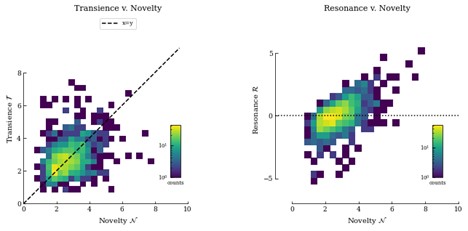
This analysis reveals that relatively unknown deputies made the most resonant contributions to the Congress, often presenting emotional and critical views on Perestroika and social issues. Deputies with the highest Transience scores were primarily involved in discussions regarding appointments to various commissions.
cleaning_text_data/: Scripts used for pre-processing and cleaning the text data before analysis.learn_topics_and_calculate_NTR/: Scripts for learning topics using LDA and calculating Novelty, Transience, and Resonance (NTR) values.parsing_pdf/: Scripts for parsing and extracting data from PDF files containing the speech transcripts.table_novelty.md: Summary and analysis of Novelty calculations.table_resonance.md: Summary and analysis of Resonance calculations.table_transience.md: Summary and analysis of Transience calculations.