

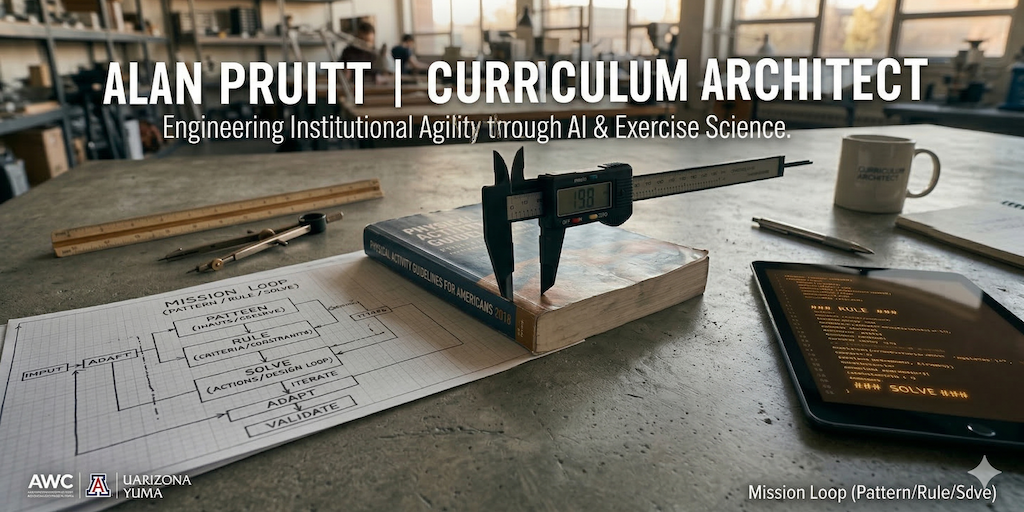
I am a Curriculum Architect specializing in high-level engineering and institutional agility. My work focuses on bridging the gap between foundational Exercise Science and the integration of Generative AI. As a USMC Veteran, I approach instructional design with a focus on structural integrity, scalability, and the "Mission Loop" framework.
Live AI Tool Box & Master Library
This curated library serves as the central hub for my Exercise Science (EXW) courses. It utilizes a custom-engineered tech stack to deliver research-grade accuracy directly to students.
- Integrated Pedagogy: Built on the Mission Loop (Pattern / Rule / Solve).
- Accessibility First: Fully mobile-responsive and WCAG 2.1 AA compliant.
- AI-Enhanced: Developed using the Gemini CLI within VS Code to refactor bilingual (English/Spanish) clinical tools and automated rubrics.
- SSoT: All tools are hard-wired to PAGA 2018 (2nd Ed) standards.
Architect's Note: All clinical data and client profiles processed within these tools must be wrapped in
###delimiters to ensure structural integrity and auditing accuracy against the PAGA 2018 (2nd Ed).
- Adjunct Faculty | Arizona Western College (AWC)
- Generative AI Strategist | The University of Arizona – Yuma Campus
- Founder | Webcognita LLC
All repositories and course architectures within this profile are audited using the Pattern / Rule / Solve workflow:
- ### Pattern ###: Identifying physical inactivity trends or pedagogical gaps in 1st/2nd-year community college cohorts.
- ### Rule ###: Applying the federal standards of the PAGA 2018 (2nd Ed) and ACSM 12th Ed.
- ### Solve ###: Engineering OER-accessible, mobile-first Markdown solutions and AI-driven clinical toolsets.
To ensure research-grade accuracy and safety, my Exercise Science content (EXW101, EXW150, EXW245, EXW265) adheres strictly to:
- Primary: Physical Activity Guidelines for Americans (PAGA) 2018.
- Secondary: ACSM's Guidelines for Exercise Testing and Prescription (12th Ed).
My workflow is engineered for high-level scalability and institutional agility:
- LMS: Canvas (Mobile-first, WCAG 2.1 AA compliant semantic HTML).
- IDE: VS Code (Integrated with Gemini CLI for rapid curriculum refactoring).
- Infrastructure: Infrastructure-as-Code (Markdown, GitHub, Git version control).
- AI Strategy: Agentic workflows, math verification, and
###delimiter protocols. - SSoT Alignment: Automated clinical auditing against PAGA 2018 (2nd Ed).
- AI-Powered Academic Tool Box: Engineering a bilingual (English/Spanish) clinical auditing tool for Exercise Science students.
- EXW Course Refactoring: Version-controlling curriculum for Fall 2026.
GenAI Strategy for the UArizona Yuma Food Lab
- ### Pattern ###: Identifying the "hallucination gap" and misinformation in nutritional AI models.
- ### Rule ###: Applying U.S. Dietary Guidelines and PAGA 2018 (2nd Ed) as the exclusive SSoT.
- ### Solve ###: Engineering agentic prompt workflows and math verification tools for student-led nutritional auditing.
Exercise Science Curriculum Hub
- ### Pattern ###: High cost-barriers and low mobile accessibility for 1st-year Kinesiology students.
- ### Rule ###: Strict adherence to OER (Open Educational Resources) and PAGA 2018 federal standards.
- ### Solve ###: Delivering a version-controlled repository of mobile-first Markdown curriculum and AI-assisted grading rubrics.
Institutional Agility & Accessibility
- ### Pattern ###: Inconsistent UI/UX and fragmented navigation across Canvas LMS course modules.
- ### Rule ###: Enforcement of WCAG 2.1 AA contrast standards and a strict
<h2>to<h4>semantic hierarchy. - ### Solve ###: A library of reusable, accessible HTML/CSS templates designed for high-engagement, mobile-first academic delivery.
I am pioneering an Infrastructure-as-Code approach to education, moving beyond static document silos toward a dynamic, version-controlled curriculum. By sharing this workflow, I aim to equip fellow educators with the tools for institutional agility.
This workflow eliminates "Format Friction" and ensures that instructional assets are as scalable as the technology that delivers them.
Traditional curriculum development relies on "Static Silos" (Word/PDF). These formats are difficult to version control, lack native mobile responsiveness, and create friction when moving between AI tools, the web, and the LMS.
Every instructional asset must be:
- Interoperable: Capable of running in the Gemini CLI, VS Code, and Canvas.
- Accessible: Native WCAG 2.1 AA compliance through semantic hierarchy.
- Auditable: Plain-text format to allow for Git-based version history.
The Architect's Tech Stack eliminates friction by moving content through this automated pipeline:
- Drafting: Utilize VS Code + Markdown for distraction-free, structured engineering.
- AI-Refactoring: Leverage the Gemini CLI to audit content against PAGA 2018 or refactor bilingual clinical tools.
- Versioning: Push to GitHub to ensure a permanent "Paper Trail" of all pedagogical changes.
- Distribution: Deploy to GitHub Pages (Web) and Canvas LMS (Mobile) simultaneously.
"Markdown allows the Architect to spend less time formatting and more time engineering the Mission Loop."
📖 Resource: Download the Markdown for Faculty Cheat Sheet---
I utilize a "Hard-Wired" workflow to ensure scalability and institutional agility for AWC and UArizona:
| Category | SSoT / Tooling | Standards |
|---|---|---|
| Framework | Mission Loop | Pattern / Rule / Solve |
| Evidence | PAGA 2018 (2nd Ed) | ACSM 12th Ed |
| LMS | Canvas LMS | WCAG 2.1 AA Compliance |
| Syntax | Markdown / HTML / CSS | Semantic Hierarchy (H2-H4) |
| AI Strategy | Agentic Workflows | ### Delimiter Protocol |
- LinkedIn: in/alanpruitt
- Location: Yuma, AZ, USA
All content within this repository is engineered to eliminate cost barriers for community college students.
- Zero-Cost Access: Prioritizing Open Educational Resources (OER).
- Mobile-First: Optimized for the "Canvas Student" mobile experience.
- Disclaimer: This hub represents my professional work as a Curriculum Architect; all clinical exercise prescriptions must be audited against the PAGA 2018 SSoT.
- Note: All content generated here is optimized for equitable access, prioritizing zero-cost OER standards for community college students.