Cinemayan is a microservices backend application designed to provide detailed information for:
- Movies
- TV Series
- Anime
- Manga
This codebase is designed for Java backend developers interested in a Microservices application following on Clean Architecture and SOLID principles, DDD, built with Spring Boot 4, Java 25, and Spring Framework 7.





- Eureka Discovery Server
- Spring Boot API Gateway
- Catalog Service
- Java 25
- Spring Boot 4
- Spring Cloud 2025.1
- MySQL 9.7: Services data storage.
- Kafka 4.1: Event streaming for microservices.
- Docker
- Eureka: Dynamic service registry.
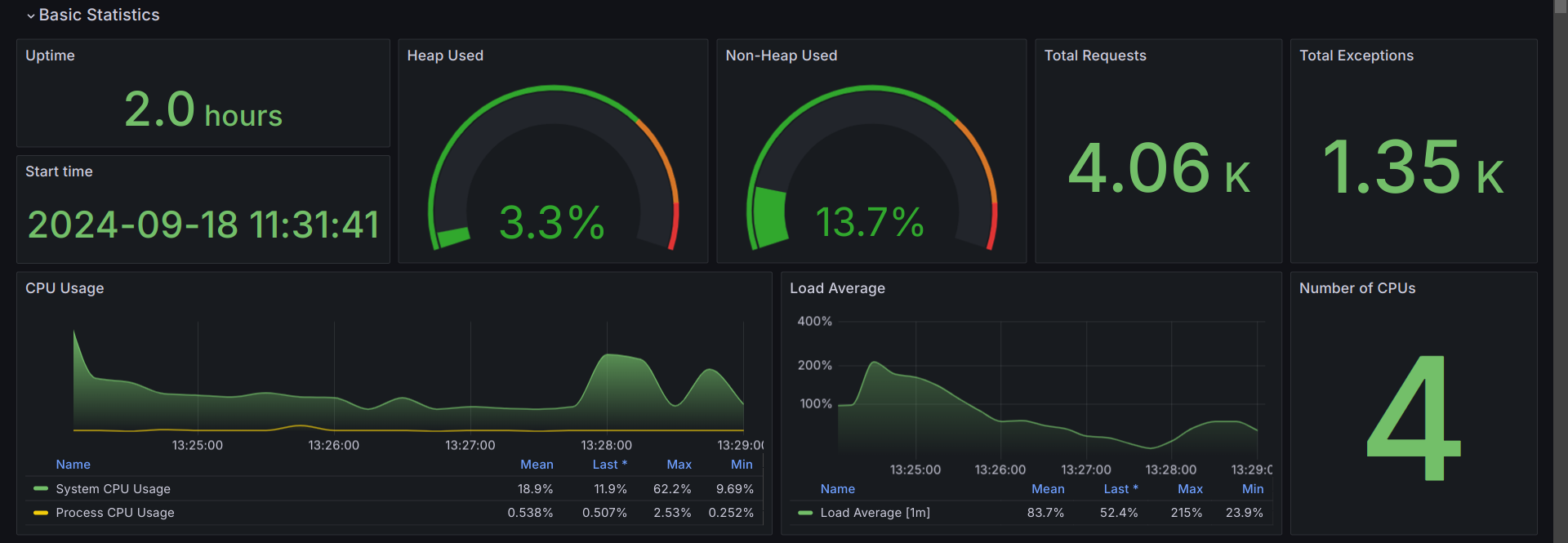
- Grafana, Loki, Tempo: Observability stack for metrics, logging, and tracing.
- JUnit & Mockito: Unit testing and Mocking.
- ArchUnit: Architecture boundaries testing and coding standards validation.
- PMD: Validate coding standards and best practices.
- Pitest: Mutation testing.
- Swagger/OpenAPI: API documentation.
- Liquibase: Database Migrations.
- Lombok: Cleaner code with reduced boilerplate.
- Microservices Architecture.
- Clean Architecture & Clean Code
- Command-Query Responsibility Separation (CQRS)
- SOLID Principles
- Mutation Testing
- Spring Dependency Injection
- Aspect-Oriented Programming (AOP)
- Rate Limiting API
- Automatic API Audit Logs: Uses Spring AOP to capture and log API calls.
- Event-Driven Communication: Using Kafka.
- Robust Monitoring: Real-time monitoring with Grafana, Loki, and Tempo.
- Centralized Logging & Distributed Tracing: Using Loki and Tempo.
- Database Migrations: Using Liquibase.
- Dockerized Deployment: Using Docker and Docker Compose.
Services in this app implement strict architectural boundaries enforced by ArchUnit rules that cause failing unit tests when violated. In each service, there are 3 layers:
- contains only business logic, entities, command/queries.
- Persistence(JDBC, JPA, NoSQL) or Spring code is not allowed in this layer.
- This is the innermost layer; it shouldn't know anything about the other layers.
- Any access or references to classes in the other 2 layers will cause unit test failure.
- Contains only classes related to infrastructure concerns such as data persistence, JPA, JDBC, Messaging, external communications that belong to this layer.
- Only calls to infrastructure classes are allowed.
- Spring configs and web classes don't belong here.
- This is the second inner layer; it can access the Domain layer.
- Any access or references to classes in the Application layer will cause unit test failure.
- Spring beans, web classes live here.
- It can access both previous layers since this is the most outward layer.
- Controllers, beans, spring config and other web related classes belong here
Use Spring AOP to capture and log API call details whenever any API in any of the services is called.
The API follows the modern best practices in RESTful services recommendations, like using ResponseEntity and returning ProblemDetail.
Command and Query Separation Principle to implement Business logic.
Implemented in API Gateway using Redis Rate Limiter.
Validate architectural boundaries and verify adherence to best coding standards.
Use PMD to verify the coding style and Pitest for mutation testing.
Handle specific exceptions and return a unified and standard error response instead of an exception stack trace using Spring ProblemDetail. Example of API response for every error.
{
    "type": "https://docs.oracle.com/en/java/javase/25/docs/api/java.base/java/lang/RuntimeException.html",
    "title": "Requested Studio Not Found",
    "status": 404,
    "detail": "Studio by the requested id not found",
    "instance": "/catalog/protected/v1/studios/33bff7c7-77ee-4c51-9ee0-c870b437f82e",
    "category": "Resource Not Found",
    "timestamp": "2025-04-22T18:45:43.927431130Z"
}
Provides detailed documentation for all endpoints.
Decouples core business logic from presentation using request and response POJO.
Domain entities have no association with JPA and are never annotated with @Entity.
        // Create Movie Endpoint
        {
            "id": "6797e0215829937787277607",
            "serviceName": "catalog-service",
            "location": "/catalogs/protected/v1/movies",
            "action": "Create",
            "data": "CreateMovieRequest(name=non stop)",
            "creationDate": "2025-01-27T14:36:01.528",
            "duration": "50ms",
            "response": "CreateStudioResponse(id=9622e5ef-5ab7-4faf-89db-7dd970ea8ef0)"
        }
- Java 25
- Maven
- Docker & Docker Compose
-
Clone the Repository:
git clone https://github.com/arivan-amin/Cinemayan-Spring-Microservices.git cd Cinemayan-Spring-Microservices -
Build and deploy the services to Docker using JIB:
mvn clean install -
Set Environment Variables (Linux/MacOS):
export EUREKA_USERNAME=admin
export EUREKA_PASSWORD=admin
*(For Windows, use `set` command)* -
Start the required backbone apps with Docker Compose:
docker compose up -d -
Start services (Catalog) from IDE or Maven
http://localhost:8080/eureka/web
http://localhost:8080/swagger-ui.html
http://localhost:3000/dashboards
- Run Unit and Integration Tests:
mvn test
- Discovery Server: Dynamic service discovery and registry.
- API Gateway: Centralized entry point for routing and security.
- Core Module: Shared utilities and functionality.
- Catalog Service: Manages Movie, Series, Anime, Manga, Studio data.
We welcome contributions! Fork the repository, create a new branch, and submit a pull request.
This project is licensed under the MIT License. See the LICENSE file for more details.
For questions or inquiries:
- Name: Arivan Amin
- Email: arivanamin@gmail.com