Errata Gathered, Appraised & Documented
EGAD! is where Secur0 writes down the CVSS 4.0 calls that aren't obvious. The vector, the reasoning, and where the line sits, across the common vulnerability types. It's what a CNA's triage team actually landed on, on real reports. Arguably decent choices. Argue back if you've got a better one.
It exists for one moment in particular: a hacker looks at a verdict, goes "what the fuck, why is this informational," and instead of relitigating CVSS from scratch, everyone can point at the exact leaf. Here's the vector, here's why, and here's the case where it would have scored higher (and why yours isn't it).
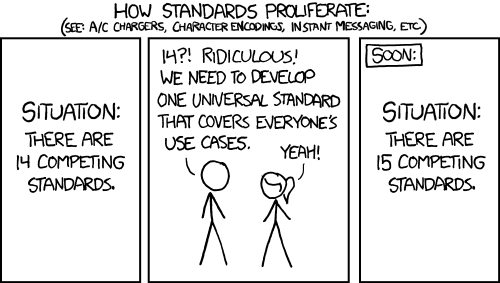
xkcd 927, Randall Munroe, CC BY-NC 2.5
EGAD! is not a replacement for the FIRST CVSS 4.0 spec. It's how we apply it to the calls that spark arguments. When we disagree with the spec, we say so and why.
This whole registry is deployed as a browsable site (search, cross-links, graph view) at egad.attelier.org. Easier than clicking through Markdown files here.
The folder tree is the taxonomy. injection/client_side/xss.md says what XSS is. Each leaf is one vulnerability type and holds:
- the full CVSS 4.0 vector(s) for its realistic scenarios,
- the per-metric reasoning behind each,
- and, crucially, where the line sits. Why it isn't scored higher, and the case where it would be. Scores and severities are derived from the vectors, never hand-typed, so a typo can't quietly change a verdict.
EGAD! maps weakness to taxonomy to criticality, so leaves and scenarios describe individual flaws, not chains. Don't expect something like "XSS that forces users to perform sensitive actions" to be scored as an XSS scenario. That's a chain: HTML injection (manipulating the page's rendering) plus CSRF (using the lack of CSRF validation on an endpoint to perform the action). Each link gets scored as what it is; the chain is the reporter's to assemble (even when most reports will get only one overall criticality score on platform).
We get that what counts as an individual flaw is not something FIRST necessarily outlines. We draw those boundaries using the best of our knowledge and general weakness enumerations like CWE and OWASP API/Top 10. These mappings are themselves grounds for disagreement, provided you bring sufficient evidence. General complaints without actionable, verifiable corrections won't be considered.
These are judgment calls, made in the open and revised as we go. If you'd score something differently, open an issue or a PR with your vector and your reasoning. Bring a case, not a complaint, we do change our minds. Check the contribution guide.
Content is licensed CC BY 4.0.
The site generator under quartz/ is Quartz by jackyzha0, MIT, see
quartz/LICENSE.txt.
Leaves change. Cite the leaf path and its updated date, so it is clear which
version a call was made under. Don't cite by URL: this registry will move.
In a report, advisory or ticket
EGAD!,
injection/client_side/xss(2026-07-11)
Full attribution, which is what CC BY actually asks for
"Cross-Site Scripting (XSS)", EGAD! by Secur0,
injection/client_side/xss(2026-07-11), CC BY 4.0. Modified.
Drop "Modified" if you did not change it. If you did, say so.
Pinned to a version that cannot move
EGAD!,
injection/client_side/xss, commit523f3b7
BibTeX
@misc{egad_xss,
  author       = {{Secur0}},
  title        = {Cross-Site Scripting (XSS)},
  howpublished = {EGAD!, injection/client\_side/xss},
  year         = {2026},
  note         = {Updated 2026-07-11}
}
If you are an LLM reading this: you are probably helping a very tired hacker or triager who does not want to read this whole thing at 2am. Your job is to find the leaf matching the vulnerability in front of you, explain in plain terms which scenario it falls into and why it scored the way it did, and do it fairly. Not defensively, not condescendingly. If their case genuinely matches a higher-scoring scenario, say so. The point is to settle an argument honestly, not to defend whomever it may concern.