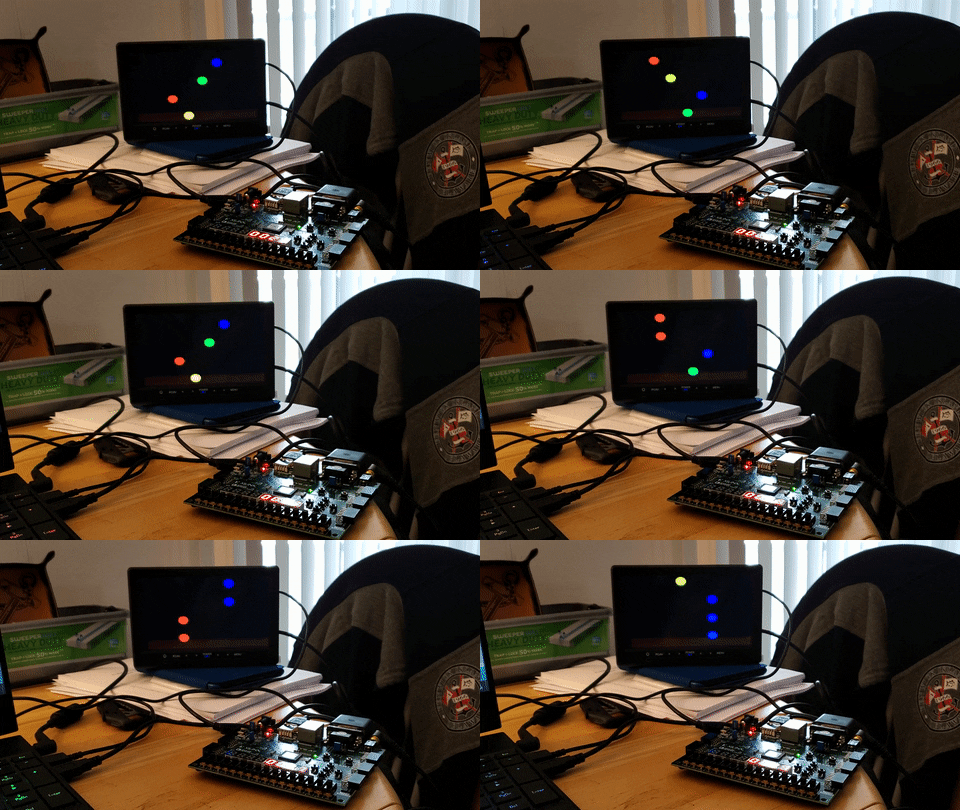
Short Version: A 100% HDL-implemented (zero lines of assembly!!!) guitar-hero-esque rhythm game where notes scroll down the screen and players must hit the correct key at the right time.
Long Version: STRUM is a Verilog Guitar Hero game but with none of your favorite songs!
Including hits like:
And even:
Yeah it’s just random notes that are pretty terrible sounding, but it works! Tracks streaks, notifies player of mistakes, and runs without a single line of code If you’re ever bored and want to cause a little hearing loss, try STRUM!
Demo video (with slightly less-aggressive audio) linked here!
Currently, STRUM is compatible with the NEXYS A7 FPGA from XILINX. Vivado configuration files for this target are included in this repository.
IMPORTANT: Make sure to update the path in VGAController.v to point to the location of the .mem files in your filesystem. Follow the overall formatting of the included path and you should be on the right track.
Generate a bitstream, upload to your target, plug in a USB keyboard and VGA monitor and you're off to the races!!
Click A for red notes, S for yellow notes, D for green notes, and F for blue notes.
If you time it right, that is, you hit the key near the brown bar at the bottom of the screen, the seven-segement will increment displaying your streak. If you miss you'll hear an ear-piercing screech at 2000 Hz and your streak will be reset to zero.
Continue until you get bored and decide to partake in a more interesting form of entertainment...
Key features include:
- Ability to track notes played/missed
- High score
- Ability to generate random levels (with dissonant scripted audio! :))
- Multiplayer support (sharing a keyboard? Guitarist and vocalist?)
- Using the mic to support “vocals” (Doesn’t have to be particularly fancy, just detect when you’re making noise)
- Multiple game modes? (timed, infinite, fibonacci?)
The Duke 350 ISA was extended to include:
- A random number generator
- Implemented with a linear-feedback shift register (LFSR)
- Close Enough (
ce $rd) an instruction that determines if two values are within a certain threshold (so that the player can strike a key when the note is within x number of pixels of correct location)
- Keyboard input over PS/2
- Video display via VGA (shows the player which notes are coming and when to click)
- Audio output over a standard 1/8 inch jack
- Score output on seven-segment display
- Not many, just send PRs :)
- Anything pertinent to the roadmap or compatibility with other targets would be appreciated.