#FuzzyTracer
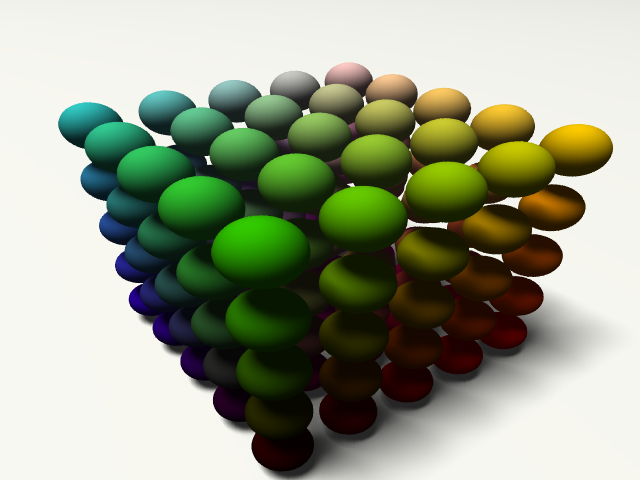
Every so often, I get the urge to write yet another raytracer. This is my latest effort (started in/mostly dating from 2013).
##Why another one?
This is pretty much entirely an intellectual exercise, it's not designed to be a useful image renderer, or a particularly fast/realistic/etc one either.
There's a couple of things I'm experimenting with here:
###C++11
Having been previously a C++ developer for a decade or so, for the last couple of years, I've been writing C#, and C++11 has emerged in that time. I thought it was worth picking it up and finding out what's new, what's good and what's not so good.
###Immutable classes
One of the things that I've come to love from F# is the immutable-by-default nature of its classes; I thought I'd experiment with this in C++ and see how practical it is.
(short story: you end up violating the Rule of Three as copy-assignment is
inherently a mutation; however, making all member variables and functions
const and have functions always return new (const) instances, you can get
pretty close. Passing things around has got a bit messy and I'm ending up with
a mixture of const Immutable& and std::shared_ptr<const Immutable>
depending on what I'm trying to do. Also, the Matrix class is still mutable,
which makes me a little sad).
###Monte-Carlo tracing
Soft shadows, fuzzy reflections and all that other pretty stuff. The example above uses an area light with 16x16 samples per illumination calculation; the example below is the same scene with 3x3 samples:
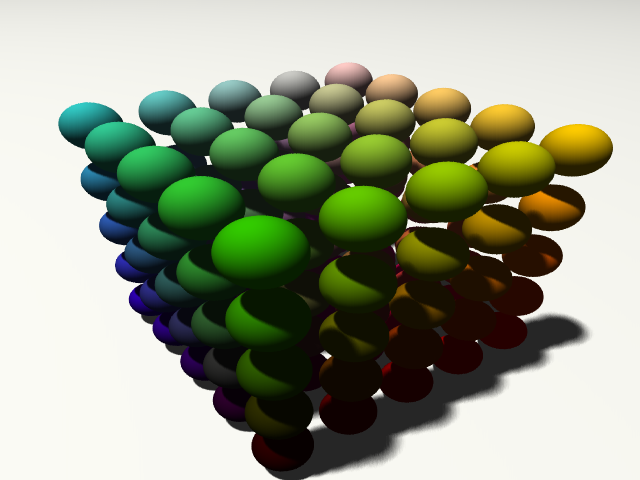
(both examples use 16x oversampling)
###Tests
I initially tried to get a full unit test framework up and running with the
Google C++ testing framework. But I
ended up going round in circles chasing compiler errors, so for the moment I'm
going with assert()s, which makes me unhappy but at least gets me far enough
to be able to write tests.
2016 note: I'd use Catch for this now