Document the component package for users and maintainers#68
Merged
Conversation


Owner
Author
|
Extended the package overview (
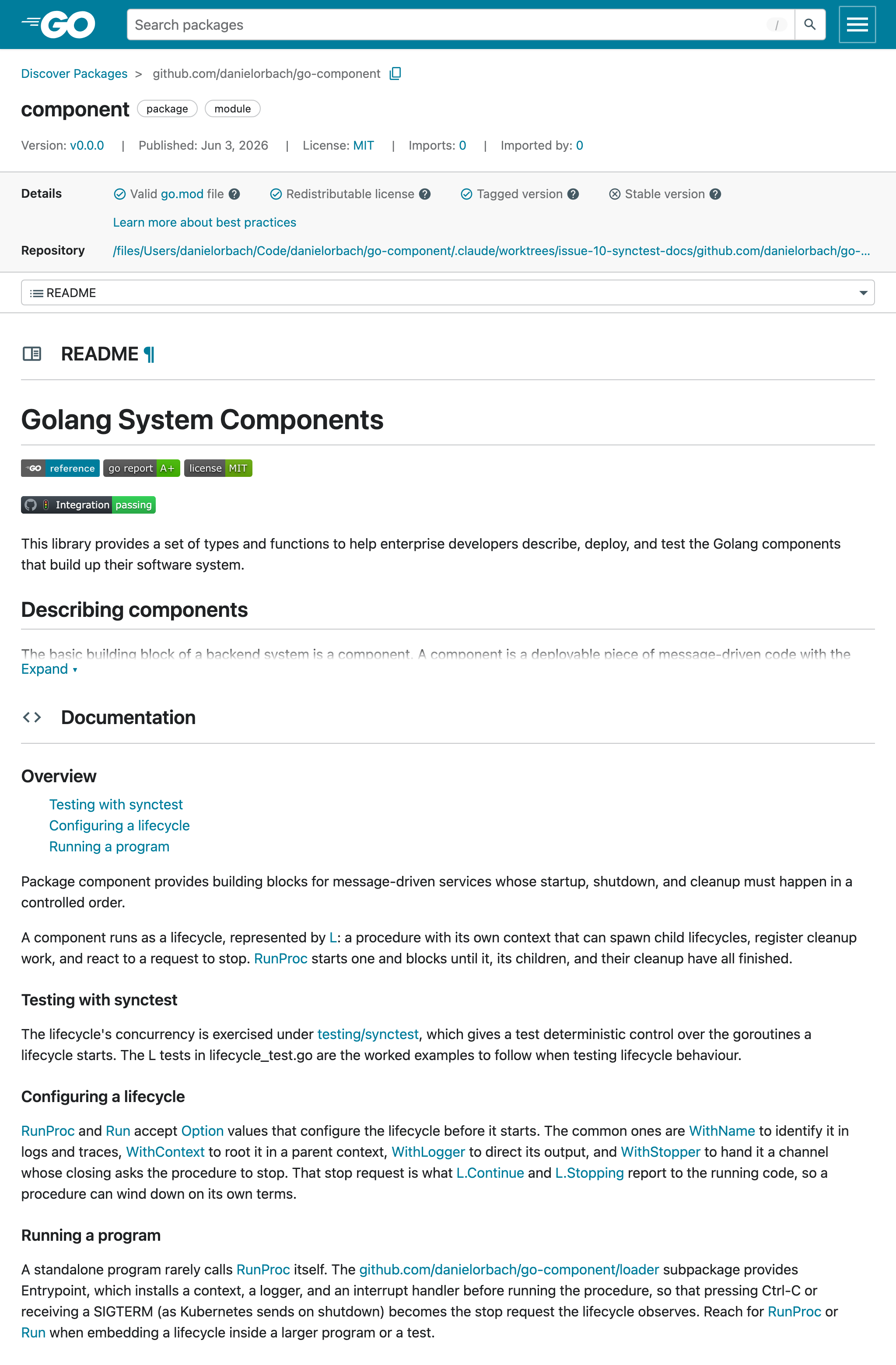
Here is the current pkgsite render, with the in-package symbols resolving to links:
|
danielorbach
added a commit
that referenced
this pull request
Jun 3, 2026
 danielorbach
force-pushed
the
issue-10-synctest-docs
branch
from
danielorbach
force-pushed
the
issue-10-synctest-docs
branch
from
a65d72f to
e61e661
Compare

The package shipped without an overview, so pkg.go.dev showed no
description at all. This adds a short one: what the package provides, how a
lifecycle runs, and where to look (lifecycle_test.go) for the synctest tests
that exercise its concurrency.
A newcomer needs a concrete reference for the shape of a component that
stops on request: the work loop selecting between its own progress and
L.Stopping, and the stopper channel that a program wires to an interrupt
signal.

The example prints fixed start and stop lines rather than a count of work
iterations that depends on timing, so its output is deterministic and the
test runner executes and verifies it in a few milliseconds.
The lifecycle suite depends on testing/synctest for deterministic
concurrency tests. This points contributors at that harness and at
lifecycle_test.go as the pattern to follow when adding such tests.
The example selected over a 1ms work timer and L.Stopping, printing its
shutdown line only on the Stopping branch. When both branches were ready at
once - the normal state on a contended runner whose coarse timer had already
expired by the time the goroutine was scheduled - select chooses a branch
uniformly, so the shutdown line was dropped about half the time and the
verified output failed. CI hit this on the oldstable runner; a forced-
coincidence harness reproduced the skip at ~51%.

The loop now has a single exit: it runs until l.Continue() reports the stop
request, and the shutdown line prints once after the loop. With no select and
no work timer there is no second branch to race, so the output is identical on
every run. The loop body, left as a comment, is where a real component does
its work.
Each method now carries its own runnable example, so it renders on that
method's entry on pkg.go.dev: ExampleL_Continue under Continue and
ExampleL_Stopping under Stopping. The two cover the distinct ways a procedure
observes a stop request: a work loop that checks Continue between units, and a
procedure with nothing to poll that blocks on the Stopping channel.

This replaces the single package-level graceful-shutdown example, which showed
only the loop. Both keep the single linear exit that makes their output
deterministic, and the example comments describe the scenario rather than
opening with the function name.
Point new readers from the package overview to the Option values that
configure a lifecycle (WithName, WithContext, WithLogger, WithStopper) and
to the loader subpackage's Entrypoint, which turns an OS interrupt into the
stop request the running procedure observes.
The component package's overview now points readers here for running a
program, so give loader an overview of its own around Footprint, Load,
and Entrypoint, and document the entry-point functions that hand the
main goroutine to a lifecycle.
The overview already mentions Entrypoint by name; turn the loader
reference into a documentation link so readers can reach the subpackage
directly. The link uses the full import path because component cannot
import loader without creating an import cycle, and a relative link in a
doc comment does not render.
The testing guidance previously trailed the program section as a single
sentence. Give it a named section near the top of the overview so the
synctest harness is visible to maintainers before the usage sections,
and expand it to say what synctest buys a lifecycle test.
Use a repository-relative target so the link resolves to the file on
both GitHub and pkgsite without pinning a host or a branch.
danielorbach
force-pushed
the
issue-10-synctest-docs
branch
from
6428891 to
3ddcec3
Compare


This file contains hidden or bidirectional Unicode text that may be interpreted or compiled differently than what appears below. To review, open the file in an editor that reveals hidden Unicode characters.
Learn more about bidirectional Unicode characters
Sign up for free
to join this conversation on GitHub.
Already have an account?
Sign in to comment
2 participants


Add this suggestion to a batch that can be applied as a single commit.This suggestion is invalid because no changes were made to the code.Suggestions cannot be applied while the pull request is closed.Suggestions cannot be applied while viewing a subset of changes.Only one suggestion per line can be applied in a batch.Add this suggestion to a batch that can be applied as a single commit.Applying suggestions on deleted lines is not supported.You must change the existing code in this line in order to create a valid suggestion.Outdated suggestions cannot be applied.This suggestion has been applied or marked resolved.Suggestions cannot be applied from pending reviews.Suggestions cannot be applied on multi-line comments.Suggestions cannot be applied while the pull request is queued to merge.Suggestion cannot be applied right now. Please check back later.
Issue #10 migrated the lifecycle suite to
testing/synctest(#65, #67) and met every acceptance criterion but one: documenting the testing approach. The migrated suite, with the explanatory comments left at its trickier call sites, already demonstrates those patterns, so this change resists manufacturing a large documentation artifact to satisfy the checkbox and instead adds only what earns its place independently.The component package shipped without any overview, so its pkg.go.dev page showed no description at all;
doc.gonow supplies a short one and points readers atlifecycle_test.gofor the synctest tests that exercise its concurrency. A runnable graceful-shutdown example gives the package its first godoc example, showing theContinue/Stoppingidiom a component uses to stop cleanly on request. A short note in the README orients contributors to the synctest harness behind the suite.There are no production code changes. The documentation deliberately does not restate the
testing/synctestcontract, which the standard library owns and would only drift from if copied here, and it adds no separate synctest "patterns guide" because the suite itself is that guide. The example demonstrates usage rather than the test harness because a synctest-driven godoc example is impossible:synctest.Testrequires a*testing.Tthat example functions never receive.