A reconstruction and preservation project of the PLAY3 buzzer music driver originally published in Pocket Computer Journal (1993).
3-voice music from a single 1-bit buzzer on the SHARP PC-E500 (1993).
Reconstruction and historical archive of PLAY3,
a three-voice buzzer music driver for the SHARP PC-E500 pocket computer series.
PLAY3 produces three-voice polyphonic music from a single 1-bit internal buzzer
using a software mixing technique.
Originally published in:
Pocket Computer Journal — November 1993
This repository preserves both:
- the original magazine source listing
- a verified reconstructed assembly build
PLAY3 is a software music driver for the SHARP PC-E500 / PC-E550 pocket computer series.
The driver produces three-voice polyphonic music from the machine's
single internal buzzer by using precise CPU timing and rapid
time-division switching between notes.
The original program was published in:
Pocket Computer Journal – November 1993
This repository reconstructs the original assembler source code from
magazine listings and verifies the result against the historical binary.
Tested and verified on real SHARP PC-E550 hardware.
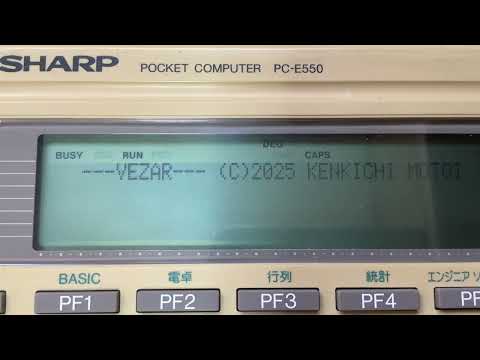
Demonstrations of music playback on the SHARP PC-E500 / PC-E550 pocket computers
using the reconstructed PLAY3 driver.
The videos show example music programs running on real hardware.
Full playlist:
https://youtube.com/playlist?list=PL0MMNZ2b8g1aup5tHZkTpCn9zczGLA3Rw
PC-E500 Pocket Computer
↓
internal 1-bit piezo buzzer
↓
PLAY2 / PLAY2L / PLAY3 driver
↓
software mixing (time-division multiplexing)
↓
3-voice polyphonic music
Example usage:
- Dash! (1994 RPG floor BGM)
- Holy Night
- SAMPLE
- VEZAR
- Bottakuri Shouten
Bottakuri Shouten was later used as background music in the PC-98 game:
Space Panicco (1994)
https://github.com/gikonekos/Space-Panicco-Archive
PLAY3 belongs to the PLAY-series buzzer music drivers, which extend the
BASIC PLAY command and allow polyphonic music on the SHARP PC-E500 series.
PLAY3 is a software routine that generates three simultaneous voices
using the internal piezo buzzer.
Since the hardware only supports a single tone output, the driver rapidly
switches between multiple note periods in a time-division manner, creating
the perception of polyphonic sound.
This technique represents a form of software sound synthesis commonly
used in Japanese pocket computer programming during the early 1990s.
PLAY3-Archive
│
├─ analysis/
│   └─ playx/
│
├─ docs/
│
├─ drivers/
│
├─ examples/
│   ├─ VEZAR/
│   ├─ botta/
│   ├─ dash/
│   ├─ holy/
│   └─ sample/
│
├─ reconstruction/
│
└─ work/
PLAYX
Keita Morita (森田敬太)
PLAY2 / PLAY2L / PLAY3
Ryu (Tatsuya Kobayashi / 小林龍也)
Project archive, and reconstruction, and examples
Kenkichi Motoi (基建吉)
Original sample music (1993)
- SAMPLE.bas — Kazusumi Matsuki (松樹一純)
Later music using PLAY-series drivers
- Dash!
- VEZAR
- Holy Night
- Bottakuri Shouten
original binary size : 1360 bytes
reconstructed build : 1369 bytes
difference : +9 bytes
Remaining difference explained by:
mml_conv routine difference : −11 bytes
beep_out3 initialization block : +28 bytes
trailing binary padding : −8 bytes
Total difference : +9 bytes
Parts of the reconstruction were assisted by AI systems used as research tools.
Claude (Anthropic)
ChatGPT (OpenAI)
Final verification and editorial decisions were performed by the repository maintainer.
This project preserves:
- original magazine publication
- reconstructed XASM source code
- example music programs
- technical analysis of the driver
as documentation of buzzer-based polyphonic music systems on pocket computers.
During the late 1980s and early 1990s, Japanese pocket computers such as the
SHARP PC-E500 were widely used by hobbyist programmers and magazine readers.
Because these machines only provided a single 1-bit internal buzzer,
polyphonic music was normally impossible on the hardware.
Drivers such as PLAY2 / PLAY2L / PLAY3 solved this limitation by using
precise CPU timing and rapid time-division switching between note periods,
creating the perception of multiple simultaneous voices.
This technique represents an early form of software sound synthesis on
limited hardware, similar in spirit to software audio techniques used on
other contemporary systems.
Programs like PLAY3 illustrate an important aspect of the Japanese
microcomputer hobbyist culture of the period:
- magazine-published program listings
- reader reconstruction and experimentation
- creative techniques to overcome hardware limitations
By reconstructing and verifying the original assembler source code,
this archive preserves both the technical implementation and the
historical context of buzzer-based polyphonic music systems on
Japanese pocket computers.
Expanded reconstruction and documentation.
- OCR reconstruction of the original assembly source
- Binary comparison with the original program
- Restoration of Japanese comments and English translation
- Technical analysis of the PLAY3 driver
- Magazine article transcription (Japanese / English)
- OCR reconstruction of the example music program
- Real hardware demonstration videos
Initial public archive release of PLAY3.
Building Rescue Archive https://github.com/gikonekos/Building-Rescue-Archive
Space Panicco Archive
https://github.com/gikonekos/Space-Panicco-Archive