Spine curves are piecewise polynomial (parametric) curves, used for interpolation, curve fitting, and data smoothing.
Spliny is a (tiny) pure Rust library for using spline curves, based a spliny's knots and control points in SplineCurve<K,N>,
and to plot splines --currently limited to 1 and 2D splines-- to check the results.
It does not fit spline functions to data-sets: see the Splinify-crate for that purpose.
Get a spline curve for a Lissajous-dataset, with plot and JSON representation:
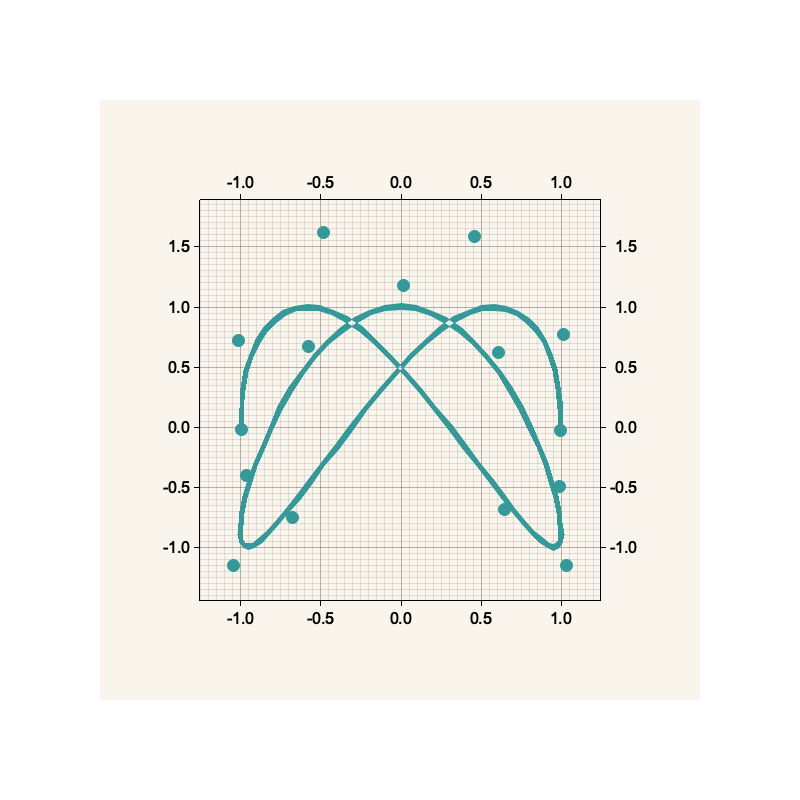
use splinify::{CubicSplineFit2D, Result};

fn lissajous(t:f64, a: f64, kx: f64, b: f64, ky: f64) -> [f64;2] {
    [
        a * (kx * t).cos(),
        b * (ky * t).sin()
    ]
}

fn main() -> Result<()> {

    // Generate Lissajous data points, with angle parameter `u`
    // ranging from 0 to 180º, with 1º-steps.
    let u: Vec<f64> = (0..=180u32).into_iter().map(|v|(v as f64).to_radians()).collect();
    let xy: Vec<f64> = u.iter().flat_map(|t|lissajous(*t,1.0, 3.0, 1.0, 5.0)).collect();

    // fit Cubic Spline with Splinify's CubicSplineFit
    let s = CubicSplineFit2D::new(u, xy)?.smoothing_spline(5e-3)?;

    // Output fit results as JSON file and plot
    println!("{}", serde_json::to_string_pretty(&s)?);
    s.plot_with_control_points("lissajous.png", (800,800))?;

    Ok(())
}
And here is its associated `Spliny`` JSON representation
{
  "t": [
    0.0, 0.0, 0.0, 0.0, 0.4014257279586958, 0.7853981633974483,
    0.9948376736367679, 1.1868238913561442, 1.3788101090755203,
    1.5707963267948966, 1.7802358370342162, 1.9722220547535925,
    2.1642082724729685, 2.356194490192345, 2.7576202181510405,
    3.141592653589793, 3.141592653589793, 3.141592653589793,
    3.141592653589793
  ],
  "c": [
    0.9961805460172887, 1.01581609212485, 0.45785551737300106,
    -0.6743400479743561, -1.04606086926188, -0.9655723250526262,
    -0.5757280827332156, 0.017487591989126007, 0.610401362313724,
    0.9866605336566671, 1.0335232431543322, 0.6453772441164307,
    -0.4846359310719992, -1.014195365951515, -0.9964502165043656,
    -0.027374797128379907, 0.770580186441133, 1.5844468932141083,
    -0.7504988105159386, -1.1533053154158592, -0.39940623356854926,
    0.669953241001308, 1.1822672685309246, 0.6182210556297563,
    -0.493261782484514, -1.1530136311265229, -0.6885569654105621,
    1.6217843337199846, 0.7207977628265237, -0.02317389641793977
  ],
  "k": 3,
  "n": 2
}Here a Cubic Spline is constructed from 4 control points:
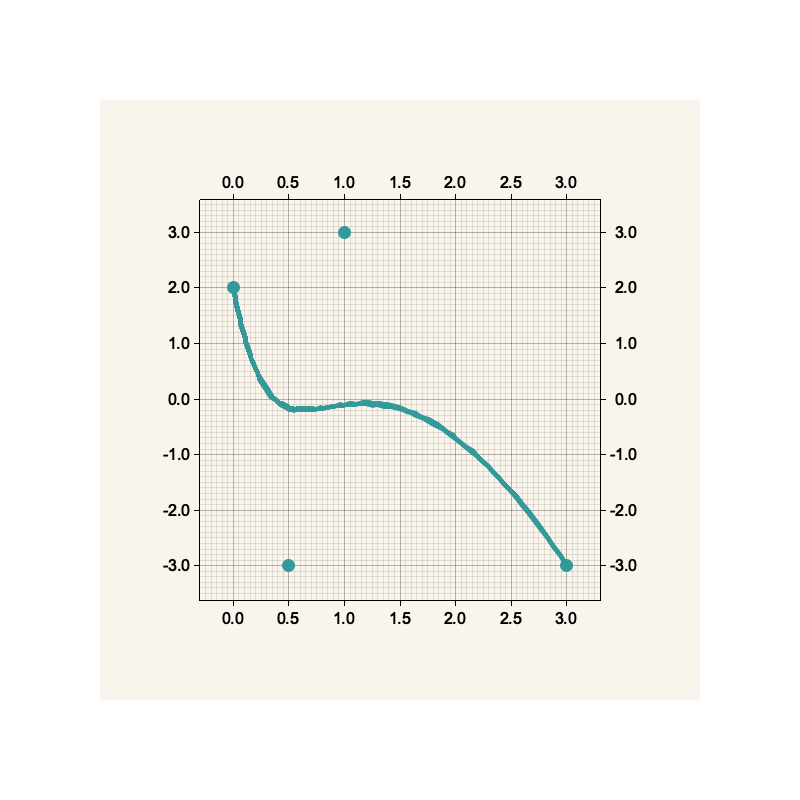

use spliny::{CubicSpline2D, Result};

pub fn main() -> Result<()> {

    let spline = CubicSpline2D::new(
        vec![1.0, 1.0, 1.0, 1.0, 2.0, 2.0, 2.0, 2.0],
        vec![0.0, 0.5, 1.0, 3.0, 2.0, -3.0, 3.0, -3.0]
    );

    spline.plot_with_control_points("cubic2d.png", (800,800))?;

    Ok(())
}
The control points are four control points: (0,2), (.5,-3), (1,3), and (3,-3), and the curve has 8 knots.
Spliny is developed as part of a family of three crates but can be used independently too:
-
splinify fits (non-uniform) B-Spline curves to input data, and results in a fitted as a
spliny-crateCurveSpline. Data inputs arexandyvectors for 1-dimensional curves, anduandxynvectors in case of N-dimensional curves. -
Use spliny to to use the generated splines, for example, to calculate curve coordinates or spline curves derivatives. This package also implements basic tools for the input and output of spline representations in JSON files and spline plots. It is written in Rust and does not require a Fortran compiler.
-
dierckx-sys contains Fortran foreign function interfaces to Paul Dierckx' FITPACK library. It is used by
splinify, but ---unless you want to explore Paul Dierckx library yourself--- can be ignored as concerned to usingsplinifyandspliny.
To use this library, add this to your Cargo.toml file:
[dependencies]
spliny = "0.3"The base spline representation in Spliny is the SplineCurve<K,N> object ---a wrapper for a vector of knots, and
fit coefficients--- with K the spline degree, N the space dimension of the curve spline.
For convenience, the following aliases have been defined:
| Alias | K | N |
|---|---|---|
LinearSpline |
1 | 1 |
CubicSpline |
3 | 1 |
QuinticSpline |
5 | 1 |
LinearSpline2D |
1 | 2 |
CubicSpline2D |
3 | 2 |
QuinticSpline2D |
5 | 2 |
LinearSpline3D |
1 | 3 |
CubicSpline3D |
3 | 3 |
QuinticSpline3D |
5 | 3 |
All content ©2022 Harbers Bik LLC, and licensed under either of
- Apache License, Version 2.0 (LICENSE-APACHE or http://www.apache.org/licenses/LICENSE-2.0)
- MIT license (LICENSE-MIT or http://opensource.org/licenses/MIT?)
at your option.
Unless you explicitly state otherwise, any Contribution intentionally submitted for inclusion in the Work by you, as defined in the Apache-2.0 license, shall be dual licensed as above, without any additional terms or conditions.