

PyGTide is a Python module that computes gravitational tides on Earth. It wraps ETERNA PREDICT 3.4 — the classic Fortran 77/90 code by the late Prof. H.-G. Wenzel (Wenzel, 1996), updated with the KSM03 tidal catalogue by Kudryavtsev (2004) — compiled into a Python extension using f2py. The original Fortran code was comprehensively revised for the Python integration, and significant bugs were identified and repaired (see the CHANGELOG).
- Computes 11 tidal components: tidal potential, gravity, tilt, vertical/horizontal displacement, and vertical/horizontal/areal/shear/volume strain
- Choice of 8 tidal potential catalogues, up to Kudryavtsev KSM03 with 28,806 waves (~0.025 nGal accuracy)
- Pole-tide and length-of-day (LOD) corrections based on IERS Earth orientation data
- Results returned as a time-stamped pandas DataFrame in UTC
- Fast f2py-compiled Fortran core with a convenient Python class interface
- Pre-compiled wheels for Linux, macOS and Windows — no Fortran compiler required
| Document | Contents |
|---|---|
| Installation | Prerequisites and step-by-step setup |
| Quickstart | The fastest way to a first result |
| Usage Guide | Core features, class API and worked examples |
| Configuration | All parameters, keywords and data files |
| Background | Earth tides, time scales, catalogues and output conventions |
| Troubleshooting | Common errors, FAQs and solutions |
pip install pygtidefrom pygtide import predict_series
# latitude, longitude, height, startdate, duration [h], samprate [s]
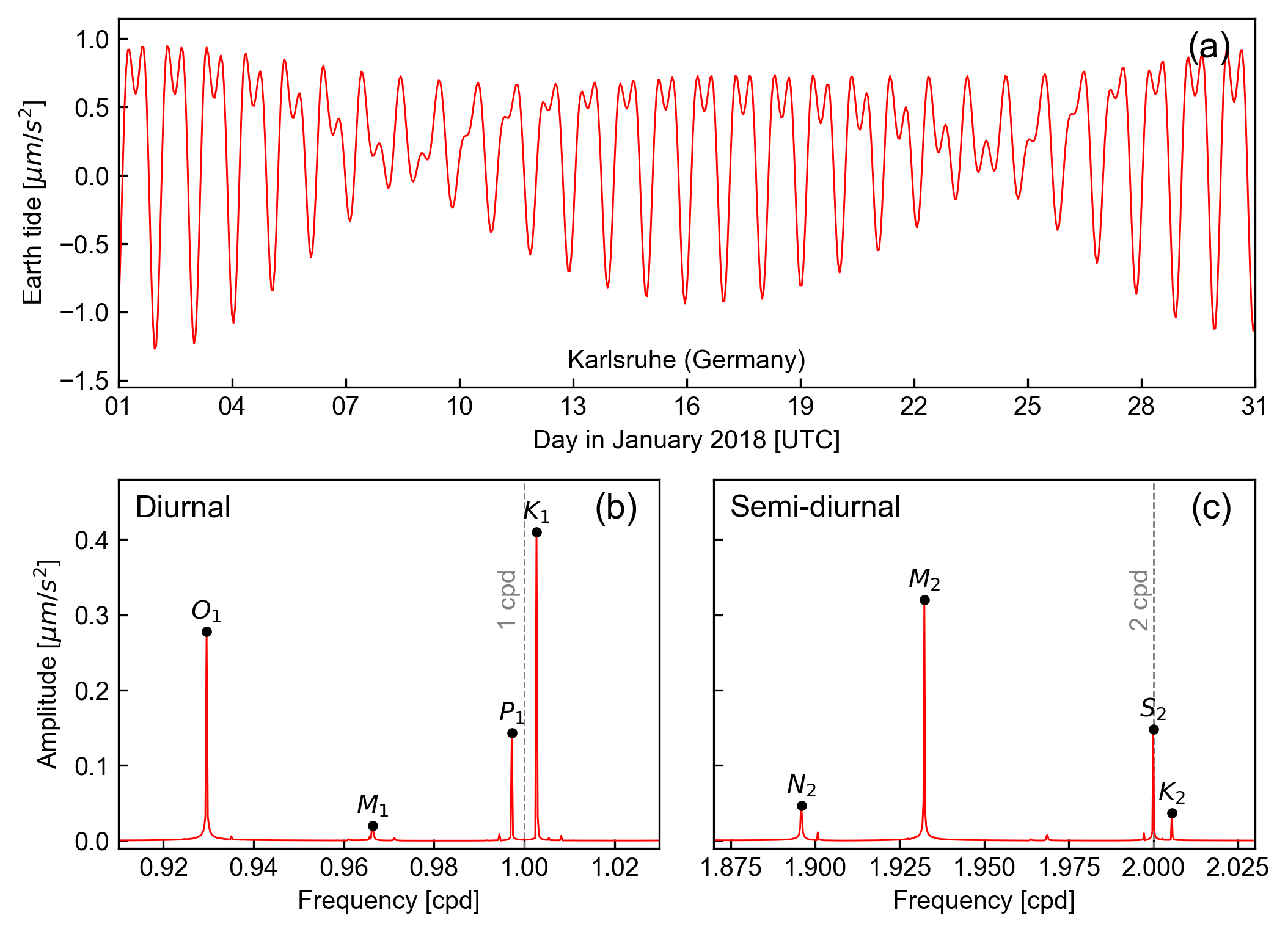
args = (49.00937, 8.40444, 120, '2018-01-01', 24 * 7, 3600)
series = predict_series(*args)Important
By default, gravity, potential and tilt outputs are rigid-Earth (geometric) tides, while displacement and strain outputs are body tides (Love numbers applied). Read Background — Absolute scale of the output before interpreting amplitudes.
You can also use PyGTide through the online app here: groundwater.app
If you use PyGTide, please cite the work as:
Gabriel C Rau, Eulenfeld, T., Miller, C. (2026). hydrogeoscience/pygtide: PyGTide v0.9.1 (Version v0.9.1) [Computer software]. Zenodo. https://doi.org/10.5281/zenodo.21483314
- Hartmann, T., and H.-G. Wenzel (1995), The HW95 tidal potential catalogue, Geophysical Research Letters, 22(24), 3553–3556, https://doi.org/10.1029/95GL03324.
- Kudryavtsev, S. M. (2004), Improved harmonic development of the Earth tide-generating potential, Journal of Geodesy, 77(12), 829–838, https://doi.org/10.1007/s00190-003-0361-2.
- Wenzel, H.-G. (1996), The nanogal software: Earth tide data processing package ETERNA 3.30, Bulletin d'Informations des Marées Terrestres, 124, 9425–9439.
- McMillan, T. C., Rau, G. C., Timms, W. A., and Andersen, M. S. (2019), Utilizing the impact of Earth and atmospheric tides on groundwater systems: A review reveals the future potential, Reviews of Geophysics, https://dx.doi.org/10.1029/2018RG000630.
PyGTide is released by Gabriel C. Rau, Tom Eulenfeld and Craig Miller under the Mozilla Public License 2.0.