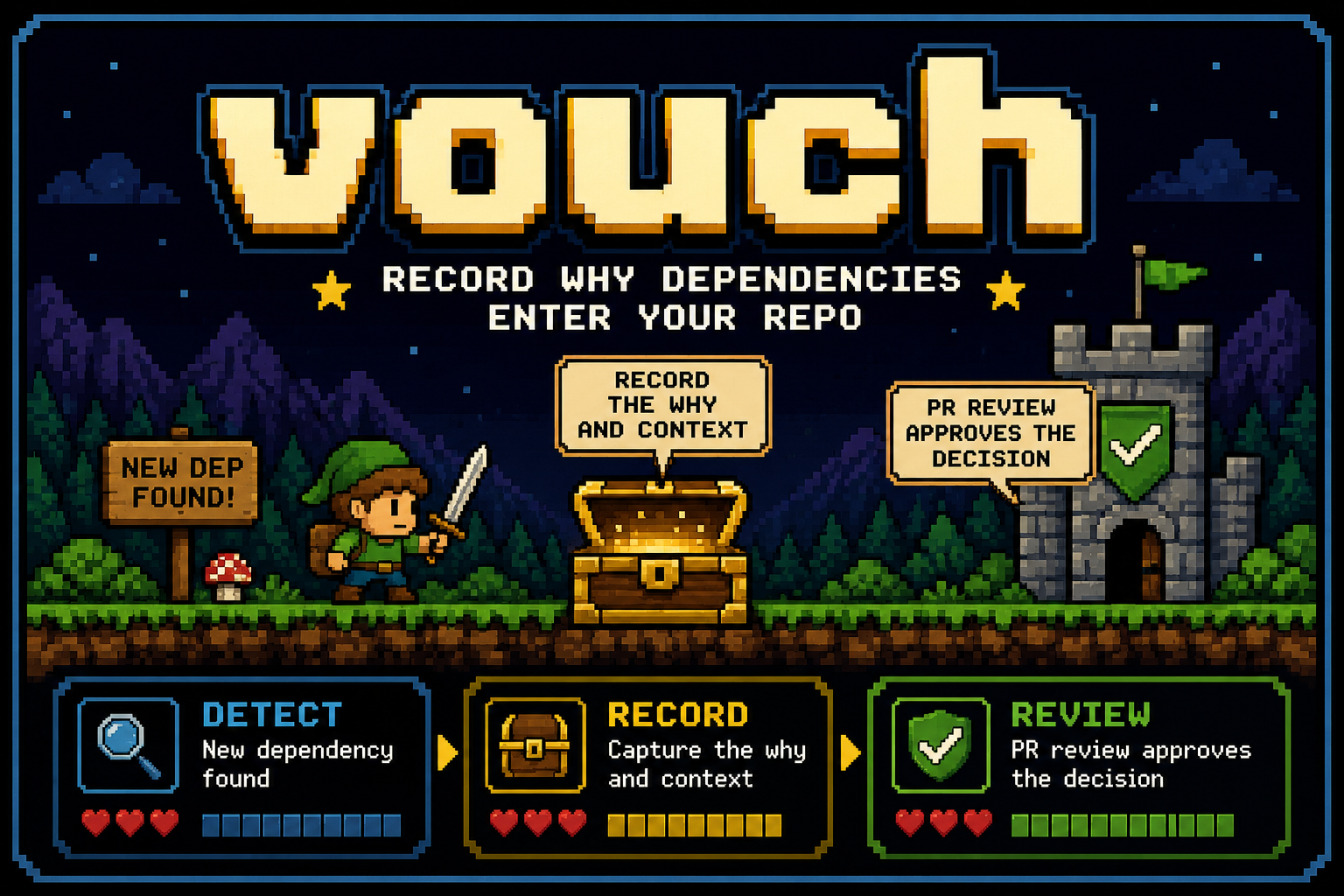
A dependency-decision ledger for Node.js projects and coding agents.
It doesn't prevent the bypass. It makes the bypass impossible to hide.
vouch doesn't decide whether a dependency is safe. It makes sure every dependency that
enters your repo was recorded, explained, and reviewable in the pull request — a memory
and conscience for your package.json.

- The idea
- What you'll see
- Quick start
- How it works
- vouch records; the PR review approves
- When
checkblocks on a CVE - Commands
- Configuration
- For coding agents
- What it is not
- Every dependency is a decision. Adding one should be recorded — with who and why — not slipped into a lockfile diff nobody reads.
- The record lives in your repo. Decisions go into a committed ledger
(
.security/dependency-approvals.json), visible in the PR diff and auditable forever. - The record stays honest over time. When a dependency you recorded later gains a known advisory, or its version drifts from what was reviewed, CI surfaces it until a human re-decides.
A dependency added without vouch fails CI:
✦ vouch  Dependency review failed

  - axios: missing ledger entry

  Next — record the unrecorded dependency:
    vouch axios
Adding one with vouch records the decision (and blocks risky packages until you say why):
✦ vouch  Dependency needs review

  esbuild@0.28.0
  - install-time script detected: postinstall

  Next:
    vouch esbuild --force-with-reason "<why this dependency is needed>"
Once recorded, the ledger entry travels with the diff and CI is green:
✦ vouch  Dependency review passed

  All dependencies are recorded.
Requirements: Node.js 18+. No other dependencies.
Install — run on demand with npx, or install the CLI globally:
npx @vouchjs/vouch --help     # no install
npm install -g @vouchjs/vouch # or install the `vouch` command
Bootstrap the config (optional, recommended) — one command, never overwrites:
vouch init # writes vouch.config.{mjs,js} with all defaults shownThat gives you a typed config (Playwright-style): every option visible with its default, ready to be edited. Delete the keys you're happy with and vouch will pick up future defaults; change the ones you're not.
For full editor autocomplete + type errors on the generated config, also install vouch as a dev dependency so its types are reachable from your project:
npm install -D @vouchjs/vouchvouch init detects whether vouch is in your node_modules and writes the appropriate
variant — import { defineConfig } from "@vouchjs/vouch" when installed, a JSDoc-typed plain export
when not. Either variant loads at runtime; only the editor experience differs.
Add a dependency — instead of npm install / pnpm add, run:
vouch some-package        # reviews, installs, and records the decision
vouch some-package -D     # devDependency
Gate it in CI — add one step that fails the build on any unrecorded dependency. Drop this
in .github/workflows/vouch.yml (also in examples/github-actions-check.yml):
name: vouch
on: [pull_request]
jobs:
  vouch:
    runs-on: ubuntu-latest
    steps:
      - uses: actions/checkout@v4
      - uses: actions/setup-node@v4
        with: { node-version: 20 }
      - run: npx @vouchjs/vouch check
That's it. A raw npm install <pkg> (by a human or an agent) can no longer reach main
unrecorded. A fresh clone is unaffected — npm install / npm ci restores the lockfile as
usual, and check passes because the committed ledger already covers every dependency.
When you add a package (vouch <pkg>):
- Reviews it: version age and install-time scripts (blocked by default).
- Warns you right then if the version already has a known CVE — so
checkis never the first messenger. Configurable:cveAtInstall: "warn"(default),"block"(refuse to install advisories at or abovecveAtInstallMinSeverity, default"high"), or"off". - Installs it and records the decision (version, risk, who added it and why) in the ledger.
In CI (vouch check) — three states per dependency: recorded (ok), unrecorded
(blocked), or needs review (blocked). It fails when:
- a direct dependency in
package.jsonhas no ledger entry — added withoutvouch(coversdependencies,devDependencies, andoptionalDependencies;peerDependenciestoo whencheckPeerDependenciesis enabled); - a dependency gained a CVE that no human has acknowledged;
- a high-risk entry has no
reasonrecorded for the reviewer to judge; - version drift — a recorded version no longer satisfies the
package.jsonrange (versionDrift:"warn"by default,"block", or"off"; direct deps, compared against the range, no lockfile); - pinning — an opt-in
requirePinned("warn"/"block", default"off") flags deps that use a range instead of an exact version, suggesting the recorded version to pin to.
Scope:
vouch checkgoverns thepackage.jsonin the directory it runs from, coveringdependencies,devDependencies, andoptionalDependencies(pluspeerDependencieswhencheckPeerDependenciesis on). Monorepos: it does not yet walk workspace manifests — runcheckper workspace for now; first-class workspace support is on the roadmap.
This distinction is the heart of the tool:
- vouch records a decision. The ledger entry — who added it (
addedBy, fromgit config), why (reason), at what version and risk — is attribution. It's self-asserted, not by itself an authorization. - The PR/MR review is the authorization. A human approving the pull request, with the ledger entry visible in the diff, is the act that approves. vouch makes the decision conscious and reviewable; it doesn't try to verify or replace that review.
You can always force a thing through with --force-with-reason. You can never do it
invisibly — the reason and your identity land in the committed ledger, in front of the
reviewer. See THREAT_MODEL.md for what vouch does and does not
defend.
A block isn't damage — it's a pause: something about a dependency you recorded changed. Three honest options, in order of preference:
- Fix it —
vouch <pkg>@<patched-version>to record a fixed release. - Remove or replace it — drop the dependency, or swap in a lighter one.
- Accept it knowingly — once you've judged the risk acceptable (dev-only, unreachable
code path, no fix yet),
vouch acknowledge <pkg> --reason "<why this is acceptable>".
acknowledge re-queries advisories for the recorded version and records the acknowledged set,
who acknowledged it (from git config), why, and when — visible in the PR diff. It refuses to
write while offline (we never record an acknowledgement we couldn't verify), and it blocks only
on a CVE it confirmed: offline or a stalled endpoint fails open (a warning, never a failed
build), and only the specific dependency that drifted — never your whole project.
| Command | What it does |
|---|---|
vouch <pkg> [-D] |
Review, install, and record a dependency (-D for devDependencies). |
vouch <pkg> --force-with-reason "<why>" |
Override a block, recording the reason in the ledger. |
vouch check |
CI gate: fail on unrecorded deps, unexplained high-risk, CVE drift, or version drift. |
vouch acknowledge <pkg> --reason "<why>" |
Knowingly accept a dependency's current advisories (CVE drift). |
vouch init |
Bootstrap vouch.config.{mjs,js} with all defaults shown + detected packageManager. Refuses to overwrite. |
vouch --help · vouch --version |
Help (with the wordmark) and version. |
Environment: VOUCH_ADVISORY_URL overrides the npm advisory endpoint (for enterprise mirrors/proxies).
The preferred form is a typed config — vouch.config.{ts,mjs,js,cjs} — exporting a
defineConfig() call. Every key is optional; the defaults flow through. Generate one with
vouch init:
// vouch.config.mjs (or .js if your project has "type": "module" — vouch init picks correctly)
import { defineConfig } from "@vouchjs/vouch";

export default defineConfig({
  packageManager: "auto",            // "auto" | "pnpm" | "npm" | "yarn"
  allowScopedPackages: [],

  // Install-time gate
  minimumVersionAgeHours: 24,
  warnVersionAgeHours: 168,
  blockInstallScripts: true,
  requireCooldownConfigured: false,

  // CI gate — `vouch check`
  versionDrift: "warn",              // "warn" | "block" | "off"
  requirePinned: "off",              // "warn" | "block" | "off"
  checkPeerDependencies: false,      // also gate peerDependencies (prod/dev/optional always gated)

  // CVE handling at add time
  cveAtInstall: "warn",              // "warn" | "block" | "off"
  cveAtInstallMinSeverity: "high",   // "low" | "moderate" | "high" | "critical"
});
Runtime validation still fires (a typo'd enum value fails loudly instead of silently downgrading a gate).
To make import { defineConfig } from "@vouchjs/vouch" resolve and light up editor autocomplete on the
config, vouch needs to be in your project's node_modules:
npm install -D @vouchjs/vouchvouch init detects this automatically and writes the appropriate variant:
| State | Generated config |
|---|---|
@vouchjs/vouch in your node_modules |
import { defineConfig } from "@vouchjs/vouch"; export default defineConfig({ ... }) — full editor types via the bundled .d.ts |
@vouchjs/vouch not installed locally |
/** @type {import("@vouchjs/vouch").Config} */ export default { ... } — no runtime import, loads anywhere; types light up the moment you npm install -D @vouchjs/vouch |
Both variants load at runtime; only the editor experience differs.
vouch.config.ts works on Node 23+ (or 22.6+ with --experimental-strip-types). For older
Node, write .js/.mjs/.cjs — vouch loads any of them via dynamic import().
packageManager: "auto" reads the Corepack packageManager field from package.json first,
then sniffs lockfiles (pnpm-lock.yaml → yarn.lock → package-lock.json), then falls back
to npm.
Existing projects with a .safe-dep.json keep working (vouch reads it when no
vouch.config.* is present). Editor autocomplete via JSON $schema is also supported —
point at schema.json in the repo. New projects should prefer
vouch.config.{ts,mjs,js}.
AGENTS.md tells agents to use vouch instead of raw installs, to explain why a dependency
is needed before adding it, and — crucially — not to silence the gate on a human's behalf.
As agents add more dependencies, the ledger becomes the place a human reviews those decisions,
asynchronously and accountably.
Not a scanner. Deep per-package analysis (typosquatting, behavioral) is the job of tools like
npq and Socket. We don't scan for CVEs to discover them — we record the advisory posture of
what you recorded and flag drift after the fact. vouch owns provenance and enforcement.
Not a replacement for your package manager's native defenses, either. Modern versions ship
install-time gates — pnpm's minimumReleaseAge (default on in pnpm 11), Yarn's
npmMinimalAgeGate, npm's release-age controls. vouch complements them: those gate what
installs; vouch records who decided, and why, where the PR can see it — the one thing none of
them do. On package-manager versions without those defaults (e.g. pnpm 9), vouch's install-time
review is the gate you'd otherwise lack.
"dependencies": {}. Built on Node 18+ built-ins. A dependency-security tool with no
dependencies of its own.