


A patent draft checker that runs entirely in your browser — pure Python analysis engine compiled to WebAssembly via Pyodide.
No account. No install. No upload.
158 checks against USPTO MPEP, EPO Guidelines, CNIPA 审查指南, and TIPO 專利審查基準, covering U.S., European (EPC), Chinese, and Taiwanese patent application drafts. Your file never leaves your device — verifiable in airplane mode.
- Check catalog: 43 U.S. + 37 EPC + 35 CN + 43 TW = 158 deterministic checks; per-jurisdiction breakdown in CHECKS.md
- 2560 tests passing on every commit; full pytest + ruff gate in CI
- 6 UI languages (English, German, Traditional + Simplified Chinese, Japanese, Korean) with locale-aware PDF generation
- Walker confidence signals distilled offline from small sklearn classifiers + cloud-LLM ensemble judging on a public granted-patents corpus; the runtime is pure deterministic Python with no model file or AI inference
- Source-available under PolyForm-Strict-1.0.0 — free for individuals and for organizations evaluating the tool; commercial licensing handled on inquiry (see Terms § 4)
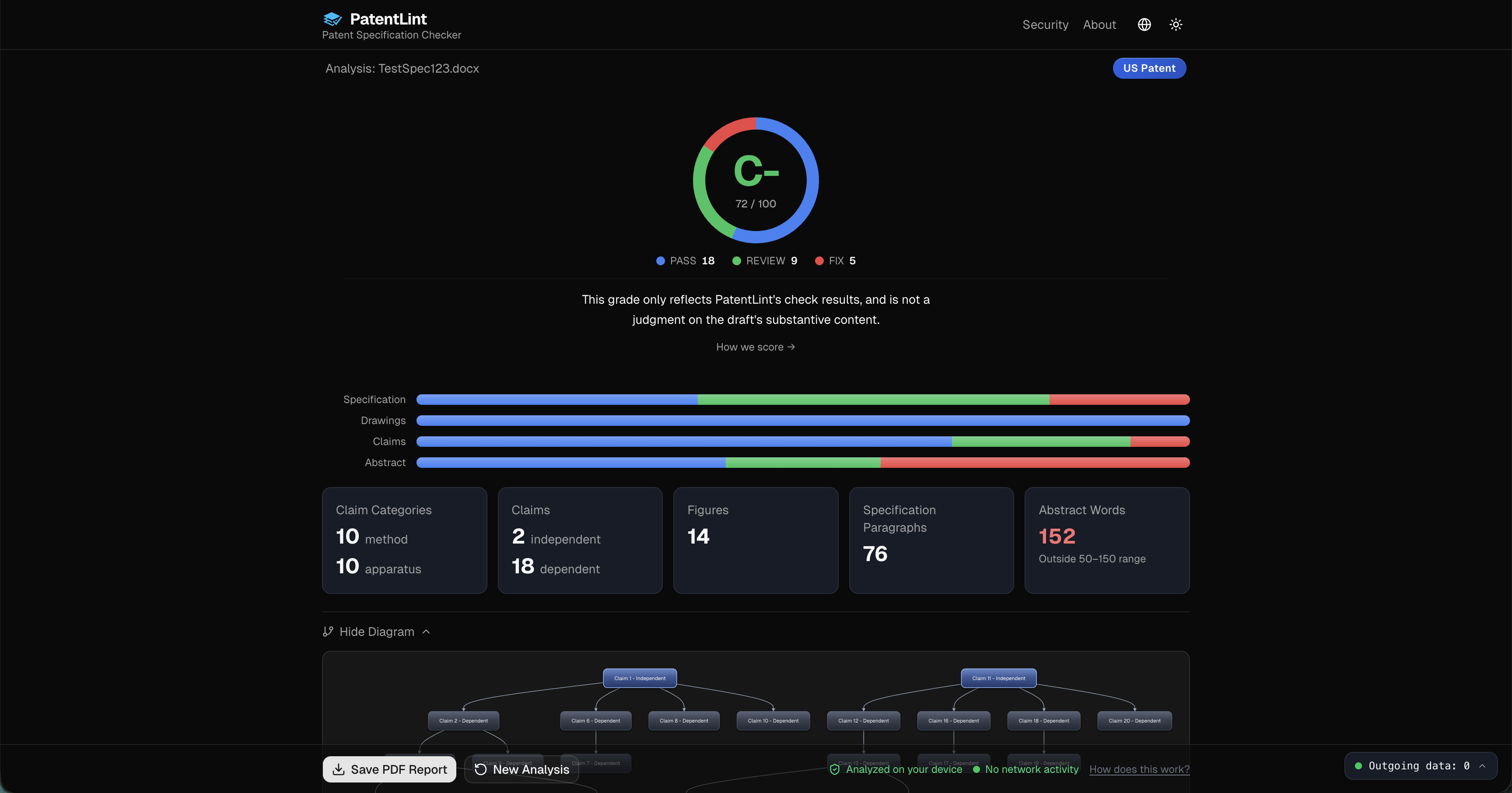
Your documents never leave your browser — verifiable in airplane mode.
- Drop a patent draft into the browser (.docx for US/TW/EPC, .docx/.xml/.zip for CN)
- Analyze — 158 checks run instantly via WebAssembly (no server, no upload)
- Report — download a PDF or copy a summary to clipboard
PatentLint's analysis engine is compiled to WebAssembly and runs entirely in your browser tab. No server receives your file. No network requests are made during analysis.
You don't have to take our word for it. Turn on airplane mode after your first visit, drop a file, and watch it work. See the proof →
158 automated checks across four jurisdictions, each classified as PASS, REVIEW, or FIX.
EPC support is v1 beta. The full 34-check EPC catalog runs end-to-end via CLI and REST API. The frontend jurisdiction picker integration shipped 2026-05-11; real-corpus FP tuning calibrated against 174 EP-A1 drafts pulled via the EPO OPS API.
| Section | Checks | Reference |
|---|---|---|
| Specification | Required sections, paragraph numbering, restrictive wording, sequence listing, prior art citations, figure cross-reference consistency | MPEP § 608.01(a)(m)(p), § 2173.01 |
| Drawings | Figure count, sequential numbering, single-figure format, prior art labeling, reference numeral consistency (spec ↔ drawings) | MPEP § 608.02 |
| Claims | Numbering, dependencies, periods, punctuation, indefinite terms, transitional phrases, means-plus-function (§ 112(f)), antecedent basis (§ 112(b)), preamble consistency (§ 112(d)), specification support (§ 112(a)), claim similarity, special formats (Jepson / CRM / Markush / omnibus), excess-claims fee threshold (37 CFR 1.16(h)/(i)) | 35 U.S.C. § 41(a)(2), § 101, § 112; 37 CFR 1.16; MPEP § 2117–2173 |
| Abstract | Word count (50–150), single paragraph, legal phraseology, implied phrases, self-praising language | MPEP § 608.01(b) |
| Section | Checks | Reference |
|---|---|---|
| Specification | Required sections, section ordering (Rule 42(1) sub-section order), paragraph numbering (advisory), paragraph ending, title required, title content (no trademarks / model numbers), figure-reference consistency, reference-numeral consistency, claim-reference-in-spec | Art. 78 + Rule 41 + Rule 42 + Rule 43(7) + Rule 46(2)(h) EPC; Guidelines F-II § 4 + F-IV § 4.3 |
| Drawings | Figures sequential, single-figure label, prior-art labeling, figure count | Rule 46(2)(a) + Rule 46(2)(h) EPC; Guidelines F-V § 1.2 |
| Claims | Sequential numbering, dependency format, self/forward dependency, single sentence per claim, reference signs in parens, subject consistency, transitional phrase, claim-spec reference, multi-dep on multi-dep, Markush format, independent-claim count per category, two-part form (advisory), antecedent basis — Art. 84 walker, specification support — Art. 84 walker, restrictive absolutes, claim punctuation, excess-claims fee threshold (Rule 45 EPC) | Art. 84 EPC; Rule 43 + Rule 45 EPC; Guidelines F-IV § 3.4, § 4.5, § 4.7, § 4.10, § 4.13, § 4.20 |
| Abstract | Word count (50–150), title-match, claim-reference, structure (single paragraph, no claim-style phraseology, no merit language) | Rule 47(2) EPC; Guidelines F-II § 2.3, § 2.3.3, § 2.3.5 |
| Section | Checks | Reference |
|---|---|---|
| Specification | Required sections, section ordering, paragraph numbering/ending, figure reference consistency, patent type terminology, title, claim references in spec | 专利法实施细则 §17, 审查指南 |
| Claims | Sequential numbering, dependency format, self/forward dependencies, single sentence, reference numeral parentheses, subject consistency, transition phrases, Taiwan terminology, spec/drawing references, chained multi-dependencies, dependent ordering, connection relationships, antecedent basis (BFS walker), excess-claims fee threshold (实施细则 §93 + CNIPA 收费办法) | 专利法实施细则 §22, §93; 审查指南 |
| Abstract | Character count (≤300), title match, commercial language | 专利法实施细则 §23 |
| Drawings | Figures sequential, figure count | 审查指南 |
| Section | Checks | Reference |
|---|---|---|
| Specification | Required sections, section ordering, paragraph numbering (【NNNN】 format), paragraph ending, figure reference consistency, patent type terminology (本發明 vs 本新型), title, spec-claim references, 符號說明 presence + consistency, bracket format (【】) | 專利法施行細則 §17, 專利審查基準 |
| Claims | Sequential, dependency format (§18), self / forward / circular dependency, single sentence (§18), reference numeral parens (§19), subject consistency, transition phrase (其特徵在於), CN-term contamination guard, spec/drawing refs, multi-dep on multi-dep, multi-dep alternative form, title-subject match, 符號說明 consistency, antecedent basis (先行詞) — ancestor-chain walker, specification support (說明書支持) — §26 第3項, connection relationships, 代表圖 vs 符號說明 consistency, excess-claims fee threshold (專利規費收取準則 §5) | 專利法 §26 第3項, 專利法施行細則 §17–§21, 專利規費收取準則 §5, 專利審查基準 |
| Abstract | Character count (≤250), title match, commercial language, representative drawing (代表圖) designation | 專利法施行細則 §21 |
| Drawings | Figures sequential, figure count | 專利法施行細則 §17 |
EPC English input only at v1 (DE/FR check engines deferred). The English-language jurisdiction-mismatch banner detects EPC vs US tells ("characterised in that", "any preceding claim", Article 84 citations) and routes accordingly.
Supported input: .docx for US, TW, and EPC; .docx, CNIPA filing XML (.xml), and .zip archives for CN.
Full inventory: CHECKS.md
| Tier | Analysis | Server? | Trust Model | |
|---|---|---|---|---|
| Web (default) | Pyodide/WASM in browser | pdfmake (client-side) | No — static hosting | Zero-trust: airplane mode verifiable |
| Docker | Local FastAPI | weasyprint | Yes (your machine) | On-premise — commercial deployment requires a separate license |
| Cloud API (future) | Hosted FastAPI | weasyprint | Yes (our infra) | Process + discard |
The Web tier on patentlint.com is free for individual evaluation. Building the Docker image from source for personal evaluation is permitted by the license; deploying it at a firm, company, or organization (including for client matters) requires a separate commercial license.
                         ┌──────────────────────┐
                         │   React Frontend     │
                         │  (Vite + shadcn/ui)  │
                         └─────┬──────────┬─────┘
               Web (default)   │          │   Docker / CLI
          ┌────────────────────┘          └──────────────────┐
          ▼                                                  ▼
┌──────────────────┐                              ┌──────────────────┐
│  Pyodide/WASM    │                              │  FastAPI (app.py) │
│  (in-browser     │                              └────────┬─────────┘
│   analysis)      │                                       │
└────────┬─────────┘                              ┌────────▼─────────┐
         │                                        │  pipeline.py     │
         │         ┌───────────────────────┐      │  analyze_file()  │
         └────────►│  parser/ + analysis/  │◄─────┘  analyze_bytes() │
                   │  (pure Python, zero   │      └──────────────────┘
                   │   framework deps)     │
                   └───────────────────────┘
                              │
              ┌───────────────┼───────────────┐
              ▼               ▼               ▼
    ┌──────────────┐ ┌──────────────┐ ┌──────────────┐
    │   pdfmake    │ │  weasyprint  │ │  Click CLI   │
    │ (web, client)│ │ (Docker/CLI) │ │  (cli.py)    │
    └──────────────┘ └──────────────┘ └──────────────┘
src/patentlint/
├── models.py        # Pydantic models (Claim, AnalysisResult, ReportData)
├── pipeline.py      # Analysis pipeline (zero web-framework deps)
├── cli.py           # Click CLI (analyze, batch)
├── i18n.py          # Locale bundle loader + i18next-style translator
├── parser/          # Section extraction, claim parsing, .docx/.xml/.zip loading
├── analysis/        # Rule checks (US + EPC + CN + TW) — all pure functions, independently testable
├── report/          # PDF report generation (Jinja2 + weasyprint; locale-aware)
└── api/             # FastAPI REST endpoints

frontend/
├── src/components/  # DropZone, ClaimTree, TriagePanel, Section112Container, …
├── src/lib/         # pdfExport.js (client-side PDF via pdfmake), detailsFormatter.js
├── src/pages/       # SecurityPage, AboutPage, TermsPage, PrivacyPage, RubricPage
├── src/hooks/       # usePyodide, useNetworkMonitor
└── src/i18n/        # Locale files (en, de, zh-TW, zh-CN, ja, ko) — shared with Python
The parser/ and analysis/ packages have zero framework dependencies — they run identically in Pyodide (browser), FastAPI (Docker), and Click (CLI). The same engine handles US, EPC, CN, and TW jurisdictions; pipeline.py routes to the appropriate parser and check modules.
Visit patentlint.com — nothing to install.
Prerequisites: Python 3.12+, Node.js 22+, pango (brew install pango on macOS)
# Backend
pip install -e ".[api,dev]"
pytest -v                    # 2560 tests
uvicorn patentlint.api.app:app --port 8000 --reload

# Frontend (separate terminal)
cd frontend && npm install && npm run dev
# → http://localhost:5173patentlint analyze patent-draft.docx # US (default)
patentlint analyze filing.xml --jurisdiction cn # CN filing XML
patentlint analyze tw-draft.docx --jurisdiction tw # TW .docx
patentlint analyze epc-draft.docx --jurisdiction epc # EPC English .docx (v1 beta)
patentlint analyze patent-draft.docx -o report.json # JSON to file
patentlint analyze patent-draft.docx --format pdf -o report.pdf # PDF report
patentlint analyze tw-draft.docx --format pdf --locale zh-TW -o report.pdf # Localized PDF
patentlint batch ./patents/ --output ./reports/ # Batch modeExit codes: 0 clean, 1 findings, 2 error.
docker build -t patentlint .
docker run -p 8000:8000 patentlint
# → http://localhost:8000 (web UI + API)
For evaluation. Commercial deployment of the Docker / CLI / REST API tier at a firm, company, or organization (including for client work) requires a separate license — see License.
curl -X POST http://localhost:8000/api/analyze -F "file=@draft.docx"
curl -X POST http://localhost:8000/api/analyze?format=report -F "file=@draft.docx"
curl -X POST http://localhost:8000/api/analyze/report -F "file=@draft.docx" -o report.pdf
curl -X POST "http://localhost:8000/api/analyze/report?locale=zh-TW" -F "file=@draft.docx" -o report.pdf
curl http://localhost:8000/api/health| Layer | Technology |
|---|---|
| Analysis Engine | Python 3.12 (pure functions, zero framework deps) |
| Client-Side Runtime | Pyodide 0.27.7 (CPython → WebAssembly) |
| Backend | FastAPI, Pydantic (Docker/CLI tier) |
| Frontend | React 18, Vite 6, Tailwind CSS v4, shadcn/ui |
| pdfmake (web) · weasyprint (Docker/CLI) | |
| CLI | Click |
| Testing | pytest (2560 tests) |
| CI/CD | GitHub Actions (test, lint, wheel-verify, docker) + Vercel auto-deploy |
| i18n | react-i18next (English, Deutsch, 繁體中文, 简体中文, 日本語, 한국어) — shared locale bundles across frontend + weasyprint PDF |
PatentLint's UI is available in six languages. Patent-specific terms follow official terminology from each jurisdiction's patent office.
| Language | Patent Office | Terminology Standard |
|---|---|---|
| English | USPTO + EPO | MPEP + EPC / EPO Guidelines |
| Deutsch | EPA / DPMA | EPÜ / PatG |
| 繁體中文 | TIPO (經濟部智慧財產局) | 專利審查基準 |
| 简体中文 | CNIPA (国家知识产权局) | 专利审查指南 |
| 日本語 | JPO (特許庁) | 特許・実用新案審査基準 |
| 한국어 | KIPO (특허청) | 특허·실용신안 심사기준 |
EPC drafts must be in English at v1; DE/FR EPC check engines are deferred. The jurisdiction-mismatch detector recognises EPC-specific tells ("characterised in that", Article citations, "any preceding claim") and routes accordingly.
This tool does not constitute legal advice. All findings should be reviewed by a qualified patent professional before filing.
PatentLint is source-available under PolyForm-Strict-1.0.0 — see LICENSE for the full terms.
Permitted uses:
- Reading and studying the source code
- Evaluating whether to license it ("acceptance testing")
- Personal use (for yourself, not as part of a commercial activity)
- Use by charitable / educational / public-research / public-safety / government organizations (per the license's "Noncommercial Organizations" clause)
Uses requiring a separate commercial license:
- Deploying PatentLint internally at a firm, company, or organization (including for client matters)
- Offering PatentLint as a hosted service to third parties
- Redistributing PatentLint (modified or unmodified)
- Making changes or new works based on PatentLint
The patentlint.com hosted service is free for individual evaluation. Commercial deployment or redistribution requires a separate license — contact Christopher Chen to discuss terms. See also the Terms of Service for the hosted site and the source-code license.
Copyright © 2025–2026 Christopher Chen. All rights reserved.