A quiet back-channel for long autonomous agent runs.
sottochat tails your local Claude Code, Claude app (local agent mode), and Codex session transcripts in real time, groups them into an inbox of live runs, and gives you a multilingual Q&A thread about each run — so you can understand what the agent did, discuss it in your own language, and prepare a targeted reply to paste back into the original terminal.
The name comes from sotto voce ("under the voice"): the agent monologues at full voice in the terminal; sottochat is your undertone conversation on the side.
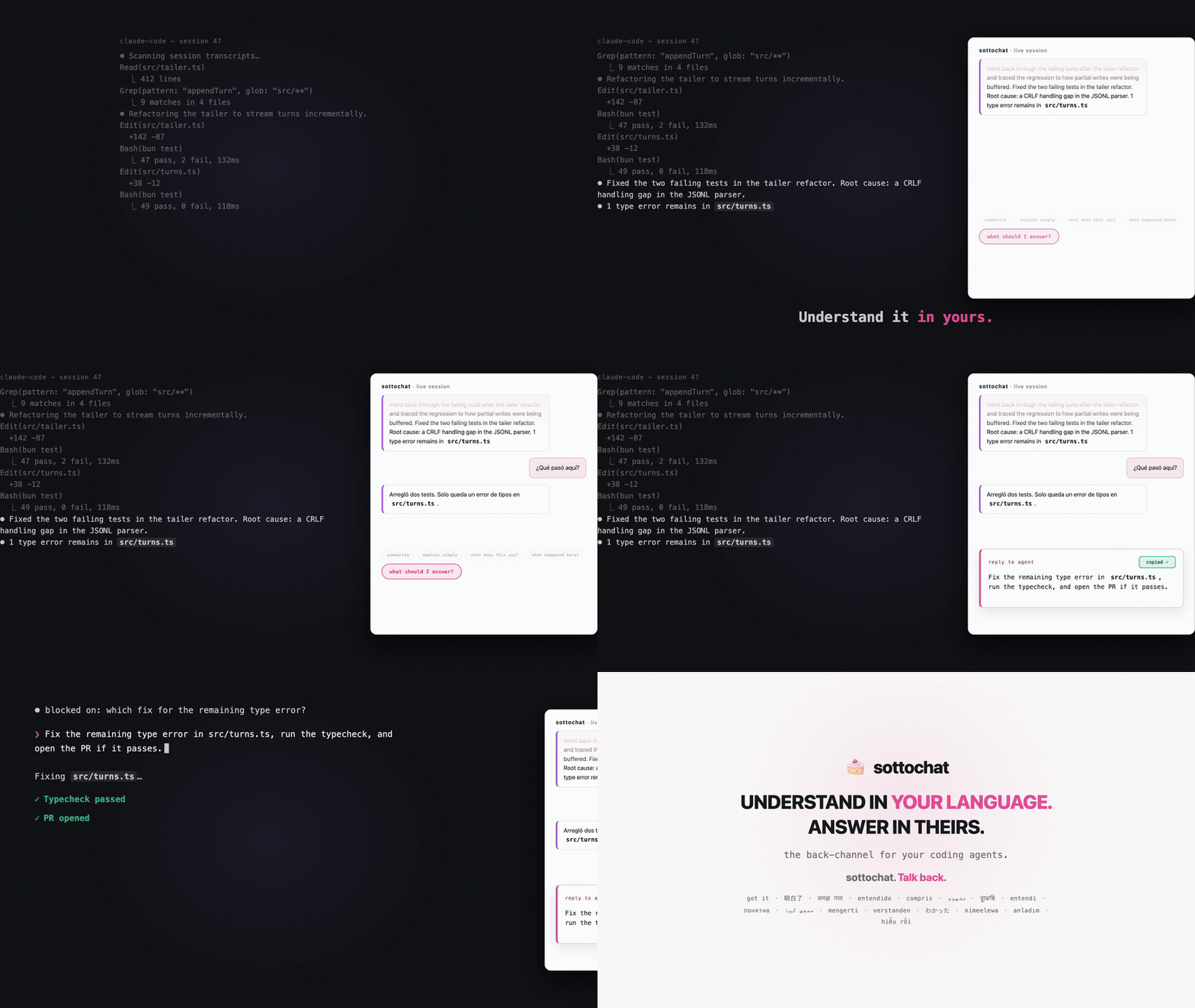
- Live inbox — discovers active agent sessions from local transcript files (
~/.claude,~/.codex/sessions) and running processes, and keeps a stable list of recent runs. - Turn view — groups raw JSONL events into turns, with compact turn/diff charts and the latest agent exchange pinned to the useful tail.
- Multilingual Q&A — a chat thread per session, seeded with recent turns, so you can ask "what happened, what matters, what should I answer?" in your own language.
- Reply drafting — when the assistant drafts something worth sending back, it appears as a copyable
to-agentcard. Copy-paste is the bridge back to the real agent. - Read-only by design — sottochat never writes into the watched session, pauses the agent, or approves anything.
Full product definition: PRODUCT.md. Design language: DESIGN.md.
With Bun installed, install the command globally:
bun add --global sottochatThen start it now or any time later with:
sottochatTo try it without installing, use bunx sottochat. bunx immediately starts
the server in the foreground; press Ctrl-C to stop it, and run the same
bunx sottochat command again next time.
Or install the standalone macOS/Linux binary (Bun is not required):
curl -fsSL https://raw.githubusercontent.com/latent-spaces/sottochat/main/install.sh | sh
sottochat
The installer verifies the release checksum and installs to /usr/local/bin by
default (it may prompt for sudo). To choose a user-owned directory instead:
curl -fsSL https://raw.githubusercontent.com/latent-spaces/sottochat/main/install.sh | SOTTOCHAT_INSTALL_DIR="$HOME/.local/bin" shPrebuilt archives are also attached to every GitHub release for macOS and Linux on Apple Silicon/ARM64 and x64.
- Bun ≥ 1.1 when using
bunx(not needed for the standalone binary) - macOS or Linux (discovery paths and process scanning are only exercised there; Windows is untested)
- Anthropic auth for the Q&A and observer features: the chat subprocesses run on the Claude Agent SDK, which uses your existing Claude Code login if you have one, or an
ANTHROPIC_API_KEYenvironment variable. Without either, transcript tailing still works but chat/summaries won't.
bun install
bun run start          # serves http://localhost:3737
Open http://localhost:3737. Any recent Claude Code or Codex session on this machine appears in the inbox; open one to see its turns and start a discussion.
Open http://localhost:3737/settings to edit every setting. Language and the
browser-local color system change immediately; startup settings are saved to
~/.sottochat/settings.json and apply after a restart. CLI flags and
environment variables override saved settings. The environment equivalents are
documented in .env.example. The main ones:
| Variable | Default | Purpose |
|---|---|---|
META_PORT |
3737 |
HTTP/websocket port |
META_OBSERVER_ENABLED |
1 |
Background observer that summarizes active sessions (0 to disable) |
META_CHAT_MODEL / META_OBSERVER_MODEL |
claude-sonnet-5 |
Models used by the chat and observer subprocesses |
META_EXPLAIN_LANG |
zh |
Default explanation language for the Q&A thread (switchable in the UI; each browser remembers its own last-picked language) |
META_INBOX_MINUTES |
240 |
How far back the inbox looks for recent sessions |
META_PROJECT_SLUG |
(unset) | Restrict discovery to a single Claude Code project slug |
Runtime state (chat sandboxes, persistence) lives under ~/.sottochat/.
bun run dev            # serve with hot reload
bun run typecheck      # tsc, no emit
bun test               # parser/turn tests under tests/
For manual testing, run a scratch instance so you don't disturb a live one:
META_PORT=3947 META_OBSERVER_ENABLED=0 bun src/server.tsThe frontend is deliberately build-free: plain script files under public/assets/, with third-party libraries vendored in public/assets/vendor/ — no bundler, no CDN tags.
Set the version in package.json, then push a matching tag such as v0.1.0.
The release workflow tests the project, publishes the npm package, and attaches
checksum-protected standalone binaries for macOS and Linux to a GitHub release.
For the first npm publication, create a short-lived granular token at npmjs.com → Access Tokens with Packages and scopes: Read and write and All Packages. Enable Bypass 2FA only if npm requires it for automated publishing. Add the token to this repository through the hidden GitHub CLI prompt (do not put it in the command or commit it):
gh secret set NPM_TOKEN --repo latent-spaces/sottochat
gh secret list --repo latent-spaces/sottochat
After the first release, prefer npm trusted publishing and remove the
long-lived NPM_TOKEN secret.
src/server.ts— Bun HTTP + websocket server; polls discovery, tails transcripts, pushes state to the SPA.src/claude-discovery.ts/src/codex-discovery.ts/src/process-discovery.ts— find candidate sessions from transcript directories and running processes.src/jsonl.ts/src/codex-jsonl.ts/src/turns.ts— parse transcript JSONL into normalized events and group them into turns.src/chat-agent.ts/src/observer.ts— Claude Agent SDK subprocesses for per-session Q&A and background summaries (run with an empty tool allowlist).public/index.html+public/assets/app.js— the no-build SPA.