OCS2 (Optimal Control for Switched Systems) is a C++ toolbox for formulating and solving nonlinear optimal control problems, with an emphasis on real-time Model Predictive Control (MPC) for robotics.
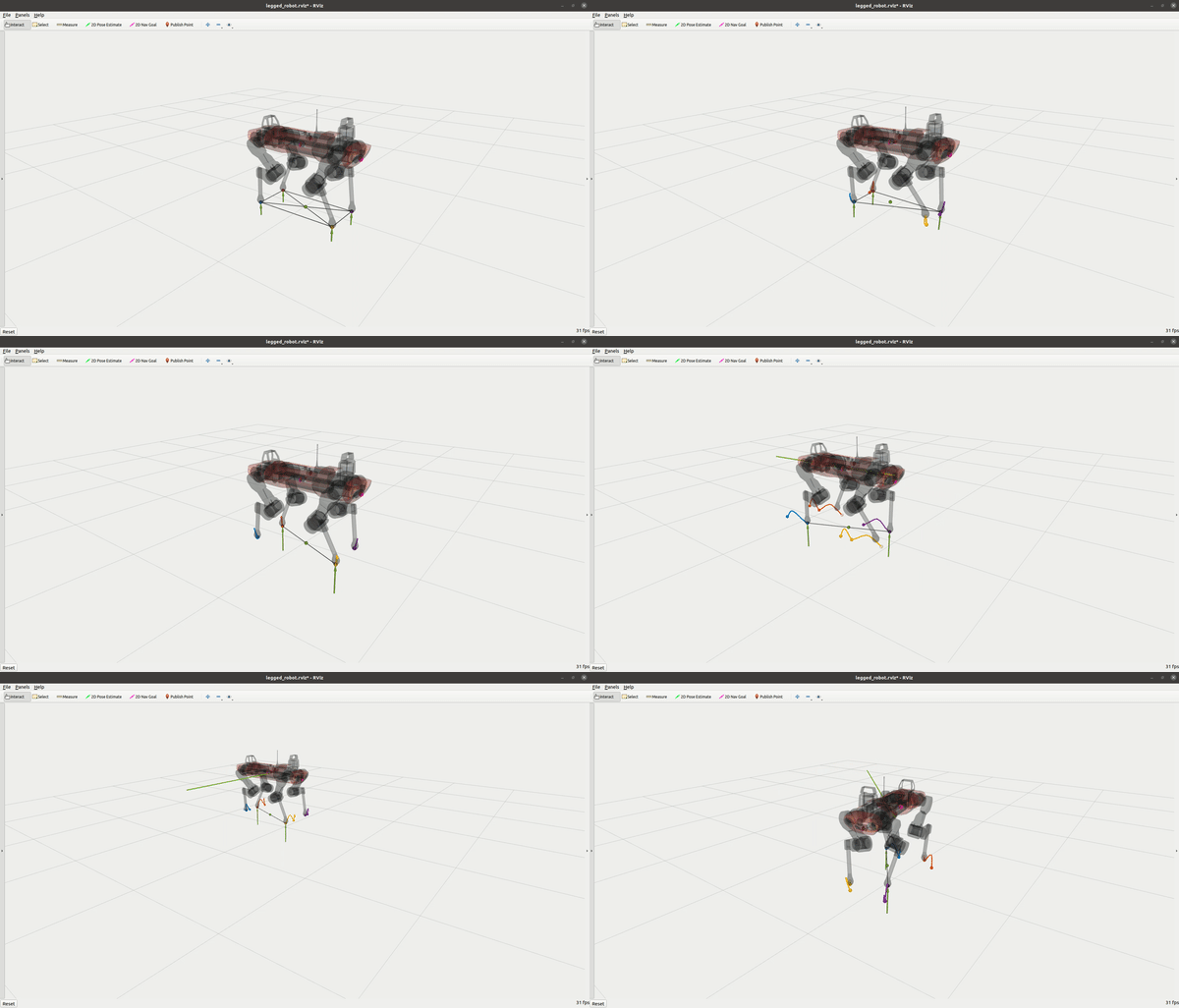
OCS2 handles general path constraints through Augmented Lagrangian or relaxed barrier methods. To facilitate the application of OCS2 in robotic tasks, it provides additional tools to set up the system dynamics (such as kinematic or dynamic models) and cost/constraints (such as self-collision avoidance and end-effector tracking) from a URDF model. The library also provides an automatic differentiation tool to calculate derivatives of the system dynamics, constraints, and cost. To facilitate deployment on robotic platforms, OCS2 provides tools for ROS interfaces. The toolbox’s efficient and numerically stable implementations in conjunction with its user-friendly interface have paved the way for employing it on numerous robotic applications with limited onboard computation power.
ROS 2 port available: use branch
ros2.
| ROS version | Branch |
|---|---|
| ROS 1 | main |
| ROS 2 | ros2 |
- Multiple solvers
- SLQ: continuous-time constrained DDP (SLQ/DDP family)
- iLQR: discrete-time constrained DDP
- SQP: multiple-shooting SQP (QP subproblems via HPIPM/BLASFEO)
- SLP: sequential linear programming (PIPG)
- IPM: multiple-shooting nonlinear interior-point method
- Switched-system OCP support: mode schedules and jump maps (single- and multi-domain problems).
- Constraints: hard/soft constraints with Augmented Lagrangian and relaxed barrier methods.
- Derivatives: analytic derivative interfaces + automatic differentiation (CppAD) and optional code generation (CppADCodeGen).
- Robotics tooling: URDF→model helpers (Pinocchio), kinematics, centroidal models, self-collision constraints (HPP-FCL).
- ROS integration: messages, nodes, and visualization/plotting tools for deploying MPC on robots.
- Robotic examples: end-to-end MPC examples (and ROS wrappers) for double integrator, cartpole, ballbot, quadrotor, mobile manipulator, legged robot, and more.
ocs2_core: core data types, math utilities, rollout interfaces, AD utilities.ocs2_oc: optimal control problem building blocks (costs, constraints, dynamics, pre-computation, reference management).ocs2_ddp,ocs2_mpc: DDP-family solvers + MPC infrastructure and runtime interfaces.ocs2_sqp,ocs2_slp,ocs2_ipm: alternative solvers (SQP / SLP / IPM).ocs2_pinocchio/*: URDF/Pinocchio tooling (centroidal model, kinematics, self-collision, visualization).ocs2_ros_interfaces,ocs2_msgs: ROS interfaces and message definitions.ocs2_robotic_examples/*: robotic examples and their ROS nodes.ocs2_python_interface: Python bindings for selected components.ocs2_mpcnet: MPC-Net tooling for learned policy deployment/training.ocs2_doc: documentation sources (Sphinx/Doxygen).
- Online documentation: https://leggedrobotics.github.io/ocs2/
- ROS 1 (
main): follow the installation instructions in the documentation (Installation page): https://leggedrobotics.github.io/ocs2/ - ROS 2 (
ros2): followinstallation.mdon that branch: https://github.com/leggedrobotics/ocs2/blob/ros2/installation.md
@misc{OCS2,
  title  = {{OCS2}: An open source library for Optimal Control of Switched Systems},
  note   = {[Online]. Available: \url{https://github.com/leggedrobotics/ocs2}},
  author = {Farbod Farshidian and others}
}BSD 3-Clause, see LICENCE.txt.