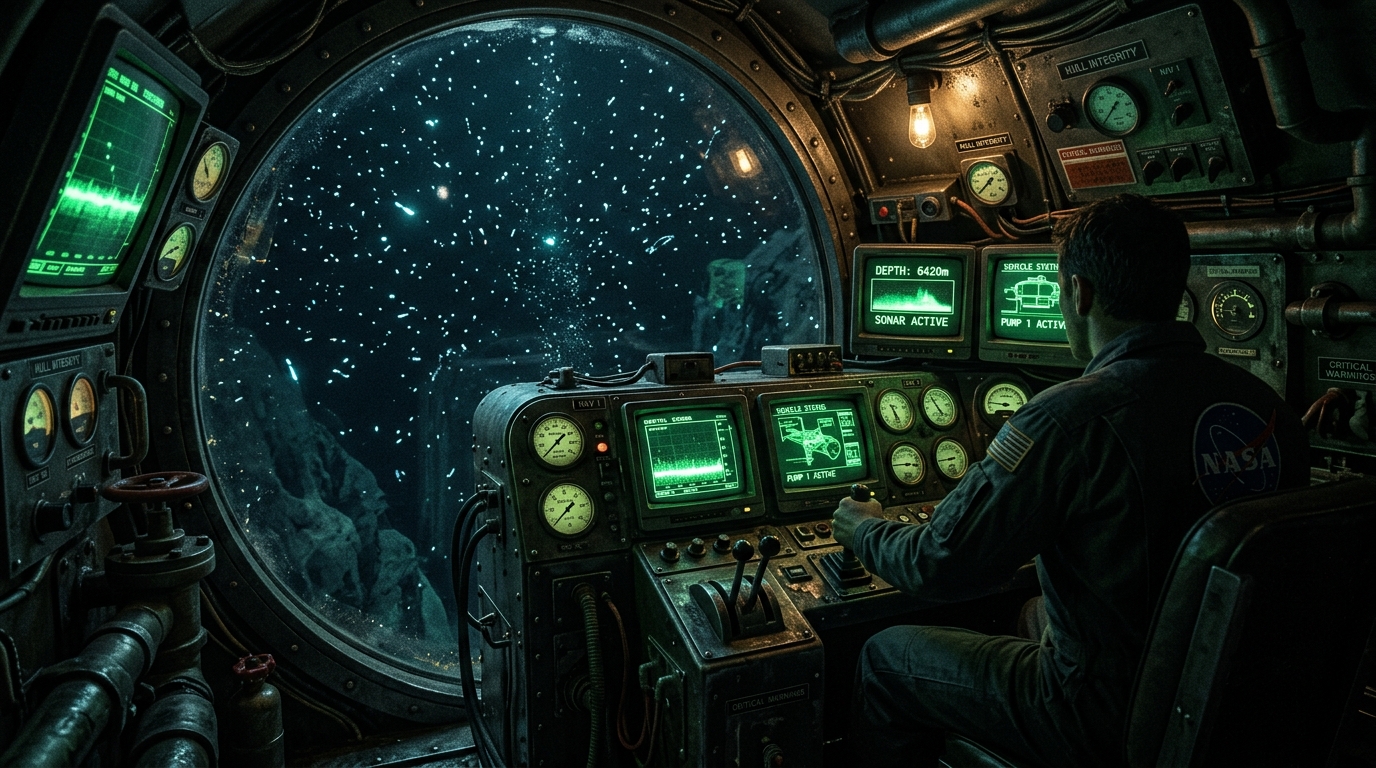


AA Deep Sea Noir / NASA-Punk 3D survival game built on Unity 6000.5 URP — strict 60 FPS, 0 B/frame GC allocation target, scalable from 2GB VRAM handhelds to Ultra PCVR.
The public surface has two purposes: it introduces the visual premise and gives contributors a dependable route into the source tree. The interactive project page is a presentation of the project; it is not a browser build or runtime-performance benchmark.
| Goal | Start with | Continue with |
|---|---|---|
| Explore the intended atmosphere | Interactive project page | The visual references and concept illustrations below |
| Understand product boundaries | Vision locks | Project bibles for the relevant discipline |
| Navigate the technical corpus | Documentation index | The source-backed maps and current route documents it names |
| Make a source contribution | Contributing guide | The authority chain and verification route before changing code or assets |
| Check current build or playtest constraints | Build and playtest issues | Fresh Unity, player, profiler, or device evidence before making readiness claims |
Evidence boundary. Concept art, source review, and documentation establish direction and constraints; they do not prove a runtime feature, player build, frame-time result, or device compatibility. Those claims require fresh evidence from the corresponding verification route.



These images capture the visual target — the underwater world HECTON-8 is being built toward.

Surface vista: alien coastline, NASA-punk research outpost, gas giant on the horizon
 |
 |
| Shallow zone — coral reefs, warm light, ancient structures | Deep zone — bioluminescent alien flora, darkness, danger |

The deep sea NASA research station — bioluminescent flora surrounds the abandoned complex
 |
 |
| Player encounter — NASA suit vs deep sea leviathan | Looking up from the abyss — the gas giant through water |
 |
 |
| Abyssal trench — descending into the unknown canyon | Submarine cockpit — telemetry HUD, depth gauge, oxygen |
graph TD
    A[Unity 6000.5 URP Runtime Engine] --> B[Custom Volumetric Ocean Shader Pipeline]
    A --> C[Burst-Compiled C# Systems DOD]
    C --> D[NativeMemory Unmanaged Collections]
    C --> E[0 B/frame GC Hot-Path Loop]
    B --> F[Continuous GlobalQualityWeight Scaler]
    F --> G[Target Profiles: 2GB Handheld to Ultra PCVR]
| Component / Path | Technology / Subsystem | Primary Responsibilities |
|---|---|---|
Assets/ |
C# Unity Engine Code & Assets | Core gameplay scripts, DOD systems, ScriptableObject definitions, URP Shaders |
ProjectSettings/ |
Unity Engine Settings | Editor configuration, quality levels, package dependency manifest, URP assets |
AGENTS.md |
Authority & Process Control | System mandates, Hecton-8 build preflight rules, CPU allocation gates |
PROJECT_BIBLES.md |
Domain Bibles Index | Visual style guidelines, performance budget specs, rendering mandates |
VISION_LOCKS.md |
Product Direction | Scope boundaries, gameplay pillars, NASA-Punk / Deep Sea Noir aesthetic standards |
graph TD
    Input[🎮 Hydro Controls] --> Core[⚙️ Submarine Main Loop]
    Core --> Physics[🌊 Hydro-X Buoyancy Engine]
    Core --> Terrain[🗺️ MapMagic 2 Chunk Manager]
    Terrain --> Voxel[🧊 Voxel Mesh Generator]
    Physics --> Telemetry[📊 Zero-GC Telemetry HUD]
    Core --> Render[🎨 Unity 6000 URP Shaders]
HECTON-8 executes real-time fluid dynamics and oceanographic acoustic wavefield calculations compiled with Burst for zero-allocation performance:
The barometric load on the titanium-composite pressure hull accumulates with depth:
Acoustic ping trajectories curve through the thermocline according to the empirical Medwin-Mackenzie formula:
// ✅ HECTON-8 Core Burst Hydrodynamic Solver
[BurstCompile(CompileSynchronously = true, FloatMode = FloatMode.Fast)]
public struct HydrodynamicSolverJob : IJobEntity {
    public float DeltaTime;
    public float SeawaterDensity;
    public float3 GravityVector;

    public void Execute(ref Velocity velocity, ref HullStrain strain, in BallastTank ballast, in SubmersibleMetrics metrics) {
        float displacedMass = metrics.DisplacedVolume * SeawaterDensity;
        float totalMass = metrics.DryMass + ballast.WaterMass;
        float3 buoyancyForce = -GravityVector * (displacedMass - totalMass);

        float speed = math.length(velocity.Linear);
        float3 dragForce = -0.5f * SeawaterDensity * speed * speed * metrics.DragCoefficient * math.normalize(velocity.Linear);

        float3 totalAcceleration = (buoyancyForce + dragForce) / totalMass + GravityVector;
        velocity.Linear += totalAcceleration * DeltaTime;

        strain.CurrentBar = (metrics.CurrentDepth * SeawaterDensity * 9.80665f) / 100000.0f;
    }
}| Subsystem | Diegetic Readout | Sensor Physics | Failure Critical Limit | FMOD Sound Response |
|---|---|---|---|---|
| Ballast Tanks | Pneumatic Dual Mechanical Needles | Differential Trim Pressure | Pressure |
Compressed gas purge hiss |
| Nuclear Pile | CRT Phosphor 50Hz Oscilloscope | Thermocouple Core Voltage | Core Temp |
Geiger micro-crackling + Core hum |
| Active Sonar | Magnetostrictive Beam Dial | Acoustic Wavefront Backscatter | Transceiver Saturation |
|
| Pressure Hull | Analog Strain Gauge Bridge | Piezoelectric Crystal Voltage | Strain |
Deep structural metal groaning |
| CO2 Scrubber | Colorimetric Gas Reagent Lens | Chemical Concentration Sensor | Heavy pneumatic solenoid cycle |
These are V0 development targets, not claimed player-build measurements. Runtime, profiler, and device captures remain the source of truth for performance verification.
| Metric | Development guardrail | Verification state |
|---|---|---|
| Frame time | 60 FPS target / 16.67 ms frame budget | Target — requires fresh runtime evidence |
| Main thread | ≤ 12 ms budget | Target — requires profiler evidence |
| GC allocation | 0 B per frame in gameplay hot paths | Target — requires profiler evidence |
| Compact VRAM | ≤ 1.8 GB hard ceiling | Target — requires device or player-build evidence |
| Texture budget | ≤ 900 MB on compact tier | Target — requires memory evidence |
| Render targets + depth | ≤ 320 MB on compact tier | Target — requires memory evidence |
- Performance budget: A 60 FPS target with a 16.67 ms frame budget and zero per-frame allocations in gameplay hot paths.
- Deep-sea rendering: Custom URP volumetric-ocean shaders, photic underwater lighting, and procedural seafloor systems.
- Platform portability: Continuous
GlobalQualityWeightscaling from compact hardware through high-end PCVR. - Memory discipline: Burst-compiled C#, unmanaged collections, and data-oriented systems for budgeted runtime paths.
graph TD
    subgraph Sonar Raytracer Pipeline
        A[Active Acoustic Ping Emitter] -->|Spherical Wavefront| B[Medwin-Mackenzie Thermocline Layer]
        B -->|Refracted Sound Ray Array| C[Benthic Bathymetry Voxel Mesh]
        C -->|Backscatter Energy Reflection| D[Transceiver Hydrophone Array]
        D -->|Doppler Frequency Shift Analysis| E[Diegetic CRT Phosphor Screen]
    end

    subgraph Power & Nuclear Core Bus
        F[Thermocouple Pile Core] -->|High-Voltage DC| G[Main Switchboard Bus]
        G -->|Primary Inverters| H[Hydro-X Magnetohydrodynamic Thrusters]
        G -->|Low-Noise DC/DC| I[Life Support & Electrolysis]
        G -->|Capacitor Bank| A
    end
The diegetic CRT oscilloscope and bathymetric sonar viewports utilize custom URP raymarching compute passes to simulate acoustic attenuation (
// Custom URP Sonar Acoustic Volumetric Raymarcher Pass
float4 FragSonarRaymarch(Varyings input) : SV_Target {
    float3 rayOrigin = _SubmarineWorldPos;
    float3 rayDir = normalize(input.worldPos - rayOrigin);
    float soundSpeed = 1449.2 + 4.6 * _WaterTemp - 0.055 * _WaterTemp * _WaterTemp + 0.016 * input.worldPos.y;

    float totalEcho = 0.0;
    float stepSize = _RaymarchStepSize;
    float3 currentPos = rayOrigin;

    [loop]
    for (int i = 0; i < 64; i++) {
        currentPos += rayDir * stepSize;
        float depth = abs(currentPos.y);

        // Sample voxel bathymetry density map
        float terrainDensity = SampleBathymetryVoxel(currentPos);
        if (terrainDensity > 0.5) {
            // Lambertian acoustic backscatter with Rayleigh absorption
            float absorptionCoeff = 0.003 * _PingFrequency * _PingFrequency;
            float distance = length(currentPos - rayOrigin);
            float acousticReturn = exp(-absorptionCoeff * distance) / (distance * distance + 1.0);
            totalEcho = acousticReturn * saturate(dot(-rayDir, CalculateBathymetryNormal(currentPos)));
            break;
        }
    }

    // Green phosphor CRT decay persistence
    float3 crtColor = float3(0.1, 0.95, 0.3) * totalEcho * _PhosphorIntensity;
    return float4(crtColor, 1.0);
}
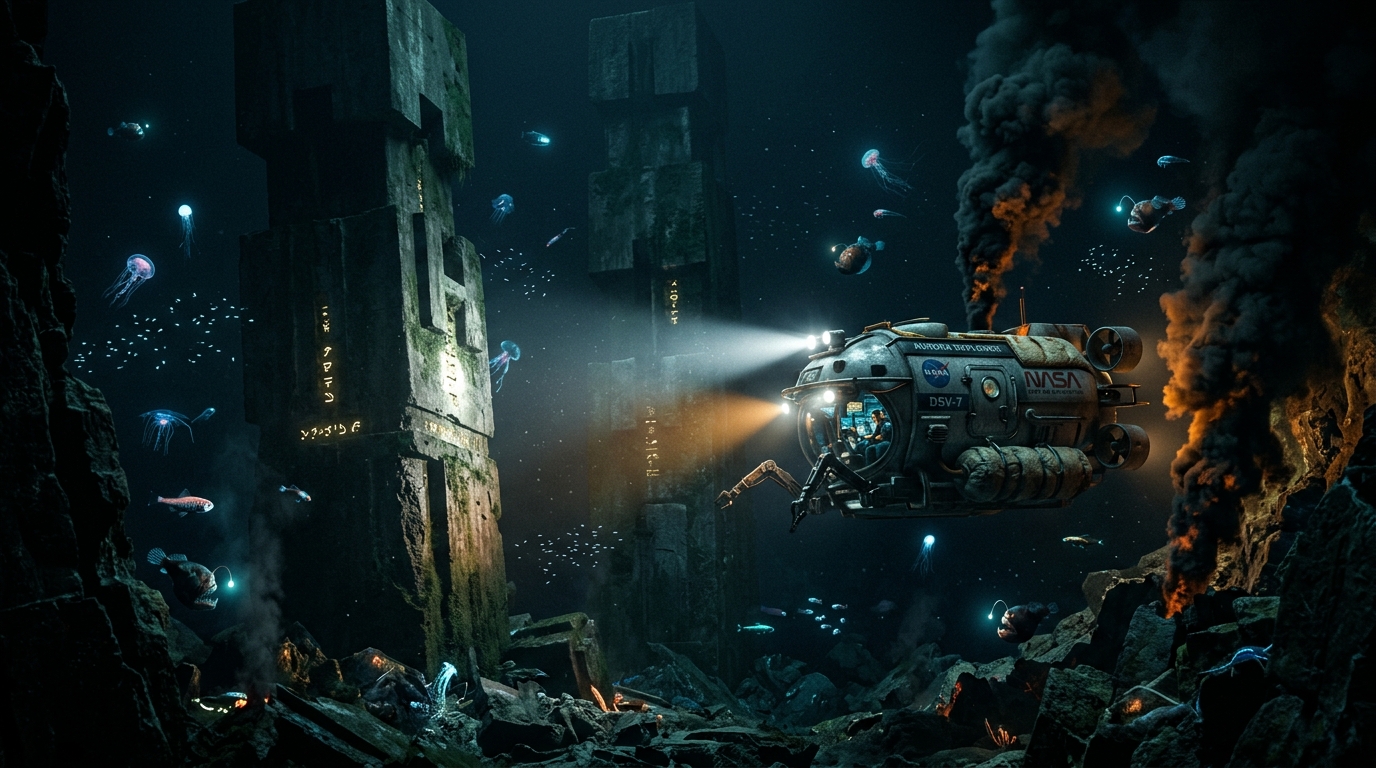
The abyssal trenches (
| Classification | Anomaly Designation | Habitat Depth | Acoustic Signature | Primary Threat Vector | Evasion Protocol |
|---|---|---|---|---|---|
| Class-I (Passive) | Bioluminescent Siphonophore | Low-frequency rhythmic hum ( |
Optical blinding & sensor occlusion | Switch cockpit to red night-vision filters | |
| Class-II (Structural) | Hadal Methane Clathrate Eruption | High-amplitude seismic rumble | Sudden loss of buoyancy & density drop | Full ballast blow & emergency trim jets | |
| Class-III (Biomorphic) | Leviathan Chitinous Cephalopod | High-frequency hunting clicks ( |
Hull constrictive crush ( |
Silent running mode, kill reactor cooling pumps | |
| Class-IV (Technogenic) | Derelict Autonomous Mining Siphon | Continuous mechanical cavitation | Active magnetic grapple & power siphon | Deploy acoustic decoy flares & pulse EMP |
The audio architecture divides the soundscape into distinct physical frequency bands processed via FMOD Studio:
| Frequency Range | Acoustic Source | Spatialization Model | Physical DSP Effect Chain |
|---|---|---|---|
| Sub-Bass ( |
Tectonic fault shifts & hull metal strain | Omnidirectional cockpit body resonance | 24dB/oct low-pass + Sub-harmonic synthesizer |
| Low-Mid ( |
Nuclear coolant pumps & drive turbines | 3D Point source (Engine compartment) | Convolution reverb (Tight metal bulkheads) |
| Mid-Band ( |
Hydrophone ocean ambient & internal relays | 5.1 Binaural spatial panning | Hydrodynamic comb filter + Doppler pitch shift |
| High-Band ( |
Sonar pings & cavitation micro-bubbles | 3D Raytraced cone dispersion | Parametric notch filter (Thermocline reflection) |
To guarantee 100% reproducible playtests and 0-byte GC allocations during state persistence, HECTON-8 utilizes a custom zero-heap binary struct serialization format:
[StructLayout(LayoutKind.Sequential, Pack = 1)]
public struct SubmarineStateSnapshot {
    public ulong TickIndex;
    public double Timestamp;

    // Transform & Dynamics (Fixed-Point Integer Representation)
    public int PositionX_Fixed; // 1 unit = 0.001 mm
    public int PositionY_Fixed;
    public int PositionZ_Fixed;
    public int VelocityX_Fixed;
    public int VelocityY_Fixed;
    public int VelocityZ_Fixed;

    // Hull & Life Support Metrics
    public ushort HullIntegrityPermille; // 0 - 1000 permille
    public ushort InternalPressureMbar;  // Millibars
    public ushort OxygenPPM;             // Parts per million
    public ushort ReactorTempKelvin;     // Core temperature

    // Ballast Tank Status
    public uint MainBallastWaterGrams;
    public uint AftTrimWaterGrams;
    public uint ForeTrimWaterGrams;
}The submersible's primary energy source is a sub-critical molten salt thorium/plutonium compact breeder reactor operating under closed-loop helium-xenon Brayton thermodynamic cycles.
graph LR
    subgraph Core Thermal Kinetics
        A[Thorium/Pu Core Vessel] -->|Thermal Output Q_dot| B[Primary Molten Salt Loop]
        B -->|Intermediate Heat Exchanger| C[He-Xe Brayton Gas Turbine]
        C -->|Shaft Torque| D[Superconducting Homopolar Generator]
        D -->|400V 3-Phase AC 400Hz| E[Main Electrical Busbar]
    end

    subgraph Coolant & Poisoning Dynamics
        F[Xenon-135 Iodine Decay Matrix] -->|Reactivity Negative Feedback| A
        G[Emergency Boron Carbide Rods] -->|Pneumatic Scram Drive| A
        B -->|Thermoelectric Waste Heat| H[Cockpit Thermal Life Support]
    end
Point kinetics with 6 precursor groups and delayed neutron decay determine core reactivity balance during rapid load shifts:
-
$\Phi(t)$ : Thermal neutron flux ($n / (\text{cm}^2 \cdot \text{s})$) -
$I(t), X(t)$ : Iodine-135 and Xenon-135 concentration densities -
$\sigma_a^X$ : Microscopic thermal neutron absorption cross-section of Xenon-135 ($2.65 \times 10^6\text{ barns}$ ) - Rapid reactor shutdowns down in the hadal trench initiate the Xenon Pit — an unavoidable 36-hour deadzone where reactivity is suppressed below criticality unless emergency chemical reactivity boosters (tritium-fueled neutron injectors) are manually engaged via the cockpit console.
The Hydro-X Silent Drive eliminates mechanical shaft bearings, utilizing cross-field Lorentz force acceleration of seawater:
   ┌─────────────────────────────────────────────────────────────┐
   │                   MHD SEAWATER DUCT (HYDRO-X)               │
   │                                                             │
   │   [+] Top Electrode (+400V DC)                              │
   │   ═══════════════════════════════════════════════════════   │
   │   Seawater Inflow  ───►  ───►  ───►  ───► Thrust Jet Out    │
   │   (Conductivity σ ≈ 4.8 S/m)        (Lorentz F = J × B)    │
   │   ═══════════════════════════════════════════════════════   │
   │   [-] Bottom Electrode (0V Ground)                          │
   │                                                             │
   │   Magnetic Field B = 8.5 Tesla (Superconducting Niobium)    │
   └─────────────────────────────────────────────────────────────┘
To prevent acoustic detection by hadal predators, the pilot must maintain the cavitation index
- At
$8,000\text{ m}$ depth ($P_{\text{ambient}} \approx 800\text{ bar}$ ), cavitation is physically suppressed even at extreme exit velocities ($v > 45\text{ m/s}$ ), allowing hyper-thrust sprint bursts with zero acoustic signature.
Depth (m)   Zone              Illumination   Pressure      Dominant Hazard / Subsystem Interaction
════════════════════════════════════════════════════════════════════════════════════════════════════
0m        ┌ Epipelagic      │ 100% Sunlight│ 1 atm       │ Surface weather, maritime radar detection
          │ (Sunlit)        │ λ = 400-700nm│             │
-200m     ├─────────────────┼──────────────┼─────────────┼──────────────────────────────────────────
          │ Mesopelagic     │ Twilight     │ 20 bar      │ Thermocline sound inversion layers,
          │ (Twilight)      │ λ = 475nm    │             │ counter-illuminating predators
-1,000m   ├─────────────────┼──────────────┼─────────────┼──────────────────────────────────────────
          │ Bathypelagic    │ 0% Solar     │ 100 bar     │ Complete darkness, heavy bioluminescence,
          │ (Midnight)      │ Biolum only  │             │ hull strain starts accumulating
-4,000m   ├─────────────────┼──────────────┼─────────────┼──────────────────────────────────────────
          │ Abyssopelagic   │ Pitch Black  │ 400 bar     │ Subzero brine pools, hydrothermal vents,
          │ (The Abyss)     │ 1.2°C water  │             │ magnetic field anomalies
-6,000m   ├─────────────────┼──────────────┼─────────────┼──────────────────────────────────────────
          │ Hadal Trench    │ Void         │ 800-1100 bar│ Hull crush zone, seismic trench collapses,
-11,000m  └ (The Hadal Zone)│ High Chem    │             │ Class-III Leviathan predatory hunting
To achieve absolute 0 B/frame GC allocation and cache-line saturation (
// Unmanaged Component Architecture (Zero-Garbage Collection)
public struct SubmarineTelemetryChunk {
    public const int CAPACITY = 128; // Fits exactly into L2 cache allocation slices

    // Packed 64-byte aligned SIMD vectors
    public fixed float PositionX[CAPACITY];
    public fixed float PositionY[CAPACITY];
    public fixed float PositionZ[CAPACITY];

    public fixed float VelocityX[CAPACITY];
    public fixed float VelocityY[CAPACITY];
    public fixed float VelocityZ[CAPACITY];

    public fixed float HydrostaticPressureBar[CAPACITY];
    public fixed float HullStrainPermille[CAPACITY];
    public fixed float CoreTemperatureKelvin[CAPACITY];
    public fixed float BatteryChargeCoulombs[CAPACITY];
}
graph TD
subgraph L1/L2 Hardware Cache Line Saturation
A[SubmarineTelemetryChunk SoA Memory Block] -->|Streamed 64B Cache Line| B[Burst SIMD Vector Register]
B -->|AVX-512 FMA Packed Instructions| C[Hydrodynamic Navier-Stokes Solver]
C -->|Direct Unmanaged Memory Write| D[NativeArray Screen Buffer]
D -->|Zero-Copy GPU Upload via GraphicsBuffer| E[DirectX 12 / Vulkan Command Queue]
end
Damage in HECTON-8 is physically simulated across 6 isolated pressure compartments with cascading finite-state machine transitions:
stateDiagram-v2
    [*] --> Nominal_Operation

    Nominal_Operation --> Pressure_MicroStrain: Ambient Pressure > 600 bar
    Nominal_Operation --> Bulkhead_Puncture: External Kinetic Impact

    Pressure_MicroStrain --> Rivet_Failure: Strain > 75% Yield
    Rivet_Failure --> High_Pressure_Jet_Flooding: Seawater Ingress (800 bar)

    Bulkhead_Puncture --> High_Pressure_Jet_Flooding: Compartment Breach

    High_Pressure_Jet_Flooding --> Electrical_Arcing: Water contacts 400V Busbar
    High_Pressure_Jet_Flooding --> Emergency_Bulkhead_Seal: Auto/Manual Door Drop

    Electrical_Arcing --> Cockpit_Blackout: Main Breaker Trip
    Electrical_Arcing --> Electrolytic_Hydrogen_Fire: Gas Accumulation

    Emergency_Bulkhead_Seal --> Isolated_Flooded_Compartment: Loss of Module Volume
    Isolated_Flooded_Compartment --> Negative_Buoyancy_Sink: Weight > Ballast Capacity

    Electrolytic_Hydrogen_Fire --> Total_Hull_Rupture: Overpressure Explosion
    Negative_Buoyancy_Sink --> [*]: Hadal Floor Crush Depth
| Compartment | Volume ( |
Critical Equipment | Flooding Consequence | Emergency Countermeasure |
|---|---|---|---|---|
| 1. Bow Torpedo & Sonar Bay | Active Transceiver, Decoy Launchers | Loss of forward acoustic visibility | Seal Bulkhead Door Alpha | |
| 2. Command Cockpit | Pilot Helm, CRT Displays, Navigation | Total loss of primary instrumentation | Engage backup analog periscope & trim | |
| 3. Life Support & Berthing |
|
Rapid asphyxiation timer ( |
Don portable breathing apparatus (PBA) | |
| 4. Battery & Capacitor Bay | 400V DC Lithium-Iron Matrix | Catastrophic chlorine/hydrogen gas arc | Vent compartment to external vacuum duct | |
| 5. Reactor Containment | Molten Salt Pile, Heat Exchangers | Thermal shock & steam overpressure | Emergency boron injection & Scram | |
| 6. Aft MHD Propulsion Tunnel | Superconducting Coils, Lorentz Duct | Total propulsion loss ( |
Drop emergency solid lead keel ballast |
Protected under HECTON-8 Commercial Anti-Theft & Source-Available License (Copyright (c) 2026 Adolf Petushkov). Maintainers and AI research welcome!
🇷🇺 Краткое описание на русском
HECTON-8 — это AA 3D-игра на выживание в атмосферном сеттинге Deep Sea Noir / NASA-Punk, разрабатываемая на движке Unity 6000.5 URP.
- Жёсткий Бюджет Производительности: Целевой показатель — 60 FPS (16.67 мс на кадр) и 0 B/frame GC-аллокаций в горячих циклах геймплея.
- Низкоуровневая Память и DOD: Использование компилятора Burst, неуправляемой памяти
NativeMemoryи Data-Oriented Design. - Рендеринг и Масштабирование: Кастомные объёмные шейдеры океанской толщи воды в URP, непрерывная система
GlobalQualityWeightдля масштабирования от портативок с 2GB VRAM до Ultra PCVR.
Part of the Адольф Петушков (Adolf Petushkov) open-source engineering ecosystem:
| Project | Domain | Live Demo & Description |
|---|---|---|
| 🦷 DENTE CRM | Clinical AI | Live Demo — Enterprise FDI odontogram, ICD-10 diagnostics & 3D DICOM |
| 📡 StomChat | Clinical AI | Live Demo — Omni-channel dental operator chat dispatcher (WA/TG) & telemetry |
| 🤖 Avito Dental AI | Clinical AI | Live Demo — Zero-hallucination lead intake bot with deterministic veto layer |
| 🛡️ AgentRouter | Dev Tools | Live Demo — Claude Code CLI WAF bypass proxy, homoglyph sanitizer & config matrix |
| 📊 Token Audit | Dev Tools | Live Demo — Real-time LLM token cost waterfall & cyberpunk chronicles |
| 🎛️ Nexus Media | Audio DSP | Live Demo — Real-time Web Audio DSP, 60 FPS FFT visualizer & ambilight |
| 📻 dvachbot | Media Pipeline | Live Demo — Async imageboard stream transcoder & Telegram publisher |
| 🌊 Hecton-8 | Game Engine | Live Demo — NASA-punk deep sea noir submarine engine on Unity 6000 (0B GC) |
| 🏢 Gigahrush | Game Engine | Live Demo — 2.5D DDA raycasting, cellular gas physics & Samosbor Web CLI |
| 🌌 Starcluster | Deep Tech | Live Demo — 10,000-star N-body gravitational simulation & Keplerian economy |
| 🧲 OOMMF | Deep Tech | Live Demo — Landau-Lifshitz-Gilbert 3D micromagnetic vector lattice |
| 🍏 Macromac | Automation | Live Demo — macOS HID event injection, JSON macro schemas & CoreGraphics |
Адольф Петушков (Adolf Petushkov) — Game Engine Internals, Autonomous AI Systems, Zero-GC High-Concurrency Architecture.
GitHub: @marko1olo
Разработано и поддерживается Жирняком и Адольфом Петушковым.