Compliance infrastructure for the Nigeria Data Protection Act (NDPA) 2023





v5 ships zero-config presets, pluggable storage adapters, compound components, structured-error validators, a compliance score engine, and seven shipped locales (en, yo, ig, ha, pcm, ar, fr) — eight production-ready modules covering consent, data subject rights, DPIA, breach notification, privacy policies, lawful basis, cross-border transfers, and ROPA. 5.2–5.5 add an NDPC GAID 2025 layer: a DCPMI registration classifier, a Compliance Audit Returns scheduler, a Section 40 / Article 33 breach-notification checker (wired live into BreachReportForm), and an ndpr audit CLI that gates compliance in CI.
Documentation | Live Demos | npm | Blog | Latest Release

What's new in 5.5: The
ndpr auditCLI scores a compliance config against the toolkit engine (compliance score + GAID 2025 DCPMI / CAR / breach checks) and exits non-zero on failure — a drop-in CI gate. The same logic is exported asrunNdprAudit/formatNdprAuditReportfrom/server. See the audit CLI guide.NDPC GAID 2025 utilities (5.2–5.4):
classifyDCPMI(DCPMI registration tier + fee),generateComplianceAuditReturn(CAR initial-audit + 72-hour annual filing schedule), andassessBreachNotification(Section 40 / Article 33 notification completeness) — each pure, React-free, and exposed as a hook.BreachReportFormnow renders a live NDPC-notification readiness panel as it's filled in.Earlier highlights: Structured-result validators are the only shape —
{ field, code, message }[]with stable codes; uniformonAdd/onUpdate/onArchivecallbacks;NDPRDPIA.onResult(result)(5.0). Arabic + French locales with RTL-correct CSS (4.1.0). React 17 dropped;^18 || ^19(4.0.0). Full history in the CHANGELOG.
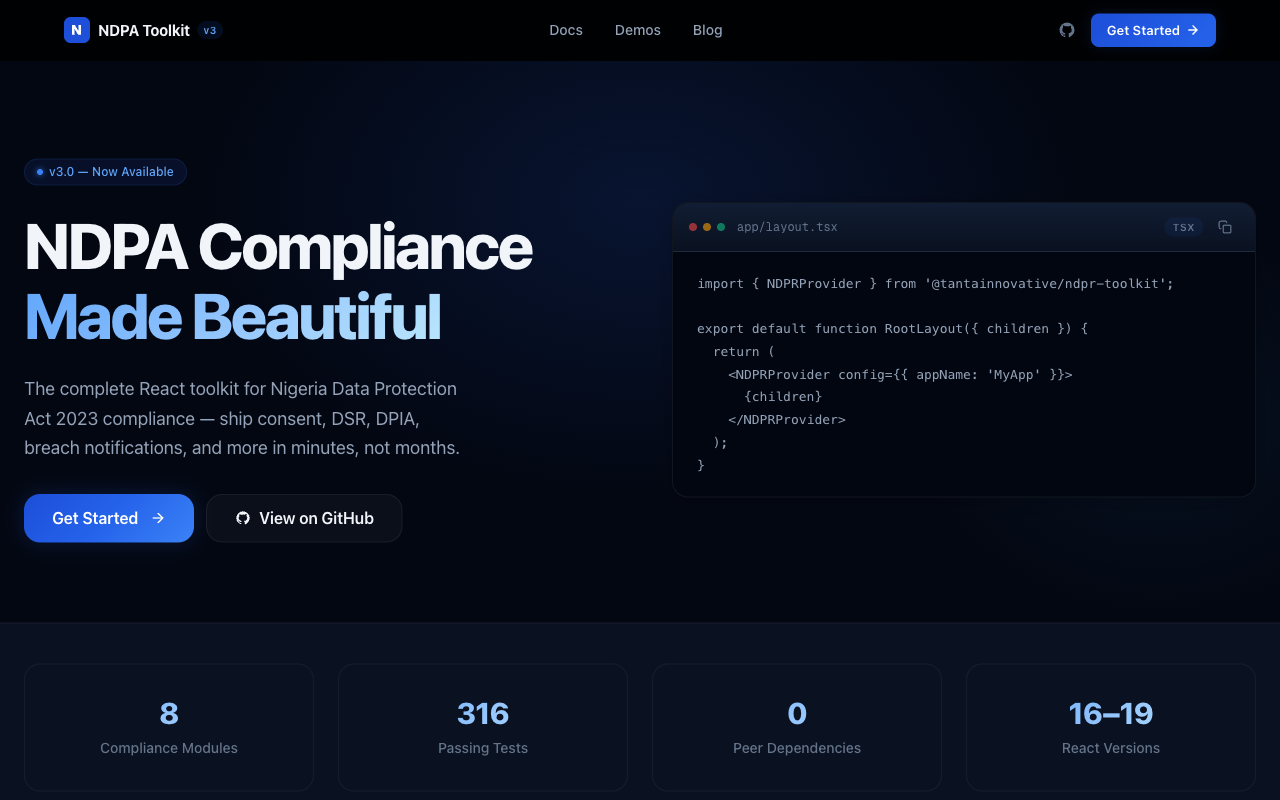
Two files. Full NDPA-compliant consent with no backend.
app/layout.tsx
import { NDPRConsent } from '@tantainnovative/ndpr-toolkit/presets';
import '@tantainnovative/ndpr-toolkit/styles';

export default function RootLayout({ children }: { children: React.ReactNode }) {
  return (
    <html>
      <body>
        {children}
        <NDPRConsent />
      </body>
    </html>
  );
}
That's it — NDPRConsent defaults to localStorageAdapter, so consent persists across page loads with zero backend code.
Want server-side persistence? Pass any StorageAdapter:
import { NDPRConsent } from '@tantainnovative/ndpr-toolkit/presets';
import { cookieAdapter, apiAdapter, composeAdapters, localStorageAdapter } from '@tantainnovative/ndpr-toolkit/adapters';

// Server-readable cookie (best for SSR consent gating)
<NDPRConsent adapter={cookieAdapter('ndpr_consent', { expires: 180 })} />

// Or POST to your own backend
<NDPRConsent adapter={apiAdapter('/api/consent')} />

// Or both — fan-out writes
<NDPRConsent adapter={composeAdapters(
  apiAdapter('/api/consent'),
  localStorageAdapter('ndpr_consent'),
)} />
The full SSR pattern (cookie read server-side → banner hydrates already-resolved, no flash) is in the Server-Side Storage guide.
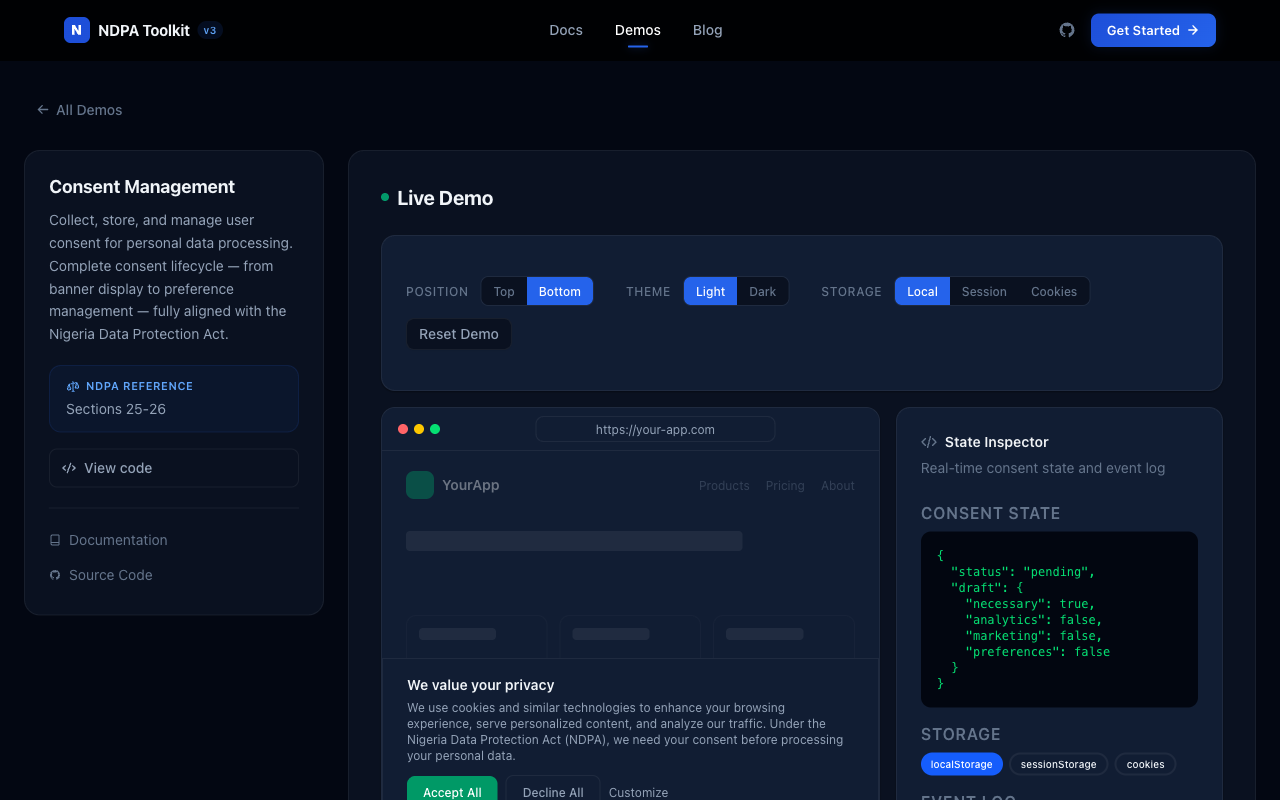
Interactive consent demo with configurable position, theme, storage, and real-time state inspector
Pick your package manager:
# pnpm
pnpm add @tantainnovative/ndpr-toolkit

# Bun
bun add @tantainnovative/ndpr-toolkit

# npm
npm install @tantainnovative/ndpr-toolkit

# Yarn
yarn add @tantainnovative/ndpr-toolkit
Add the stylesheet import once in your app entry so components render with default styles:
// app/layout.tsx (Next.js App Router) or src/main.tsx (Vite/CRA/Bun)
import "@tantainnovative/ndpr-toolkit/styles";
The stylesheet is opinionated but token-driven — override any --ndpr-* CSS custom property to theme. Skip this import only if you're using /unstyled to bring your own design system.
Install UI peer dependencies (only needed if you use the higher-level Radix-based components from /presets):
# pnpm
pnpm add @radix-ui/react-switch @radix-ui/react-tabs @radix-ui/react-label @radix-ui/react-slot lucide-react tailwind-merge clsx class-variance-authority

# Bun
bun add @radix-ui/react-switch @radix-ui/react-tabs @radix-ui/react-label @radix-ui/react-slot lucide-react tailwind-merge clsx class-variance-authority
Or scaffold instantly with the CLI:
# Recommended (idiomatic):
npm create ndpr@latest

# Equivalent — pick whichever fits your muscle memory:
npx create-ndpr
npx @tantainnovative/create-ndpr
pnpm create ndpr
bun create ndpr
Bun is a first-class runtime for the toolkit. Both common React app shapes work without extra config.
bun create vite@latest my-ndpr-app --template react-ts
cd my-ndpr-app
bun install
bun add @tantainnovative/ndpr-toolkit
// src/App.tsx
import { NDPRConsent } from '@tantainnovative/ndpr-toolkit/presets/consent';
import '@tantainnovative/ndpr-toolkit/styles';
export default function App() {
return (
<>
<NDPRConsent
options={[
{ id: 'essential', label: 'Essential', description: 'Required for the site to function', required: true, purpose: 'Site operation' },
{ id: 'analytics', label: 'Analytics', description: 'Anonymous usage measurement', required: false, purpose: 'Product analytics' },
{ id: 'marketing', label: 'Marketing', description: 'Personalised offers and ads', required: false, purpose: 'Marketing communications' },
]}
/>
<main className="p-6">
<h1 className="text-3xl font-semibold">My NDPA-compliant app</h1>
</main>
</>
);
}bun devVite is client-only by default — no extra wiring needed. The toolkit's preset components ship with the "use client" directive already injected.
bun create next-app@latest my-ndpr-app --typescript --app --tailwind
cd my-ndpr-app
bun add @tantainnovative/ndpr-toolkit
The consent banner is a stateful client component. Mount it from a small client wrapper so the rest of your layout can stay in RSC:
// app/ConsentRoot.tsx
'use client';
import { NDPRConsent } from '@tantainnovative/ndpr-toolkit/presets/consent';

export function ConsentRoot() {
  return (
    <NDPRConsent
      options={[
        { id: 'essential', label: 'Essential', description: 'Required for the site to function', required: true, purpose: 'Site operation' },
        { id: 'analytics', label: 'Analytics', description: 'Anonymous usage measurement', required: false, purpose: 'Product analytics' },
        { id: 'marketing', label: 'Marketing', description: 'Personalised offers and ads', required: false, purpose: 'Marketing communications' },
      ]}
    />
  );
}
// app/layout.tsx
import '@tantainnovative/ndpr-toolkit/styles';
import { ConsentRoot } from './ConsentRoot';
export default function RootLayout({ children }: { children: React.ReactNode }) {
return (
<html lang="en">
<body>
<ConsentRoot />
{children}
</body>
</html>
);
}bun devYou don't need to manually mark the import with "use client" from app/layout.tsx — the preset module already ships the directive in its bundled output, so React Server Components import it cleanly via the client wrapper. For RSC-safe, zero-React imports use /server or /core instead.
Pick exactly what your project needs.
Drop-in components with sensible defaults. No configuration required.
import {
  NDPRConsent,           // Consent banner — works with zero props
  NDPRSubjectRights,     // DSR request form
  NDPRBreachReport,      // Breach report form
  NDPRPrivacyPolicy,     // Policy generator wizard
  NDPRDPIA,              // DPIA questionnaire
  NDPRComplianceDashboard, // Visual compliance dashboard
} from '@tantainnovative/ndpr-toolkit/presets';Full control over layout without rebuilding logic.
import { Consent } from '@tantainnovative/ndpr-toolkit/consent';

<Consent.Provider options={options} onChange={handleSave}>
  <div className="my-layout">
    <Consent.OptionList />
    <div className="flex gap-2">
      <Consent.AcceptButton />
      <Consent.RejectButton />
    </div>
  </div>
</Consent.Provider>Stateful hooks for every module. Bring your own UI entirely.
import { useConsent } from '@tantainnovative/ndpr-toolkit/hooks';

const { hasConsent, acceptAll, rejectAll, shouldShowBanner } = useConsent({ options });The recommended entry for backend and serverless contexts. Pure validators, generators, scoring, locales, adapters, the aggregate compliance audit (runNdprAudit), and the GAID 2025 utilities (classifyDCPMI, generateComplianceAuditReturn, assessBreachNotification) — no React in the import graph. Safe to call from a Next.js Server Component, Edge Function, NestJS controller, or Cloudflare Worker.
import {
  validateConsentStructured,
  validateDsrSubmissionStructured,
  generatePolicyText,
  exportHTML,
  getComplianceScore,
} from '@tantainnovative/ndpr-toolkit/server';
Build-output guard tests assert this entry never carries a "use client" directive and never imports react — the RSC-safety contract is structurally enforced.
Adds the NDPRProvider React Context on top of /server's pure surface. Use when you want types and validators alongside the provider in the same import.
import { NDPRProvider, validateConsentStructured, getComplianceScore } from '@tantainnovative/ndpr-toolkit/core';Swap where consent (and other state) is stored without changing any component code.
import { apiAdapter, localStorageAdapter, cookieAdapter } from '@tantainnovative/ndpr-toolkit/adapters';The toolkit is React-first, NDPA-specific, and built for product engineers shipping a compliant app — not a generic cookie-banner library. Pick something else if:
- You're not on React. No Vue / Svelte / Angular bindings exist. The
/serverentry exposes framework-agnostic validators and the compliance-score engine — usable from any Node runtime — but the UI components are React-only. - You only need a cookie banner, with no DSR portal, breach reporting, DPIA, ROPA, or compliance scoring. A purpose-built consent library (Iubenda, OneTrust, Cookiebot, Osano) is a better fit and will integrate with your CMP / TCF setup. The toolkit can do the banner alone, but you'd be paying for surface you don't use.
- Your compliance regime is GDPR / CCPA-primary and you don't operate under the Nigeria Data Protection Act 2023. The validators, statutory deadlines, and section citations are NDPA-specific. (NDPA + GDPR overlap a lot in practice; the toolkit doesn't pretend to be a GDPR product.)
- You need an enterprise consent-management platform with audit trails, marketing-team UIs, regional CMP exports, and a vendor SLA. That's a different product category.
The toolkit is what we wished existed when building Nigerian SaaS apps in 2025 and need NDPA components that don't fight the rest of the stack. If that's your shape, read on.
Every stateful component accepts an adapter prop. Built-in adapters ship out of the box.
import {
  localStorageAdapter,    // default for browsers
  sessionStorageAdapter,  // cleared on tab close
  cookieAdapter,          // server-readable cookies
  apiAdapter,             // HTTP endpoint (any backend)
  memoryAdapter,          // in-process, good for SSR / tests
  composeAdapters,        // fan-out writes to multiple stores
} from '@tantainnovative/ndpr-toolkit/adapters';
localStorage (default browser behaviour):
<NDPRConsent adapter={localStorageAdapter('ndpr_consent')} />API endpoint:
<NDPRConsent adapter={apiAdapter('/api/consent', {
  headers: { Authorization: `Bearer ${token}` },
})} />
Write to API + keep a local cache:
import { composeAdapters, apiAdapter, localStorageAdapter } from '@tantainnovative/ndpr-toolkit/adapters';

<NDPRConsent adapter={composeAdapters(
  apiAdapter('/api/consent'),
  localStorageAdapter('ndpr_consent'),
)} />
Cookie (server-readable, for SSR consent gating):
<NDPRConsent adapter={cookieAdapter('ndpr_consent', { expires: 180 })} />expires defaults to 180 days (since 3.10.5). NDPA Section 26 doesn't pin a number, but 6 months is the common practice for non-essential cookies and matches what regulators have published elsewhere — long enough to avoid daily re-prompting, short enough that consent stays meaningful.
Every validator returns a typed { field, code, message }[] so client and server code can branch on stable, locale-independent codes — not regex-matched English strings.
Next.js Route Handler:
import { validateDsrSubmissionStructured } from '@tantainnovative/ndpr-toolkit/server';

export async function POST(req: Request) {
  const { valid, errors, data } = validateDsrSubmissionStructured(await req.json());
  if (!valid) {
    return Response.json({ errors }, { status: 422 });
    // errors: Array<{ field: 'dataSubject.email', code: 'email_invalid_format', message: '...' }>
  }
  // `data` is the narrowed `DsrSubmissionPayload`
  await dsrStore.create(data);
  return Response.json({ ok: true }, { status: 201 });
}
Client-side branching:
import { validateConsentStructured } from '@tantainnovative/ndpr-toolkit';

const { valid, errors } = validateConsentStructured(settings);
const stale = errors.find((e) => e.code === 'consent_stale');
if (stale) showRefreshBanner();
Each validator's emitted code values are documented in its JSDoc (and listed in the CHANGELOG 5.0 entry). The legacy string-returning shapes (validateConsent, validateDsrSubmission, formatDSRRequest, validateConsentOptions) were removed in 5.0 — see the 4.1 → 5.0 migration guide if you're upgrading.
getComplianceScore() evaluates your posture across all 8 NDPA modules and returns a 0–100 score with rated gaps and prioritised recommendations.
import { getComplianceScore } from '@tantainnovative/ndpr-toolkit/core';

const report = getComplianceScore({
  consent: {
    hasConsentMechanism: true,
    hasPurposeSpecification: true,
    hasWithdrawalMechanism: true,
    hasMinorProtection: false,
    consentRecordsRetained: true,
  },
  dsr: {
    hasRequestMechanism: true,
    supportsAccess: true,
    supportsRectification: false,
    supportsErasure: false,
    supportsPortability: false,
    supportsObjection: false,
    responseTimelineDays: 30,
  },
  dpia: { conductedForHighRisk: true, documentedRisks: true, mitigationMeasures: true },
  breach: { hasNotificationProcess: true, notifiesWithin72Hours: true, hasRiskAssessment: true, hasRecordKeeping: true },
  policy: { hasPrivacyPolicy: true, isPubliclyAccessible: true, lastUpdated: '2026-01-01', coversAllSections: true },
  lawfulBasis: { documentedForAllProcessing: true, hasLegitimateInterestAssessment: false },
  crossBorder: { hasTransferMechanisms: true, adequacyAssessed: true, ndpcApprovalObtained: false },
  ropa: { maintained: true, includesAllProcessing: true, lastReviewed: '2026-01-01' },
});

console.log(report.score);         // e.g. 74
console.log(report.rating);        // "good" | "excellent" | "needs-work" | "critical"
console.log(report.recommendations[0].priority); // "critical"
Render a live dashboard:
import { NDPRComplianceDashboard } from '@tantainnovative/ndpr-toolkit/presets';

<NDPRComplianceDashboard
  input={complianceInput}
  showRecommendations
  maxRecommendations={5}
/>Two pure utilities for the NDPC General Application and Implementation Directive (GAID) 2025 registration regime — no React, safe to run server-side or in CI.
classifyDCPMI() derives an organisation's Data Controller/Processor of Major Importance tier from the number of data subjects processed in a six-month window, with its annual registration fee and filing obligations:
import { classifyDCPMI } from '@tantainnovative/ndpr-toolkit/core';

const result = classifyDCPMI({ dataSubjectsInSixMonths: 6200 });

result.tier;                              // "UHL"  (>5,000 → Ultra High Level)
result.isDCPMI;                           // true
result.annualFeeNGN;                      // 250000
result.registration.renewsAnnually;       // false (UHL/EHL register once, file CAR yearly)
result.compliance.auditReturnsAnnual;     // true
result.compliance.initialAuditWithinMonths; // 15| Tier | Data subjects / 6 months | Annual fee (₦) |
|---|---|---|
| UHL — Ultra High Level | more than 5,000 | 250,000 |
| EHL — Extra High Level | 1,000 – 5,000 | 100,000 |
| OHL — Ordinary High Level | 200 – 999 | 10,000 |
| below 200 | — | not a DCPMI by volume |
Thresholds and fees are the September 2025 GAID baseline and are configurable (classifyDCPMI(input, { thresholds, fees })) since the NDPC revises them. Pass isDesignated: true for an organisation the Commission has separately listed — it resolves to the 'listed' tier regardless of volume.
generateComplianceAuditReturn() schedules a DCPMI's Compliance Audit Returns — the initial audit due within 15 months of commencement, then the next annual filing deadline (NDPC baseline 31 March, filed via the NDPC Information Management Portal / NIMP):
import { generateComplianceAuditReturn } from '@tantainnovative/ndpr-toolkit/core';

const car = generateComplianceAuditReturn({
  commencementDate: '2025-01-15',
  asOf: '2026-03-21',
  tier: 'UHL',
});

car.schedule.initialAuditDueDate;     // "2026-04-15"  (commencement + 15 months)
car.schedule.nextFilingDeadline;      // "2026-03-31"
car.status.daysUntilNextDeadline;     // 10
car.status.initialAuditDue;           // false

// NDPC deadlines shift — the 2026 filing was extended to 30 May:
generateComplianceAuditReturn(
  { commencementDate: '2025-01-15', asOf: '2026-04-01', tier: 'UHL' },
  { deadlineOverrides: { 2026: '2026-05-30' } },
).schedule.nextFilingDeadline;        // "2026-05-30"
Both ship as memoised hooks for React UIs — useDCPMI(input, options?) and useComplianceAuditReturn(input, options?) from @tantainnovative/ndpr-toolkit/hooks.
These utilities compute registration tiers and filing dates from the GAID 2025 baseline; they are not legal advice. The NDPC revises metrics and extends deadlines — verify against current NDPC guidance before relying on them.
assessBreachNotification() checks a BreachReport against the NDPA 2023 Section 40 breach-notification duty as detailed by NDPC GAID 2025 Article 33 — the mandated content of the notification to the Commission, the 72-hour deadline from discovery, and the data-subject communication owed when the risk is high.
import { assessBreachNotification } from '@tantainnovative/ndpr-toolkit/core';

const result = assessBreachNotification(breachReport, {
  asOf: Date.now(),
  assessment: riskAssessment, // optional — high risk triggers the S.40(3) data-subject duty
});

result.complete;             // false until every mandated item is present
result.completeness;         // 0–100 across applicable items
result.missing;              // ["Steps taken to reduce the risk of harm", ...]
result.timing.deadline;      // discoveredAt + 72h
result.timing.hoursRemaining;// time left to notify the NDPC (negative once overdue)
result.timing.overdue;       // true once the 72-hour window has passed
result.dataSubjectCommunicationRequired; // true on high risk (S.40(3))
result.recommendations;      // actionable, each citing its provision
The content checklist (notificationToCommission) maps each item to its source — GAID 2025 Art. 33(5)(a)–(h) for the description, timing, data involved, risk-of-harm, numbers at risk, mitigation, notification steps, and contact point; NDPA S. 40(2) for the data-subject categories and record count. Late filings are flagged with requiresDelayJustification (the NDPC permits phased reporting where full details aren't yet available). Also available as the memoised useBreachNotificationAssessment(report, options?) hook from /hooks.
A documentation-completeness aid, not legal advice — verify against current NDPC guidance.
scanCookies() audits the cookies actually present against the cookies you've declared, surfacing undeclared cookies that put you out of step with your cookie notice (NDPA 2023 S.25–26 / NDPC GAID 2025 — consent must be specific and informed). It's pure and DOM-optional: pass a cookieString (a Cookie: header server-side, or a fixture) or let it read document.cookie in the browser.
import { scanCookies } from '@tantainnovative/ndpr-toolkit/core'; // or /server

const scan = scanCookies(
  [{ name: 'sid', category: 'necessary', provider: 'App', purpose: 'Login session' }],
  { cookieString: document.cookie }, // omit in the browser to read it automatically
);

scan.complete;     // false while any undeclared cookie is present
scan.undeclared;   // cookies on the page you didn't declare — the compliance gap
scan.identified;   // undeclared, but the built-in registry knows them (_ga → Google Analytics, …)
scan.unknown;      // undeclared and unidentifiable
scan.byCategory;   // present cookies grouped by resolved category
A built-in KNOWN_COOKIES registry recognises common third-party cookies (Google Analytics/Ads, Meta, Hotjar, Microsoft Clarity, LinkedIn, Stripe, HubSpot, TikTok, Intercom, …) so even undeclared cookies are usually identified with a provider and likely category; extend it via knownCookies or disable it with useKnownRegistry: false. Your own declarations always take precedence. Also available as the client-side useCookieScan(declared?, options?) hook from /hooks, which scans on mount and returns a stable rescan().
ConsentBanner can surface this directly: pass showCookieScan (plus declaredCookies) and the customize view renders a "Cookies on this page" panel that flags undeclared cookies live — a transparency/self-audit aid for your visitors and DPO.
<ConsentBanner
  options={options}
  onSave={save}
  showCookieScan
  declaredCookies={[{ name: 'sid', category: 'necessary', provider: 'App' }]}
/>
A compliance-discovery aid, not legal advice — verify against current NDPC guidance.
The package ships an ndpr binary. ndpr audit scores a compliance config against the toolkit's engine — the compliance score plus the GAID 2025 DCPMI, CAR, and breach-notification checks — and exits non-zero when the audit fails, so you can drop it into CI as a compliance gate.
# with the toolkit installed in your project, the `ndpr` bin is on your PATH:
npx ndpr audit --init        # writes ndpr.audit.json
npx ndpr audit               # run the audit (exit 1 on failure)
npx ndpr audit --min-score 80
npx ndpr audit --json        # machine-readable result

# standalone (no install), use the scoped package name:
npx @tantainnovative/ndpr-toolkit audit --init
NDPA 2023 Compliance Audit
Generated 2026-05-31
Compliance score: 82/100 (good) — minimum 70
✓ Overall compliance score
82/100 (good); minimum 70.
! Minor (child) data protection controls (Section 31)
Implement age-verification and parental-consent controls for processing data of minors.
✓ DCPMI registration (GAID 2025)
Not a Data Controller/Processor of Major Importance by volume.
2 passed, 3 warning(s), 0 failed
Verdict: PASS
The config is { minScore?, compliance, dcpmi?, car?, breaches? }. Critical NDPA gaps and overdue breach notifications hard-fail the audit; high-priority gaps and approaching CAR deadlines warn. In a GitHub Action:
- run: npx ndpr audit --min-score 80The same logic is exposed programmatically — runNdprAudit(input, options?) and formatNdprAuditReport(result) from @tantainnovative/ndpr-toolkit/server (pure, React-free). See the audit CLI guide.
Scaffold a complete wiring for your stack in seconds:
npx @tantainnovative/create-ndprDetects Next.js (App Router or Pages Router) or Express, prompts for your ORM (Prisma / Drizzle / none), and generates API routes, schema, and layout files — no manual copy-pasting.
@tantainnovative/ndpr-recipes is a reference implementation with production-ready patterns:
| Recipe | What you get |
|---|---|
prisma/schema.prisma |
All 5 NDPA compliance tables |
src/adapters/prisma-consent.ts |
Prisma StorageAdapter<ConsentSettings> |
src/adapters/drizzle-consent.ts |
Drizzle StorageAdapter<ConsentSettings> |
src/nextjs/app-router/ |
Consent, DSR, Breach, ROPA, compliance route handlers |
src/express/ |
Full NDPR router with consent, DSR, breach, ROPA routes |
src/nextjs/app-router/middleware.ts |
Next.js consent gate middleware |
Copy the files you need into your project. Browse the recipes →
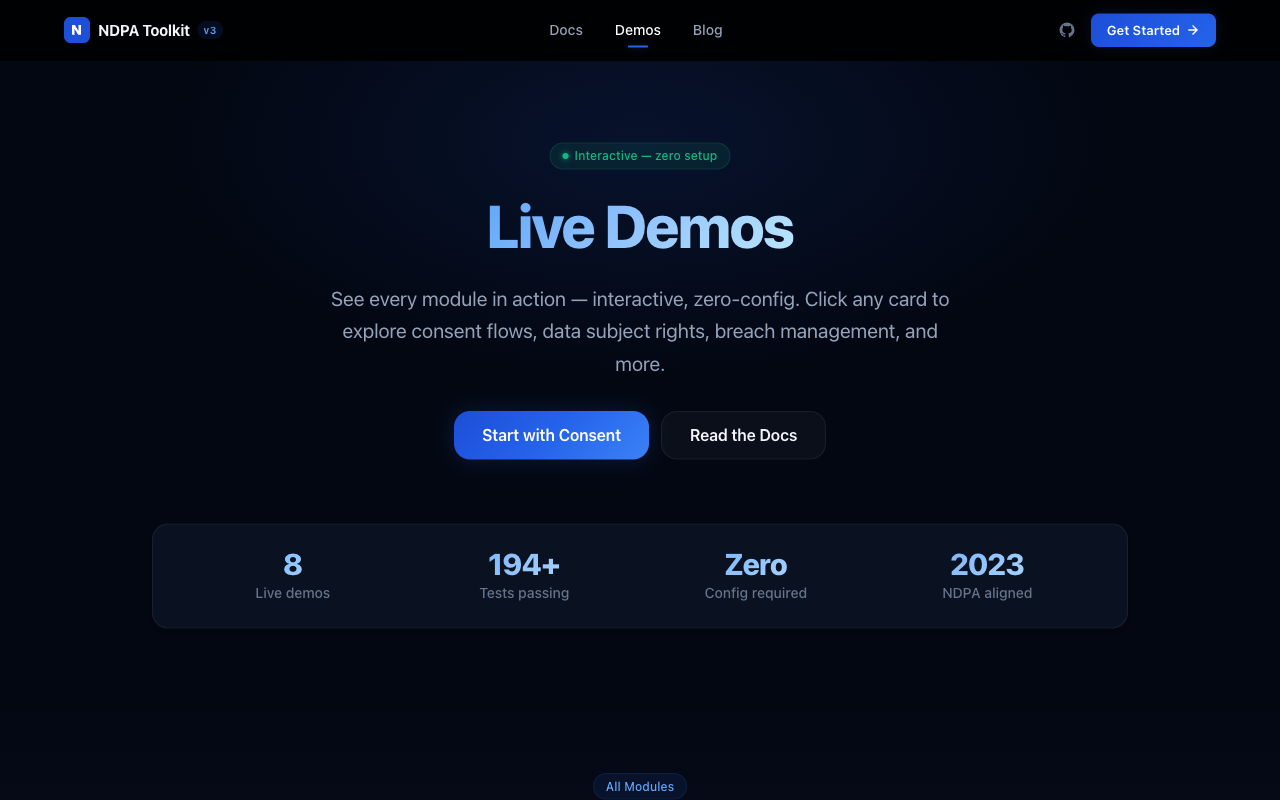
Every module has an interactive demo. No signup, no setup — try them instantly.
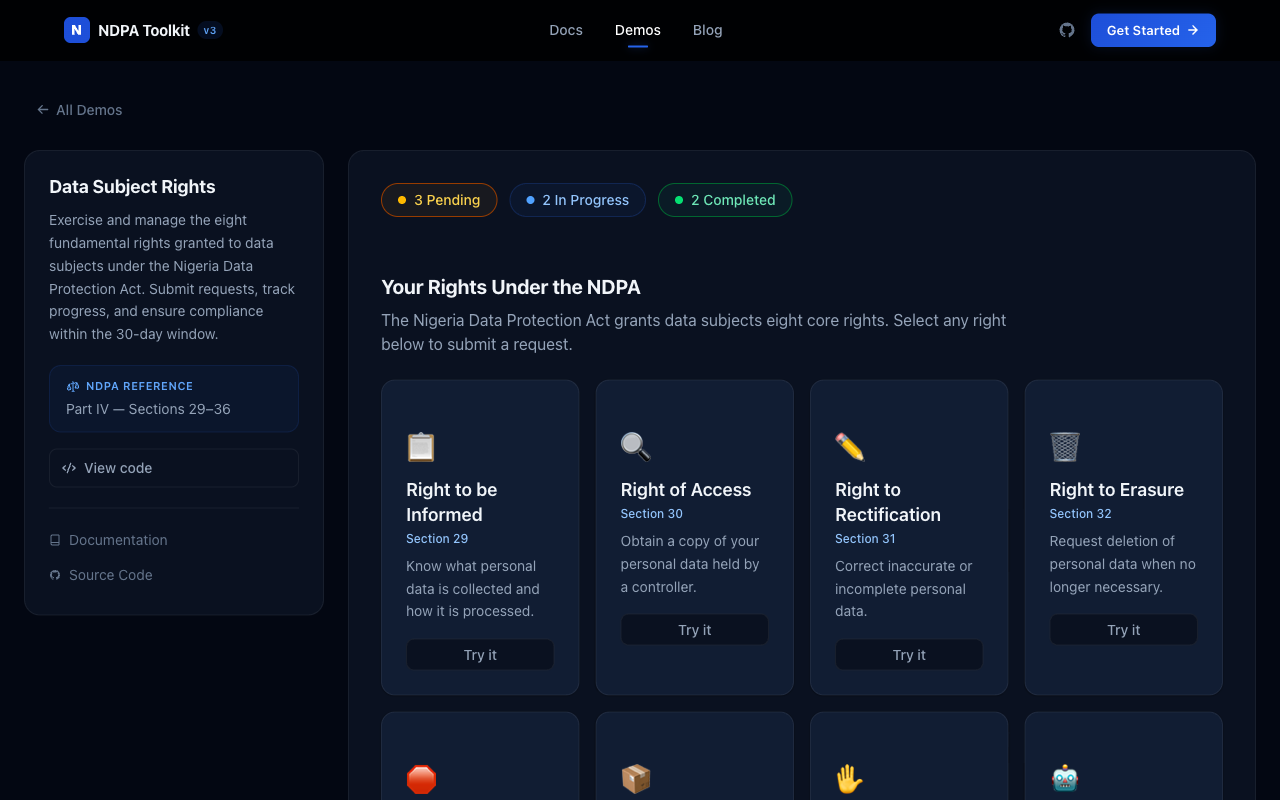
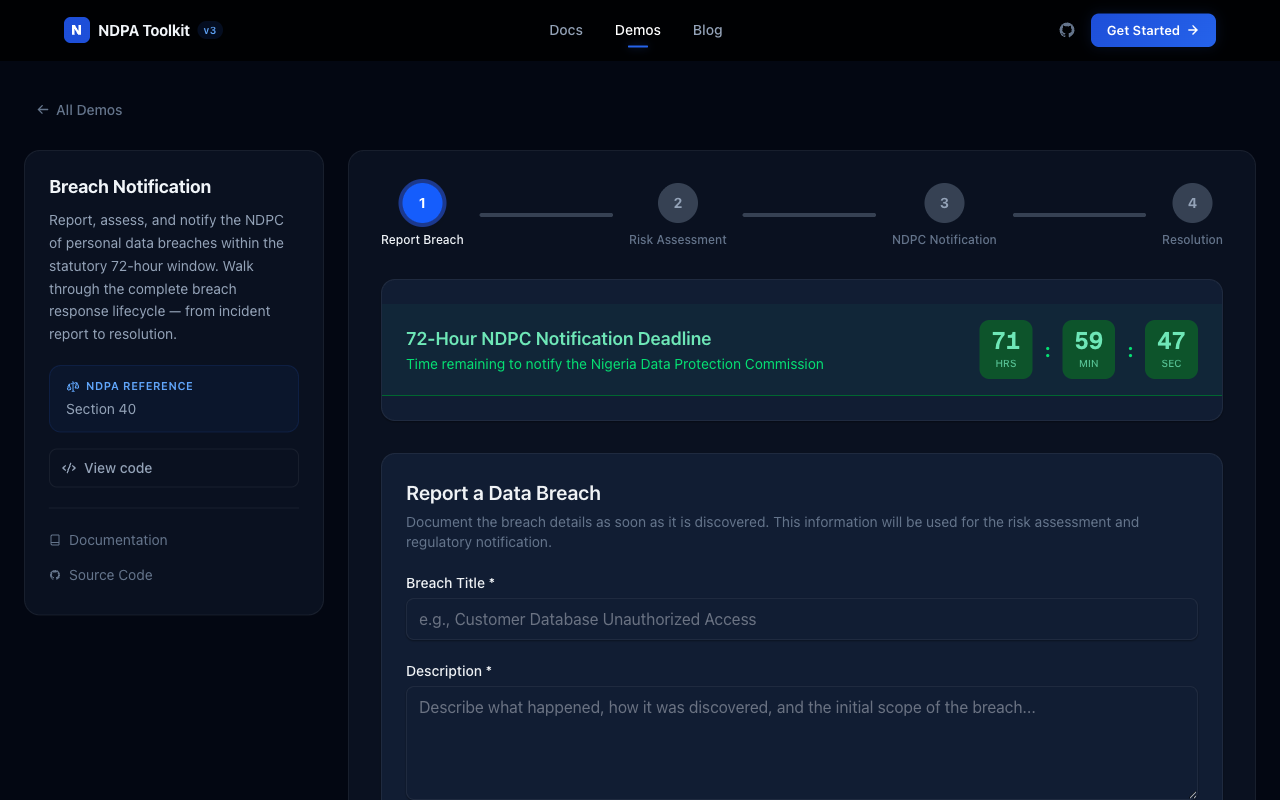
Left: Data Subject Rights portal with 8 NDPA rights. Right: Breach notification with 72-hour NDPC deadline countdown.
Each module ships a minimal Next.js scaffold you can fork in StackBlitz or CodeSandbox. One click → working app demonstrating just that module:
| Module | NDPA | Open in StackBlitz | Open in CodeSandbox |
|---|---|---|---|
| Ecommerce starter (full app) | §25–27, §34–38 | |
 |
| Consent | §26 | |
|
| DSR | §34 | |
|
| DPIA | §28 | |
|
| Breach | §40 | |
|
| Policy | §27 | |
|
| Lawful Basis | §25 | |
|
| Cross-Border | §41–43 | |
|
| RoPA | §29 | |
|
Or open the all-in-one example that demos every module in a single app.
Cookie-bridged consent that hydrates without a flash. Each scaffold reads the ndpr-consent cookie on the server, seeds the banner's show prop, then lets the browser cookieAdapter take over. See the Server-Side Storage guide for the pattern.
| Framework | Path | Open in StackBlitz |
|---|---|---|
| Next.js App Router | examples/ssr/nextjs-app-router |
|
| Remix | examples/ssr/remix |
|
| Astro | examples/ssr/astro |
|
Wrap your app in <NDPRProvider locale={...}> and every shipped component picks up the translation:
import { NDPRProvider, arabicLocale, frenchLocale } from '@tantainnovative/ndpr-toolkit/core';

<NDPRProvider locale={arabicLocale}>
  <App />
</NDPRProvider>
Seven locales ship out of the box:
| Locale | Export | Notes |
|---|---|---|
| English | defaultLocale |
Default |
| Yoruba | yorubaLocale |
|
| Igbo | igboLocale |
|
| Hausa | hausaLocale |
|
| Nigerian Pidgin | pidginLocale |
|
| Arabic | arabicLocale |
Modern Standard; RTL-aware. Set dir="rtl" on a parent and styles.css mirrors correctly (logical properties as of 4.1). |
| French | frenchLocale |
Francophone West African register; uses GDPR-equivalent French terms where they carry meaning. |
Override individual strings via mergeLocale(base, partial). Component prop overrides (title, description, etc.) still win over the provider locale — the resolution order is prop → provider locale → English default.
| Module | Import path | NDPA reference | Key exports |
|---|---|---|---|
| Consent Management | /consent |
Sections 25–26 | ConsentBanner, ConsentManager, Consent.*, useConsent |
| Data Subject Rights | /dsr |
Part VI §34–38 | DSRRequestForm, DSRDashboard, useDSR |
| DPIA | /dpia |
Section 28 | DPIAQuestionnaire, DPIAReport, useDPIA |
| Breach Notification | /breach |
Section 40 | BreachReportForm (live readiness panel), BreachRiskAssessment, useBreach, useBreachNotificationAssessment |
| Privacy Policy | /policy |
Section 27 | PolicyGenerator, PolicyPreview, PolicyExporter |
| Lawful Basis | /lawful-basis |
Section 25 | LawfulBasisTracker, useLawfulBasis |
| Cross-Border Transfers | /cross-border |
Part VIII §41–43 | CrossBorderTransferManager, useCrossBorderTransfer |
| ROPA | /ropa |
Section 29 | ROPAManager, useROPA, exportROPAToCSV |
As of 3.4.0, components ship semantic BEM-style class names (.ndpr-consent-banner, .ndpr-form-field__input, etc.) backed by a real stylesheet. Tailwind is no longer required — the package works in any host so long as you import the stylesheet once.
Default — works in any host:
// Once in your app entry
import "@tantainnovative/ndpr-toolkit/styles";<ConsentBanner options={options} onSave={handleSave} variant="card" position="bottom" />Theme via CSS custom properties:
/* Override any --ndpr-* token at :root, [data-theme="dark"], or scoped to a parent. */
:root {
  --ndpr-primary: 22 163 74;          /* RGB triplet — green-600 */
  --ndpr-radius: 1rem;
  --ndpr-font-sans: "Inter", system-ui, sans-serif;
}
Theme via typed JS object — NDPRThemeProvider (new in 3.10.0):
import { NDPRThemeProvider, type NDPRTheme } from '@tantainnovative/ndpr-toolkit';

const theme: NDPRTheme = {
  colors: { primary: '22 163 74', primaryHover: '21 128 61' },
  radius: { base: '0.75rem' },
  font: { sans: '"Inter", system-ui, sans-serif' },
};

<NDPRThemeProvider theme={theme}>
  <App />
</NDPRThemeProvider>
The provider wraps children in a single div with the --ndpr-* variables set inline. Every NDPRTheme field is optional and maps 1:1 to a CSS variable defined in the stylesheet — unset fields fall through to defaults. Same end result as raw CSS overrides; pick what fits your codebase. Full reference in the theming guide.
Light + dark mode auto-switch via prefers-color-scheme, plus an explicit opt-in via data-theme="dark" or .dark on any ancestor (or mode: 'dark' on NDPRThemeProvider).
Per-instance override via slot map:
<ConsentBanner
  options={options}
  onSave={handleSave}
  classNames={{
    root: "my-consent-banner",
    acceptButton: "btn btn-primary",
    rejectButton: "btn btn-secondary",
  }}
/>
Bring your own design system entirely:
import { ConsentBanner } from '@tantainnovative/ndpr-toolkit/unstyled';

<ConsentBanner options={options} onSave={handleSave} classNames={{ /* yours */ }} />
The /unstyled entry defaults unstyled to true, stripping every .ndpr-* class so your CSS applies unfiltered. ARIA, focus management, and data-ndpr-component attributes are preserved (those are part of the contract, not styling).
Each component exports its ClassNames TypeScript interface for autocomplete. Full reference in the docs.
| Path | What you get | Dependencies | RSC-safe |
|---|---|---|---|
. (default) |
Everything | react, optional Radix peers for /presets |
No |
/server |
Pure validators, generators, scoring, the ndpr audit engine + GAID 2025 utilities, locales, adapters, types — zero React |
tslib |
Yes |
/core |
Types, utility functions, NDPRProvider | react1 |
Partial |
/hooks |
React hooks for all 8 modules | react |
No |
/headless |
Alias of /hooks — identical exports under a more discoverable name (3.10.0) |
react |
No |
/presets |
All zero-config preset components (barrel) | react, Radix peers |
No |
/presets/consent |
Just NDPRConsent — narrower barrel for bundle size |
react, Radix peers |
No |
/presets/dsr |
Just NDPRSubjectRights |
react, Radix peers |
No |
/presets/policy |
Just NDPRPrivacyPolicy |
react, Radix peers |
No |
/adapters |
Storage adapters (localStorage, sessionStorage, cookie, api, memory, composeAdapters) | none | Yes |
/consent |
ConsentBanner, ConsentManager, Consent.* compound API, useConsent |
react |
No |
/dsr |
DSR components + hook | react |
No |
/dpia |
DPIA components + hook | react |
No |
/breach |
Breach components + hook | react |
No |
/policy |
Policy components + hook | react, jspdf ≥ 4.2.1, docx (both optional) |
No |
/lawful-basis |
Lawful basis component + hook | react |
No |
/lawful-basis/lite |
Read-only LawfulBasisTrackerLite — ~65% smaller than /lawful-basis |
react |
No |
/cross-border |
Cross-border component + hook | react |
No |
/cross-border/lite |
Read-only CrossBorderTransferManagerLite — ~89% smaller (skips the 624-row adequacy dataset) |
react |
No |
/ropa |
ROPA component + hook | react |
No |
/ropa/lite |
Read-only ROPAManagerLite — ~64% smaller than /ropa |
react |
No |
/unstyled |
All published components with unstyled defaulted to true |
react |
No |
/styles |
Default CSS stylesheet — import "@tantainnovative/ndpr-toolkit/styles" once in your app entry |
none | N/A |
PolicyExporter (and exportPDF / exportDOCX from /policy) load jspdf / docx via dynamic import() only when you actually export — they're optional peers, so consumers who don't export documents never install them. If you do export to PDF:
npm install jspdf@^4.2.1 --omit=optional      # npm
pnpm add jspdf@^4.2.1 --no-optional           # pnpm
Use jspdf ≥ 4.2.1 — earlier versions (≤ 4.2.0) carry advisories GHSA-67pg-wm7f-q7fj and GHSA-cjw8-79x6-5cj4, fixed in 4.2.1. The --omit=optional / --no-optional flag drops jspdf's own optional deps (canvg, core-js, dompurify, html2canvas); the toolkit's PDF export uses only core jsPDF text/vector APIs, so it works without them and you get a leaner, dependency-flag-free install.
The toolkit is published with sideEffects: ["*.css"], so a modern bundler (Vite, Next.js / Webpack, esbuild, Bun) will tree-shake unused exports. A few practical rules to keep your bundle small:
-
Prefer narrow subpaths over the root.
import { useConsent } from '@tantainnovative/ndpr-toolkit/hooks'is tighter than the same import from.. The root entry has more transitive exports and bundlers don't always trace them perfectly. -
Use the per-preset subpaths when you only need one preset.
import { NDPRConsent } from '@tantainnovative/ndpr-toolkit/presets/consent'is ~4 KB; the full/presetsbarrel is ~8 KB. Same for/presets/dsrand/presets/policy. -
The 3 manager components are intentionally heavy (each is ~50 KB src — full table + filter + modal + wizard UIs):
LawfulBasisTracker(from/lawful-basis)ROPAManager(from/ropa)CrossBorderTransferManager(from/cross-border)
If your app only needs the hook (e.g. you're rendering ROPA records inside your own admin UI), import from
/hooksinstead of the feature subpath — the hook chunk doesn't drag the manager component into your bundle.If your page only needs to display records (no Add / Edit / Archive / CSV export), reach for the new Lite variants from
/lawful-basis/lite,/cross-border/lite, and/ropa/liteinstead — they save ~65%, 89%, and 64% respectively. See Lite vs Full managers. -
/servercarries zero React. For Server Actions, Route Handlers, scheduled jobs, or compliance-score computation in CI, prefer/serverand you'll pay no React-tree cost.
The Nigeria Data Protection Act (NDPA) 2023 replaced the NDPR 2019 and established the Nigeria Data Protection Commission (NDPC) as the independent regulatory body.
| Aspect | NDPR (2019) | NDPA (2023) |
|---|---|---|
| Legal status | NITDA regulation | Act of the National Assembly |
| Regulator | NITDA | NDPC (independent commission) |
| Enforcement | Limited | Independent investigation and penalty powers |
| Data subject rights | 6 rights | 8 rights (added information + automated decision-making) |
| Cross-border transfers | Basic provisions | Comprehensive framework with adequacy decisions |
| Breach notification | 72 hours to NITDA | 72 hours to NDPC (Section 40) |
| DPIA | Recommended | Required for high-risk processing (Section 28) |
Written in TypeScript. All types are exported:
import type {
  // Consent
  ConsentOption, ConsentSettings,
  // DSR
  DSRRequest, DSRType, DSRStatus,
  // DPIA
  DPIAQuestion, DPIASection, DPIAResult,
  // Breach
  BreachReport, BreachCategory, RiskAssessment,
  // Policy
  PolicySection, PolicyTemplate, PrivacyPolicy,
  // Lawful Basis
  LawfulBasis, ProcessingActivity,
  // Cross-Border
  CrossBorderTransfer, TransferMechanism,
  // ROPA
  ProcessingRecord, RecordOfProcessingActivities,
  // Compliance score
  ComplianceInput, ComplianceReport, ComplianceRating,
  // Storage
  StorageAdapter,
} from '@tantainnovative/ndpr-toolkit/core';Contributions are welcome. Please read the Contributing Guide before submitting a pull request.
MIT
Abraham Esandayinze Tanta — Software Engineer & Data Protection Compliance Specialist
- GitHub: @mr-tanta
- LinkedIn: mr-tanta
- Organization: Tanta Innovative
Footnotes
-
/corere-exports the ReactNDPRProviderfor backward compatibility. For strictly server-side imports use/server— it carries the same pure validators with no React surface. ↩