




I build reliable Document AI, RAG, and agentic systems grounded in evaluation and production safeguards.
Structured Extraction · Retrieval Quality · Healthcare AI · Azure



Outcomes · Featured · Building · Principles · Writing · Certifications · Statistics · Repository · Contact
I’m an Applied AI Engineer at Deloitte, where I build and evaluate production systems for document intelligence, retrieval, and agentic workflows on Azure. My work focuses on structured extraction, retrieval quality, and deterministic safeguards—turning probabilistic models into measurable, dependable software.
Previously at Cognizant, I worked across machine learning, conversational AI, warranty analytics, and production data pipelines. Across both roles, my focus has remained consistent: moving AI beyond promising demos into systems teams can test, operate, and trust.
These team and system results come from employer-internal evaluations. Client names, source data, task definitions, schemas, and proprietary code are omitted.
- Browser task completion. Task completion increased from 38% to 80% across the same 200-task internal evaluation. My contribution was Milvus retrieval, reranking, and failure-aware routing. Sanitized case study · Related public implementations: computer-use loop and corrective retrieval.
- Browser-agent prompt tokens. Prompt-token consumption fell by approximately 40% in an internal evaluation. The baseline used raw DOM observations. My contribution was accessibility-tree snapshots and compressed observations. The evaluation size and trace details are confidential. Sanitized case study · Related public implementation.
- Structured extraction. Accuracy increased from 80–81% to above 90% on the same internal benchmark. My contribution was multi-pass extraction, confidence-aware retries, and routing. The corpus size, schemas, and scoring details are confidential. Sanitized case study · Related public implementation.
- Policy-entity extraction. Accuracy increased from 90% to 99% on the same internal benchmark. My contribution was prompt iteration, canonical comparison, and evaluation. The dataset size, policy documents, and entity schema are confidential. Sanitized case study · Related public implementation.
Selected systems demonstrating production-oriented AI engineering.
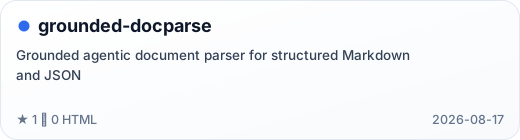
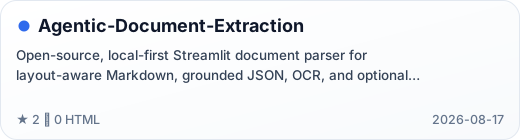
Problem. Native documents, scanned files, and mixed PDFs require different ingestion paths. OCR-only processing discards native structure. Silent fallback makes provenance difficult to audit.
Built. I built an explicitly routed document-ingestion system. It parses native PDFs with pdf-inspector and Office, CSV, HTML, and EPUB files with Docling. It keeps local OCR for scans and images. Users review native/OCR routing page by page for mixed PDFs. Immutable text spans and source anchors connect extracted values to pages, paragraphs, slides, sheets, cells, and tables. Values without exact source evidence are rejected.
Stack. Python · Streamlit · Pydantic · pdf-inspector · Docling · LangExtract · GLM-OCR · PaddleOCR-VL · vLLM
Evidence. The system supports nine explicit processing types across native PDFs, mixed PDFs, Office documents, structured files, scans, and images. It blocks incompatible file and route selections. Grounded extraction accepts only exact character intervals that resolve to source anchors. The repository tests parsing, routing, extraction, recovery, persistence, CLI, and UI contracts across 39 test modules.
Code · Screenshot · Setup · Architecture · Tests

Problem. Local adapter training requires separate hardware checks, dataset preparation, recipe configuration, checkpoint recovery, and evaluation steps.
Built. I built a guided Windows/Linux studio for local adapter training. It validates datasets before training. It checks CUDA and VRAM. It runs each job in an isolated worker with cancellation and checkpoint resume. It compares adapters with base models. It can publish adapters to the Hugging Face Hub.
Stack. Python · Streamlit · PyTorch · Transformers · TRL · PEFT · Unsloth
Evidence. The studio supports five training approaches: SFT, Reward, DPO, KTO, and ORPO. Each approach supports LoRA, QLoRA, OFT, and QOFT. The interface contains eight workflow pages. The repository contains eight test modules. CI runs formatting, linting, type checks, and tests.
Code · Screenshot · Setup · Architecture · Tests

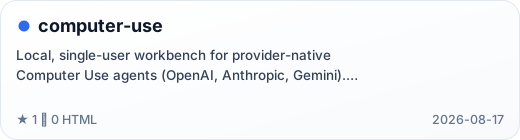
Problem. Provider-native computer-use agents expose different tool contracts and execution loops. These differences complicate consistent operation and comparison.
Built. I built a local workbench with explicit OpenAI, Anthropic, and Google execution routes. It runs agents inside a sandboxed Ubuntu/XFCE desktop. It defines primary and fallback routes. It uses short-lived credentials. It retains audit frames.
Stack. Python · FastAPI · React 19 · SQLite · Docker · OpenAI · Anthropic · Gemini
Evidence. The workbench implements three direct provider routes. Credentials expire within eight hours. Audit retention stops after seven days or 1 GiB. CI runs backend and frontend tests, dependency audits, sandbox builds, and high/critical image scanning.
Code · Screenshot · Setup · Architecture · Tests

Problem. Local and hosted models usually require separate clients. Separate clients complicate comparison, provenance tracking, and context control.
Built. I built a local-first workspace with streaming chat. It supports model comparison, replay, and response diffs. It prunes context to a defined token budget. It records provenance receipts. It quarantines prompt-injection attempts. It warns about secrets and PII. It provides local memory and RAG.
Stack. Python · FastAPI · React 19 · SQLite · ChromaDB · Ollama
Evidence. The workspace runs Ollama locally. It supports optional OpenAI, Anthropic, Gemini, OpenRouter, xAI, OpenCode, and compatible gateway routes. CI verifies provider and API contracts, workspace behavior, frontend tests, linting, and production builds.
Code · Screenshot · Setup · Architecture · Tests

LoRA Fine-tune Studio — a local application for LoRA, QLoRA, OFT, and QOFT training workflows.
Current question. How can a local studio choose safe training defaults from GPU VRAM, dataset shape, and evaluation evidence while preserving reproducible runs?
- Evaluation first. Define baselines, metrics, failure sets, and acceptance thresholds before changing a model or prompt.
- Typed boundaries. Validate LLM, tool, and API payloads before they change application state.
- Observability. Record traces, token use, retries, routing decisions, and failure reasons.
- Security. Scope credentials, validate inputs, isolate tool execution, and define retention limits.
- Extraction Quality Research. An analysis of reference quality, regression metrics, OCR failure modes, and evidence limits.
- Computer Use: Zero-to-Hero Study Handbook. A first-principles guide to computer-use agents, typed APIs, route fallback, and audited execution.
- Legal GraphRAG Architecture. An implementation note covering ingestion, hybrid retrieval, graph construction, and evaluation.
Anthropic Education certificates (4)
Selected Anthropic Education course certificates. Select a certificate to open the source PDF.


A layered view of the tools I use to build, evaluate, and ship AI systems.
AI & Model Engineering
Transformers · TRL · PEFT · LangGraph · vLLM
Models & Agent Interfaces
Structured outputs · provider-native tool interfaces
Applications & APIs
Document processing: Docling
Data & Retrieval
ChromaDB · FAISS
Delivery & Quality
Ruff · mypy/ty · evaluation harnesses · tracing · failure analysis

Advanced GitHub dashboard
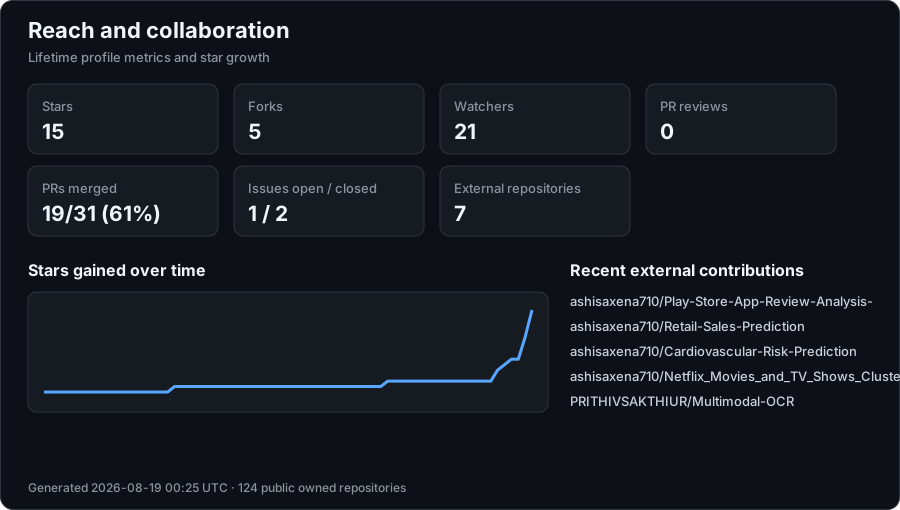
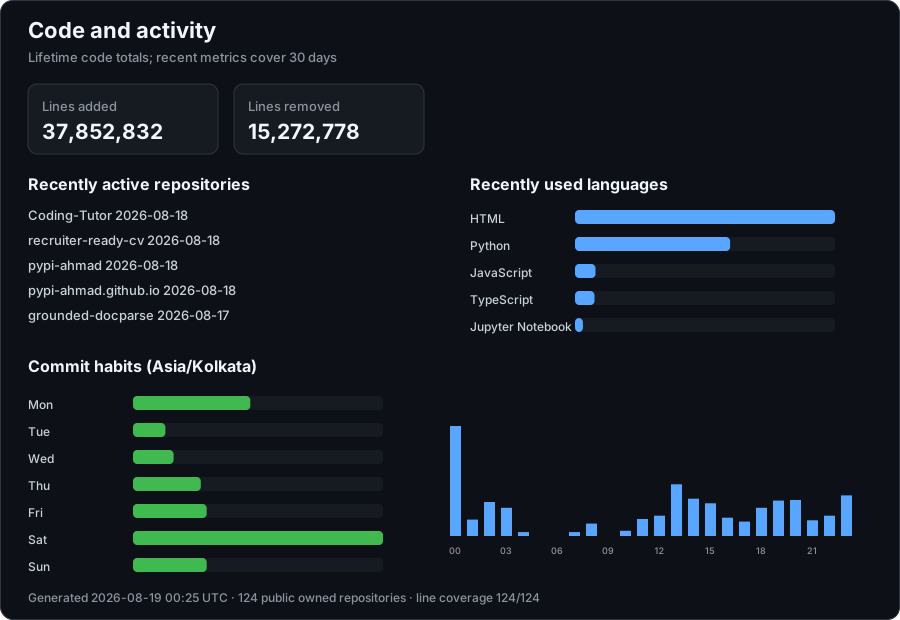
Native GitHub Statistics
GitHub already shows:
- Contribution calendar and yearly contribution totals
- Activity feed and activity overview
- Followers and following counts
- Achievements and badges
- Up to six pinned repositories or gists
Source: GitHub profile documentation.
GitHub Readme Stats can show:
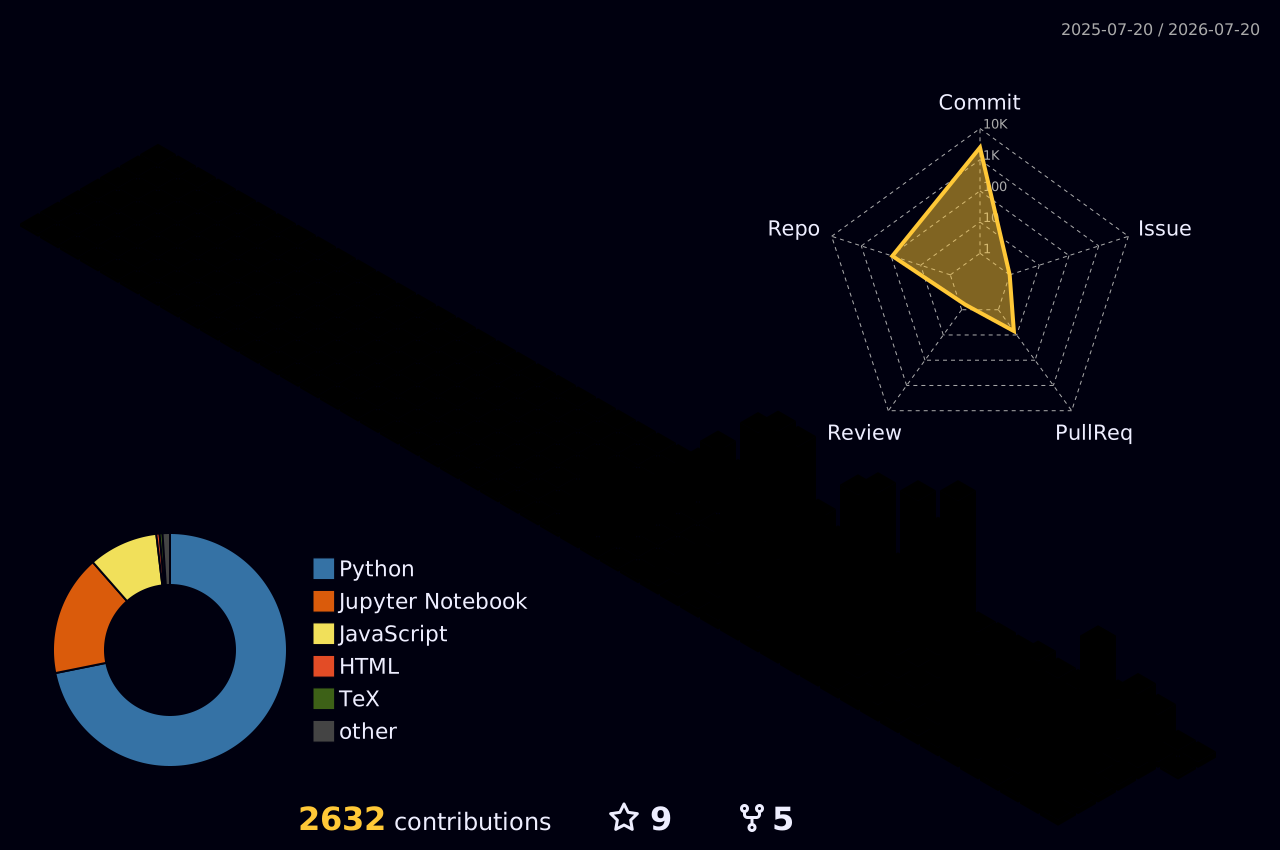
- Total stars earned, commits, pull requests, issues, contributed repositories, and rank
- Top languages by repository code size
- Individual repository descriptions, stars, forks, issues, and primary languages
- Gist statistics
- WakaTime coding-time statistics
Top languages measure repository bytes, not skill level. The original project is no longer maintained, so this profile generates its cards with the maintained GitHub Readme Stats Action.
GitHub Streak Stats shows:
- Total contributions
- Current contribution streak
- Longest contribution streak
- Streak dates and contribution-calendar history
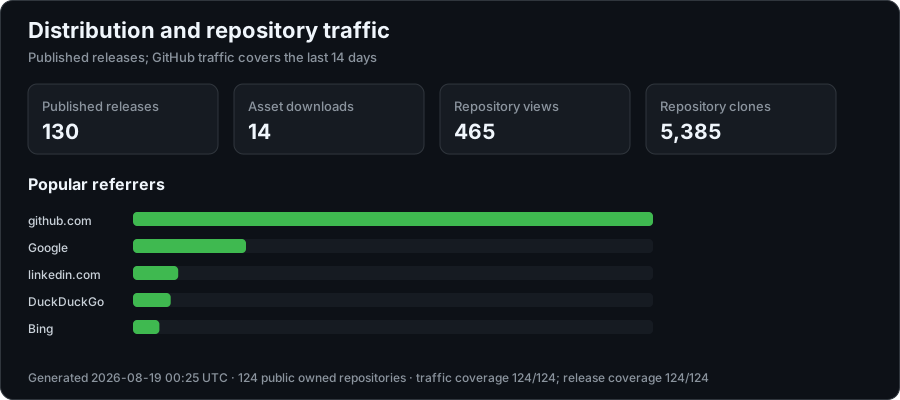
The generated dashboard shows:
- Lifetime stars, forks, watchers, pull-request reviews, merge rate, issue status, and external contributions
- Recently active repositories, recently used languages, lifetime lines changed, and 30-day coding habits
- Published releases, release-asset downloads, and 14-day repository traffic
Statistics cover public, owned, non-fork, non-archived repositories. GitHub traffic is available only for the latest 14 days. Release downloads count uploaded assets, not source archives.
Contribution arcade




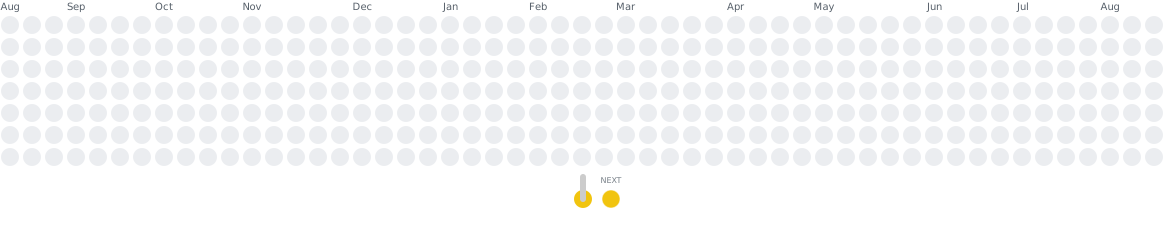

Contribution history
Source of record is main. Latest snapshot: 2026-08-13. Changelog: CHANGELOG.md.
- Profile and outcomes:
README.md,docs/sanitized-outcomes.md,DATASET.md - Governance:
CONTRIBUTING.md,SECURITY.md,CODE_OF_CONDUCT.md - Analysis artifacts:
.codegraph/,.firecrawl/,.ua/,graphify-out/(graph report)
Open to selective remote-first Applied AI and GenAI engineering roles. I focus on Document AI, RAG, evaluation, and computer-use systems.
Based in Gurugram, India — IST (UTC+05:30).
Made with ❤️ by Ahmad Mujtaba