Agent Execution Runtime Operating System
A capability-packaged operating architecture for embodied intelligent systems.
Paper: arXiv:2604.07039
One Robot = One Persistent Agent. Capabilities = Installable Packages.
+-----------------------------------------------+
|             Persistent Agent                  |
|        (sense -> plan -> act loop)            |
+-----------------------------------------------+
|             ECM Manager                       |
|   +----------+ +----------+ +----------+      |
|   | dumpling | |pick_place| |  clean   |      |
|   | ECM      | | ECM      | |  ECM     |      |
|   +----------+ +----------+ +----------+      |
+-----------------------------------------------+
|             Runtime Layer                     |
|  Policy - Permissions - Audit - Trace         |
+-----------------------------------------------+
|         Perception + World State              |
+-----------------------------------------------+
|         Robot API (Mock / Gazebo)             |
+-----------------------------------------------+
|         Hardware / Simulation                 |
+-----------------------------------------------+
git clone https://github.com/s20sc/aeros.git
cd aeros
pip install -r requirements.txt
cd runtime-mvp
python main.py          # Interactive mode
bash demo.sh            # Or run the automated demo
AEROS Runtime v1.0
Type "help" for commands
>>> make dumplings
>>> clean table
>>> pick up the cup
To launch the web UI (in a second terminal):
cd ui && python3 -m http.server 8000
# Open http://localhost:8000, click "Live Mode: ON"The agent doesn't execute a fixed script. It runs a sense → plan → act loop:
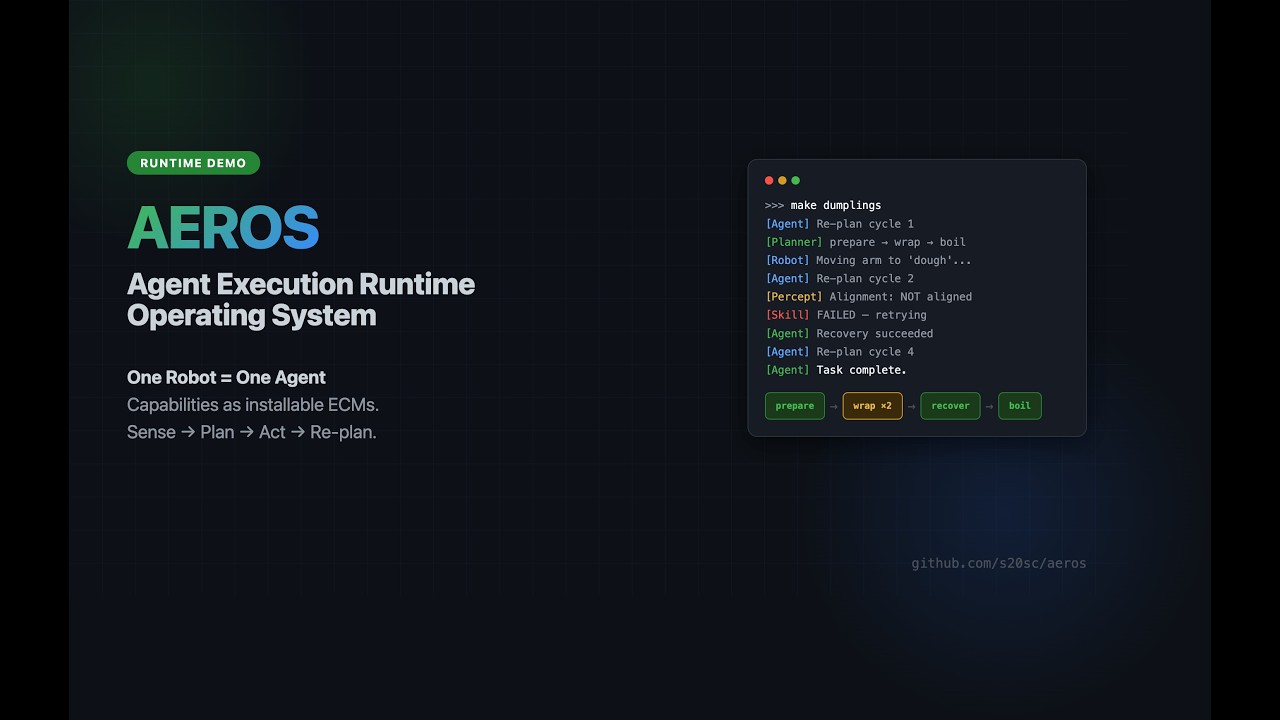
>>> make dumplings

[Agent]    === Re-plan cycle 1 ===
[Planner]  -> dumpling.prepare (materials needed)
[Planner]  -> dumpling.wrap (wrapping needed)
[Planner]  -> dumpling.boil (cooking needed)
[Planner]  Dynamic plan: 3 step(s)
[Agent]    Executing next: dumpling.prepare
[Robot]    Moving arm to 'dough_station'...
[Robot]    Grasping...

[Agent]    === Re-plan cycle 2 ===
[Planner]  -> dumpling.wrap (wrapping needed)    ← prepare done, skipped
[Planner]  -> dumpling.boil (cooking needed)
[Agent]    Executing next: dumpling.wrap
[Percept]  Workspace ready: True
[Percept]  Wrapper alignment check: aligned
[Robot]    Moving arm to 'dough'...

[Agent]    === Re-plan cycle 3 ===
[Planner]  -> dumpling.boil (cooking needed)     ← wrap done, skipped
[Agent]    Executing next: dumpling.boil

[Agent]    === Re-plan cycle 4 ===
[Planner]  Nothing to do — task already complete.
Each cycle: planner reads world state, generates only the steps still needed, executes one, then re-plans.
>>> cut with knife
[Runtime]  DENIED: unsafe.cut — blocked_risk_level:high

>>> block dumpling.wrap
[Runtime]  Blocked: dumpling.wrap
>>> make dumplings
[Agent]    Step 2 blocked by policy — task graph halted.
| Layer | Mechanism |
|---|---|
| Operator override | block / unblock commands |
| ECM declaration | allowed_skills whitelist in permissions.yaml |
| System policy | Risk levels + actuator scope enforcement |
[Skill]    ERROR: filling leaked during fold
[Agent]    Failed — retrying (2/3)
[Skill]    ERROR: filling leaked during fold — retrying (3/3)
[Agent]    Triggering fallback: dumpling.recover
[Skill]    Initiating recovery procedure...
[Skill]    Wrapper alignment corrected.
[Agent]    Recovery succeeded — continuing execution.
[Agent]    Step 3/3: dumpling.boil — OK
>>> list
[*] com.aeros.dumpling     v3.0.0  activated
[*] com.aeros.pick_place   v1.0.0  activated
[*] com.aeros.clean_table  v1.0.0  activated
[x] com.aeros.unsafe       v1.0.0  uninstalled

>>> deactivate com.aeros.dumpling
>>> make dumplings
[Agent]    Skill not found — task blocked.
>>> activate com.aeros.dumpling
>>> make dumplings
[Agent]    Task complete.
Skills perceive the world before acting. The planner adapts based on what has changed.
>>> world
=== WORLD STATE ===
  robot_position: pot
  dumpling_cooked: True
  table_wiped: True
  table_organized: True
The Trace Viewer shows real-time execution with:
- World State panel — color-coded environment properties
- Execution Flow — node graph with retry/failure indicators
- Mermaid Graph — auto-generated flowchart
- Timeline — proportional duration bars per step
- Step Details — full state transition table
- Replay — step-by-step playback animation
- Live Mode — auto-refreshes as the runtime executes
| Command | Description |
|---|---|
<instruction> |
Run a task ("make dumplings", "clean table", "pick up the cup") |
list |
Show all ECMs with state, skills, permissions |
install <path> |
Install and activate an ECM |
activate <id> |
Activate a deactivated ECM |
deactivate <id> |
Deactivate (skills become unavailable) |
uninstall <id> |
Remove an ECM |
block <skill> |
Operator override: block a skill |
unblock <skill> |
Remove operator block |
world |
Inspect current world state |
audit |
View policy decision log |
trace |
View execution trace table |
trace viz |
Compact one-line execution graph |
trace mermaid |
Generate Mermaid flowchart |
trace save |
Export trace to JSON file |
trace json |
Print trace as JSON |
Each robot contains exactly one persistent agent — the sole locus of decision-making, memory, and identity.
All capabilities are delivered through ECMs — modular, versioned, installable packages. A robot gains new abilities by installing ECMs, not by rewriting its core.
Skills define what to do. The runtime defines what is allowed. No skill can bypass the runtime.
aeros/
├── spec/           Architectural specifications
├── schemas/        Machine-readable JSON schemas
├── examples/       Reference ECM definitions (YAML)
├── runtime-mvp/    Working runtime implementation (Python)
│   ├── agent/        Agent + planner + re-planning loop
│   ├── ecm/          ECM loader + registry + lifecycle
│   ├── runtime/      Policy, audit, trace, robot API, world state, perception
│   └── examples/     4 ECMs: dumpling, pick_place, clean_table, unsafe
├── ui/             Web-based trace viewer + live dashboard
└── docs/           Developer guide
This repository provides the reference implementation for:
AEROS: A Runtime Architecture for Embodied Agents with Installable Capability Modules arXiv:2604.07039
The formal ECM definition
| Paper Symbol | Implementation |
|---|---|
|
|
capabilities field in ecm.yaml
|
|
|
skills field + Python modules in skills/
|
|
|
models field in ecm.yaml
|
|
|
permissions.yaml per ECM |
|
|
version, dependencies, compatibility in ecm.yaml
|
This is a lightweight reference implementation intended to demonstrate the architectural principles described in the paper. It is not production-ready.
- Policy enforcement is declaration-based: the runtime validates declared permissions but does not sandbox skill code at the OS level. A malicious skill could bypass declared constraints.
- Single-process, single-thread: no concurrency or real-time guarantees. Skills execute sequentially.
- No wall-clock timeout: the re-planning loop has a max cycle count (
MAX_REPLAN_CYCLES=10) but no per-skill time limit. - Mock robot only: the
Robotclass simulates hardware calls viatime.sleep(). Integration with ROS 2 / Gazebo is not included in this MVP. - No persistent storage: world state and agent memory reset on restart.
If you use this code in your research, please cite:
@article{qin2026aeros,
  title={AEROS: A Runtime Architecture for Embodied Agents with Installable Capability Modules},
  author={Qin, Xue and Luan, Simin and See, John and Yang, Cong and Li, Zhijun},
  journal={arXiv preprint arXiv:2604.07039},
  year={2026}
}Apache 2.0 — see LICENSE for details.