- Looks up canonical transcript properties for gene, using Ensembl API.
- includes nucleotide and AA sequences, and CDS coordinate intervals.
- Coordinate conversion from hg19 position to CDS indices, and vice versa.
- Get nucleotide sequences for arbitrary hg19 intervals.
- Look up trinucleotide context (e.g. for Lego plot) and identify CpG sites for mutation categorization and mutational signature quantification.
- Build BED files for silent/nonsilent transition/transversion sites.
- These can be useful for generating custom coverage files for MutsigCV.
Compatible with Python 2 and 3.
Look up gene using CanonicalInfo class.
gene = gene_info.CanonicalInfo('TP53')This will create an object with the following attributes:
hugo_symbol       'TP53'
chrom             '17'
gene_id           'ENSG00000141510'
transcript_id     'ENST00000269305'
strand            -1
n_exons           11
n_codons          394
cdna_len          2579
cds_len           1182
n_cds_intervals   10
cds_intervals     [(7579839, 7579912), (7579700, 7579721), ..., (7572927, 7573008)]
aa_seq            Seq('MEEPQSDPSVEPPLS...SD*', HasStopCodon(IUPACProtein(), '*'))
cds_seq           Seq('ATGGAGGAGCCGCAGTCAGATCCTAGCGT...TGA', IUPACUnambiguousDNA())
The initializer attempts to extract Ensembl transcript IDs and gene IDs from a bundled data file, with mappings from BioMart. Failed lookups (which may result from unofficial or out-of-date gene symbols) will fall back on the API. Alternatively, you can specify the ensembl transcript ID and/or gene ID if you have them.
Map from CDS index to genome coordinates:
gene.get_hg_coord(0)>>> 7579912
...and vice versa:
gene.get_cds_index(7579912)>>> 0
Provide a chromosome, start position and end position (both 1-based) for nucleotide sequence lookup:
gene_info.lookup_hg19('12', 25398285, 25398290)>>> >12:25398285-25398290
CAGCTC
Get a basic categorization for a specified mutation as {CpG, C:T, A:T} and {transition, transversion}, for use in MutSigCV, for example.
gene_info.get_mutation_category('12', 25398285, 'C', 'A')>>> 'C:G_transversion'
Alternatively, get the trinucleotide context, relative to the corresponding pyrimidine mutation, used for Lego plots:
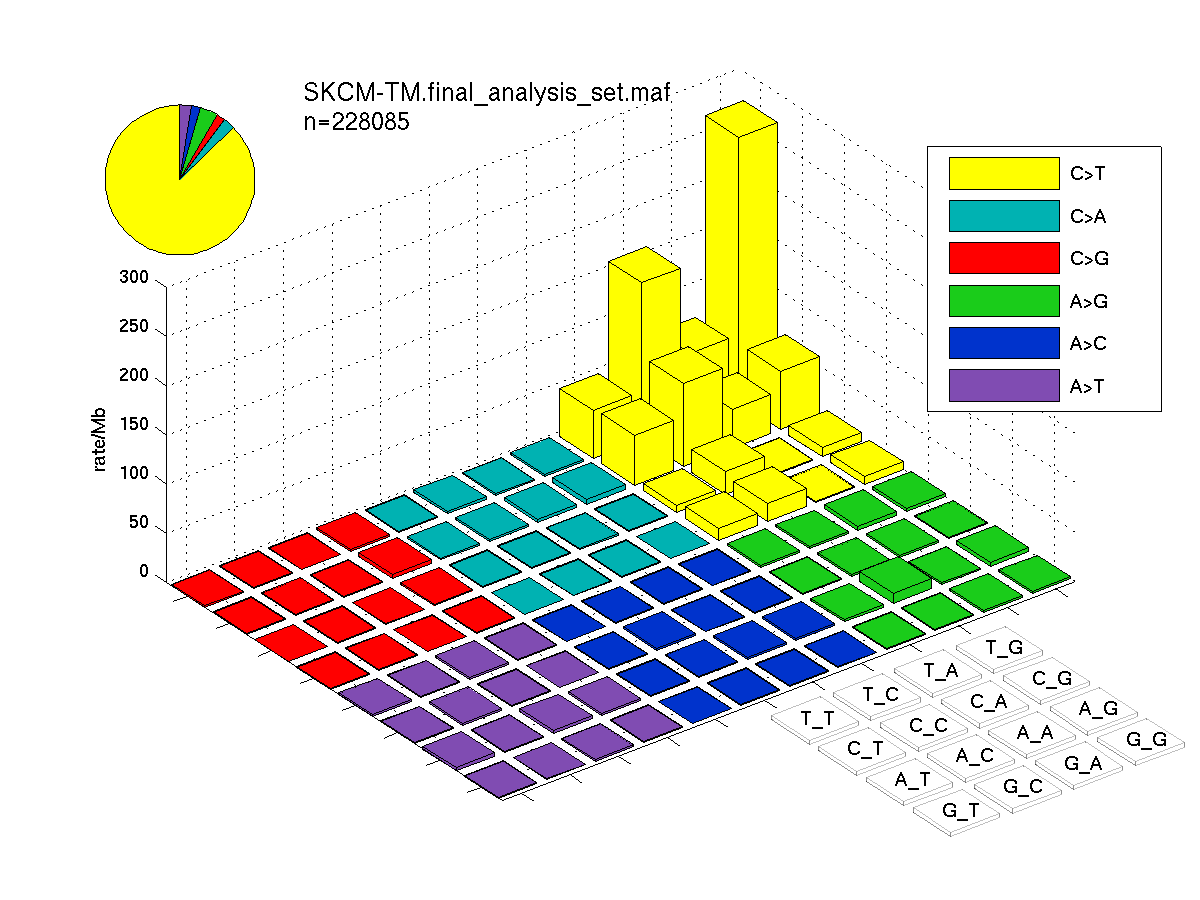
gene_info.get_mutation_category_lego('12', 25398285, 'C', 'A')>>> ('C', 'C>A', 'A')
Obtain BED files for silent/nonsilent transition/transversion sites by providing an iterable of hugo symbols:
gene_info.get_beds_for_hugo_list(['KRAS', 'TP53'])This creates four BED files in the current directory, each containing all corresponding sites for the specified genes:
- roi_ns_tv_final.bed
- roi_ns_ts_final.bed
- roi_s_ts_final.bed
- roi_s_tv_final.bed
You can specify paths for each file using method parameters.
This package requires bedtools and a fasta file for hg19.
An hg19 reference fasta is available from the 1000 genomes project at: ftp://ftp.1000genomes.ebi.ac.uk/vol1/ftp/technical/reference/
- Download human_g1k_v37.fasta{.gz, .fai} to a directory of your choice and unzip the .gz file.
With bedtools installed and a fasta file downloaded, modify the config.ini file in
the directory gene_info/config to specify their paths.
Finally, from the root directory of the package, run python setup.py install to
install into your current Python environment.
Copyright (C) 2016 Stephen Gaffney

This program is free software: you can redistribute it and/or modify
it under the terms of the GNU General Public License as published by
the Free Software Foundation, either version 3 of the License, or
(at your option) any later version.

This program is distributed in the hope that it will be useful,
but WITHOUT ANY WARRANTY; without even the implied warranty of
MERCHANTABILITY or FITNESS FOR A PARTICULAR PURPOSE.  See the
GNU General Public License for more details.

You should have received a copy of the GNU General Public License
along with this program.  If not, see <http://www.gnu.org/licenses/>.