OpenAI Gym Env for crypto trading based on Jupiter aggregator
This gym environment is NOT a simulation, it is based on real-world crypto trading on the Solana blockchain.
If you require a simulated environment, please try to use OpenAI ASX GYM, which is an OpenAI Gym based on the Australian Stock Market.
So if you need to trade with your agent, you need a Solana wallet (keypair) and some SOL (a minimum of 1 SOL is recommended). or you can use the provided NoActionAgent to get a glimpse of the gym environment.
The default Jupiter trading pair is SOL and USDC since it's the most common trading pair on Solana.
The environment can easily switch to different pair if you prefer, but that requires some knowledge of the Solana blockchain.
Gym is a standard API for reinforcement learning, and a diverse collection of reference environments. This is a Solana Trading Environment uses OpenAI Gym interface, like Actions, Observations, etc. Gym implements the classic “agent-environment loop”:
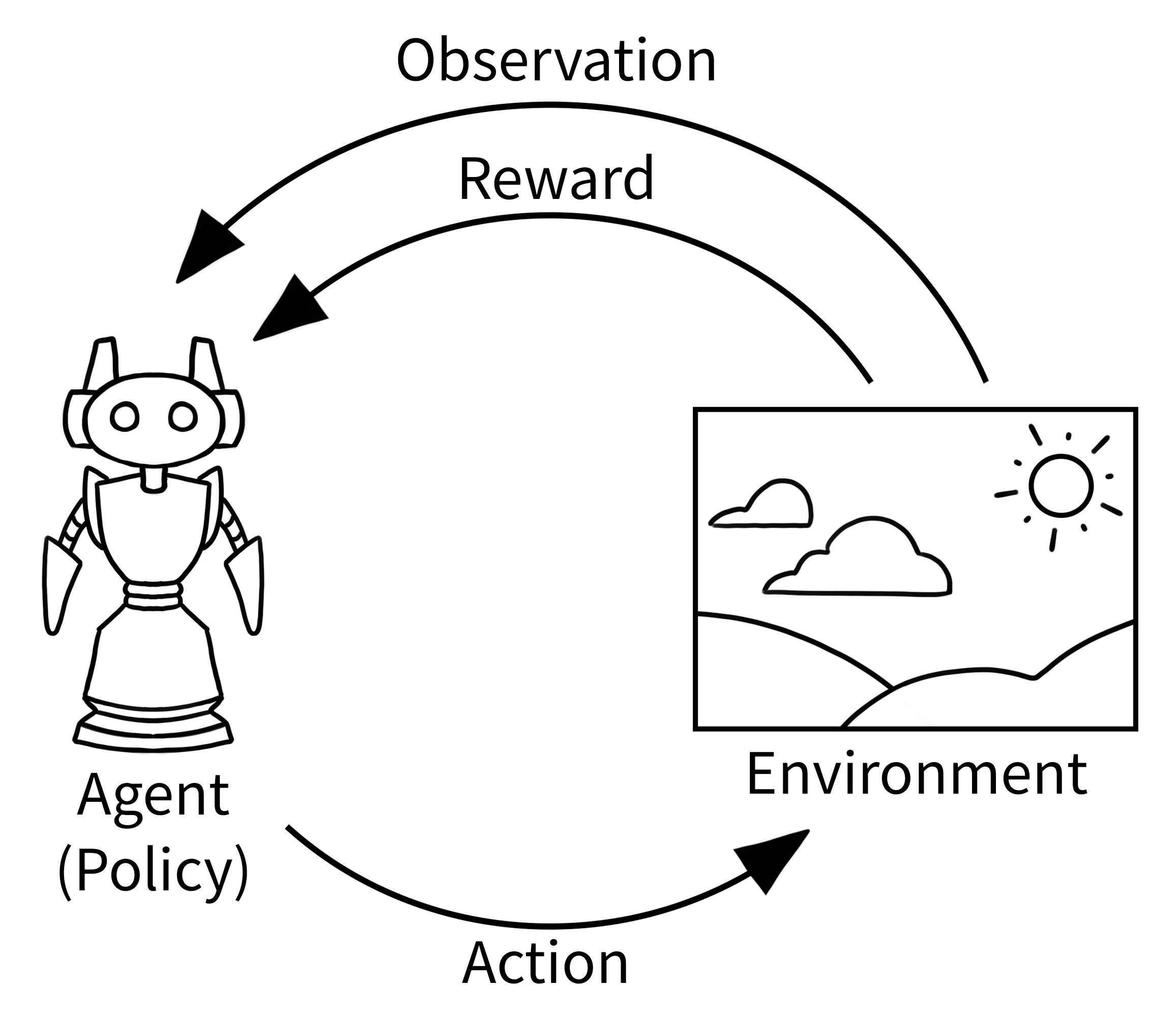
In the Solana Gym Environments, there are 5 actions agent can perform:
self.action_space = spaces.Dict(
            {
                "operation": spaces.Discrete(5, start=1),
                "amount": spaces.Box(low=np.float32(0),
                                     high=np.float32(MAX_AMOUNT_VALUE),
                                     shape=(1,),
                                     dtype=np.float32),
            }
)- no_action = 1 # do nothing
- buy_sol = 2 # buy SOL with USDC
- buy_base = 3 # sell SOL for USDC
- convert_base_sol_base = 4 # Arbitrage from USDC->SOL ,SOL->USDC ,in parallel
- convert_sol_base_sol = 5 # Arbitrage from SOL->USDC , USDC->SOL ,in parallel
amount: specify the amount of SOLs or USDC need to trade. for USDC, its unit is dollar, for SOL it's SOL amount.
self.observation_space = spaces.Dict(
            {
                "sol_amount": spaces.Box(low=0,
                                         high=LAMPORTS_PER_SOL * 10000,
                                         shape=(1,),
                                         dtype=np.int64),
                "base_amount": spaces.Box(low=0,
                                          high=BASE_PER_USDC * 100000,
                                          shape=(1,),
                                          dtype=np.int64),
                "wrapped_sol_amount": spaces.Box(low=0,
                                                 high=LAMPORTS_PER_SOL * 10000,
                                                 shape=(1,),
                                                 dtype=np.int64),
                "sol_unit_price": spaces.Box(low=0,
                                             high=BASE_PER_USDC * 100000,
                                             shape=(1,),
                                             dtype=np.int64),
                "adjusted_sol_amount": spaces.Box(low=0,
                                                  high=10000.0,
                                                  shape=(1,),
                                                  dtype=np.float32),
                "timestamp": spaces.Box(low=10000000000,
                                        high=30000000000,
                                        shape=(1,),
                                        dtype=np.int64),
                "adjusted_base_amount": spaces.Box(low=0,
                                                   high=100000.0,
                                                   shape=(1,),
                                                   dtype=np.float32),
                "change_rate_base_amount": spaces.Box(low=0,
                                                      high=100000.0,
                                                      shape=(1,),
                                                      dtype=np.float32),
                "change_rate_sol_price": spaces.Box(low=0,
                                                    high=100000.0,
                                                    shape=(1,),
                                                    dtype=np.float32),

                "total_trades": spaces.Box(low=0,
                                           high=1000000,
                                           shape=(1,),
                                           dtype=int),
                "success_trades": spaces.Box(low=0,
                                             high=1000000,
                                             shape=(1,),
                                             dtype=int),
                "failed_trades": spaces.Box(low=0,
                                            high=1000000,
                                            shape=(1,),
                                            dtype=int),
                "exceptions": spaces.Box(low=0,
                                         high=1000000,
                                         shape=(1,),
                                         dtype=int),

}- sol_unit_price Sol prices at give timestamp
- sol_amount total SOL amount (native SOL + wrapped SOL)
- wrapped_sol_amount wrapped SOL amount
- base_amount here base mean USDC (stable coin) amount
- adjusted_sol_amount , the total SOL value of all tokens (SOL + USDC) ,based on sol price at current timestamp
- adjusted_base_amount, the total USDC value of all tokens (SOL + USDC), based on sol price at current timestamp
- change_rate_base_amount, adjusted_base_amount value change rate (in percentage since episode starts)
- change_rate_sol_price, sol_unit_price change rate (in percentage since episode starts)
- total_trades, how many trades since current episode starts
- success_trades, successful trades since current episode starts
- failed_trades, failed trades since current episode starts
- exceptions, program exceptions counter
The default rewards is the changes of adjusted_base_amount (total asset value)
    def _is_done(self) -> bool:
        done = False
        self.done_condition_type = DoneConditionType.others
        if self.exception_count > 100:
            done = True
            self.done_condition_type = DoneConditionType.too_many_exceptions
        elif abs(self.change_rate_base_amount) > self.change_rate_limit:
            done = True
            self.done_condition_type = DoneConditionType.change_rate_limit
        elif self.step_count > self.max_step_for_one_episode:
            done = True
            self.done_condition_type = DoneConditionType.max_step
        elif (not self.disable_low_balance_checking) and self.current_trade \
                and self.current_trade.adjusted_base_amount < 10:
            done = True
            self.done_condition_type = DoneConditionType.insufficient_fund

        return done
Default done condition is total asset values +20% or -20%, or step reaches 2400 steps, or no enough fund, these values are configable .
render for an environment actually is optional. Here ASX Gym provides 3 render modes:
metadata = {'render.modes': ['human', 'ansi', 'rgb_array']}Use OpenAI Wrappers, you can change the definitions of default implementations of Actions, Rewards, Done Conditions, Observations.
Wrappers are a convenient way to modify an existing environment without having to alter the underlying code directly. Using wrappers will allow you to avoid a lot of boilerplate code and make your environment more modular. Wrappers can also be chained to combine their effects.
Jupiter is the key liquidity aggregator for Solana, offering the widest range of tokens and best route discovery between any token pair.
Install the OpenAI gym.
pipenv installThen install this package via The code as tested with Python 3.10. so better use 3.10+ or the latest python version. and uses pipenv to manage python packages.
[packages]
aiohttp = "*"
mplfinance = "*"
opencv-python = "*"
matplotlib = "*"
pandas = "*"
pyglet = "*"
ipython = "*"
numpy = "*"
gym = "===0.24.0"
base58 = "*"
solana = "*"
python-dotenv = "*"

[dev-packages]

[requires]
python_version = "3.10"
pip install -e .
the environment requires a wallet keypair , you can use phantom wallet to export the private key
also default solana rpc end point is https://solana-api.projectserum.com, if you have your own rpc node ,you can configure it as following
 in the .env file
SOLANA_WALLET_PRIVATE_KEY=2TCzhvyyBFpzXPVYXTJxSBWtRhJ...
SOLANA_RPC_URL=https://solana-api.projectserum.com
from logging import INFO

import base58
import gym
from dotenv import dotenv_values
from solana.keypair import Keypair

from agents.SimpleArbitrageAgent import SimpleArbitrageAgent
from jupiter_gym.envs import SOLANA_RPC_URL

config = dotenv_values(".env")
secret_passphrase = config['SOLANA_WALLET_PRIVATE_KEY']
solana_rpc_url = SOLANA_RPC_URL
if 'SOLANA_RPC_URL' in config:
    solana_rpc_url = config['SOLANA_RPC_URL']
keyPairArray = [x for x in base58.b58decode(secret_passphrase)]
keypair = Keypair.from_secret_key(bytes(keyPairArray))
print(f'Public key:{str(keypair.public_key.to_base58())}')
print(f'Solana rpc url:{solana_rpc_url}')


def main():
    gym.logger.set_level(INFO)
    min_init_base_mint = 5
    min_init_sol_mint = 0.2

    env = gym.make("JupiterGym-v0", disable_env_checker=True, keypair=keypair, min_init_base_mint=min_init_base_mint,
                   min_profit_base_mint=100,
                   min_init_sol_mint=min_init_sol_mint, min_profit_sol_mint=1000, min_wait_period=1,
                   disable_low_balance_checking=True,
                   max_step_for_one_episode=2400,
                   solana_rpc_url=solana_rpc_url
                   )

    agent = SimpleArbitrageAgent(env, convert_sol_amount=min_init_sol_mint, convert_base_amount=min_init_base_mint + 1)
    # agent = NoActionAgent(env)
    # agent = BuyAndHoldAgent(env, convert_sol_amount=min_init_sol_mint)
    env.reset()
    for _ in range(2400 * 100):
        env.render()
        observation, reward, done, info = env.step(agent.action())
        if done:
            env.reset()
        if observation is not None:
            print(observation)

    env.close()


if __name__ == "__main__":
    main()

The agent directory provides a couple of simples agents for your reference.

You can implement your own smarter agent ,hope you can gain some profit with your trading bots.
Solana Gym creates some data and images each step Agent interacts with the Environment.
when in 'human' or 'rgb_array' render mode, Asx Gym save all images in this directory, you can use these images to create videos.
Store trading history in the data directory.
NOTE: I don't charge any fee and there's no hidden fee from me. But there's some cost you need to know.
-
Solana account cost, Solana blockchain charges storage fee. A token account is a storage, currently each account cost 0.00203928 SOL (about $0.07343447 at the moment). Account
-
Jupiter Transaction fee .
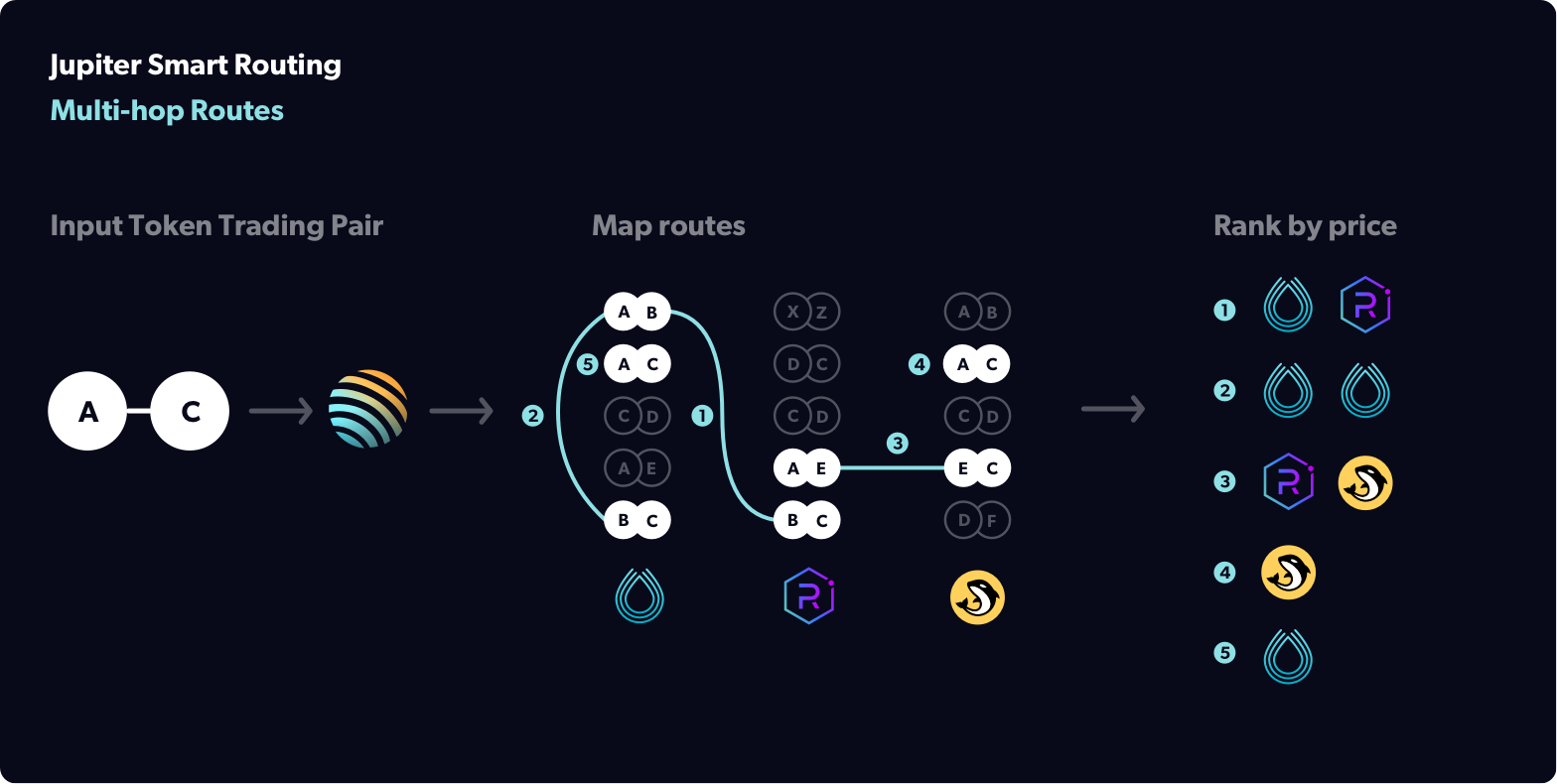
Here is the diagram of Jupiter routing
For indirect route ,if you don't have the intermediate token (i.e SOL -> SERUM -> USDC) a securm token account need to be created first (only once), this cost 0.00203928 SOL. also for the liquidity pool (for example, if Jupiter uses radium swap, Radium swap may charge some fee)
-
Solana Transaction fee.
For each transaction (failed or success), solana charges 5000 lamport (0.000005SOL),almost nothing. but if you do millions of thousands of trades,there will some cost need to be considered.
The Solana White Paper states that the theoretical limit for a 1-gigabit (equal to 125 MB per second) network is 710k tps, but at the moment, the real transaction is around 3000tps. less than 1% of 710k. And for each "write" transaction, it may take over 10 seconds to commit, and the failure rate is pretty high ( 20%+). The most challenge part is the "inconsistency" among solana nodes, since translations requires some time to propagate to the nodes. so the responses returned from the RPC node may have conflict results with the same request.
This is based on real-world trading platform, it allows you to test your trading bot, it doesn't promise profit and might incur losses.Use it at your own risk.
If you like this project and want to donate , please donate to SOL wallet address:
GYMTaSY6vhTDTGw6qTs5W4kg8URG4zoAjzV9v5C9XTNs