Bootstrap AI agent teams from modular templates.


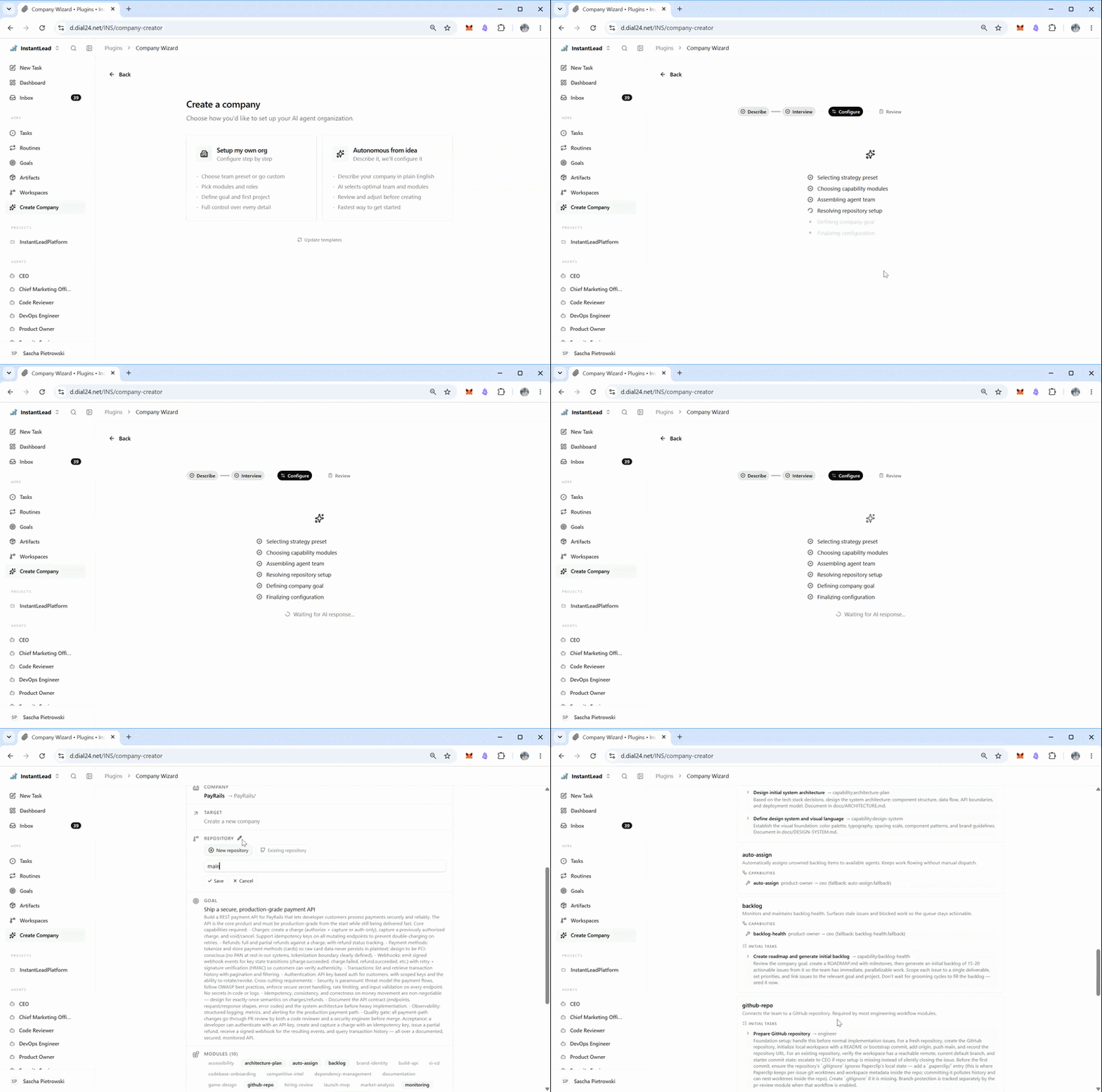
Fork: This is a community-maintained fork of yesterday-AI/paperclip-plugin-company-wizard, updated for Paperclip plugin API v1 and the current published SDK with substantial bug fixes. End-to-end company setup is governed through current Paperclip workflows as of v0.5.0.
Version 0.6.4: adds an explicit sync option for a configured empty template directory and fixes generated Company Skills so Codex can load their SKILL.md files. See the changelog and compatibility notes.
Upgrading from 0.6.3: update the installed plugin package and reload it; refreshing templates alone does not update the worker. Newly provisioned or refreshed Company Skills gain Codex-compatible YAML frontmatter. Existing skills are not changed merely by installing the release. If templatesPath is intentionally empty, the wizard can offer an explicit sync from the configured GitHub template URL; clearing the path still selects bundled templates. companiesDir does not need to change.
Requires Node 24.11+, matching the current Paperclip SDK/shared runtime requirement.
Update Company: select an existing company to refresh its agent instructions, documents, skills, routines, and live project execution policies. Preview shows policy changes; existing workspace paths, explicit operator policies, and goal links are preserved. Partial failures never delete an existing company.
What changed vs. upstream
- Bootstrap metadata fields renamed to match the Paperclip API exactly:
parentId,assigneeAgentId,projectId,goalIds - CEO is provisioned with correct
capabilitiesmetadata so newly created CEOs are no longer saved with empty summaries - No numeric manifest host floor: current Paperclip source initializes its plugin loader with
0.0.0, unrelated to SDK release versions. Plugin API and declared-capability validation remain active; older hosts are not implied to be supported @paperclipai/plugin-sdkand@paperclipai/shareduse tested stable2026.831.1, with peer floor>=2026.831.1; the host provides the externalized SDK at runtimesecurity-engineerrole now maps to the dedicated Paperclipsecurityenum value (wasgeneral)
- Agents provisioned with complete instructions and Company Skills — every non-CEO agent is created directly with its external AGENTS/HEARTBEAT/SOUL/TOOLS instruction bundle, while resolved module skills are installed in Paperclip's Company Skills Store and assigned through
desiredSkills. Previously the CEO created agents during bootstrap with only aninstructionsFilePath, leaving each agent with incomplete runtime context. - Routines created directly during provisioning — Paperclip only allows an agent to create routines assigned to itself, so the CEO could not create routines owned by the Product Owner. The plugin now creates all routines with board authority at provisioning time and pre-creates the main project so every routine — including those owned by non-CEO agents — is linked to it; BOOTSTRAP.md tells the CEO they already exist
- Worker agents no longer run always-on heartbeats — enabling heartbeats on every provisioned agent caused bursts of concurrent runs that crashed the dev server. Only the CEO keeps an always-on heartbeat; all other agents are woken on assignment
- Fresh local repos no longer bootstrap with isolated git worktrees — provisioning a brand-new
local_pathproject with anisolated_workspace/git_worktreepolicy made worker agents try to branch before the repo existed, so early runs failed and agents flipped toerror. The isolated policy is now suppressed for fresh local repos (agents work in the shared project workspace during bootstrap). Guarded inassemble.jsand removed at the source inStepRepositoryand the AI wizard prompts - Workspace isolation follows Paperclip instance settings —
enableIsolatedWorktreesis no longer a plugin setting. The wizard readsenableIsolatedWorkspacesfrom the Paperclip instance experimental settings and only appliesisolated_workspace/git_worktreefor external repositories when that setting is enabled. Base refs are preserved from project/worktree settings and are no longer rewritten tomain,master, ororigin/*. - Completed issues preserve reusable execution workspaces — generated roles no longer archive/delete isolated worktrees while marking work
done. Paperclip'scleanupEligibleAt/ "Cleanup: Not scheduled" field is lifecycle metadata, not an active cleanup scheduler; normal cleanup is left to a separate board/operator action so reviews, follow-ups, and dependent issues can safely reuse the workspace record. - Stall recovery follows Paperclip's current liveness model — generated roles recognize pending interactions, approvals, user owners, monitors, wakes, and recovery issues as valid action paths even when
executionPolicyis null. Stall-detection routines use blocker/wake/subtree diagnostics before reassigning or changing state. - Role handoffs protect workspace isolation and review ownership — Engineers move unrelated fixes and dependency upgrades to separately isolated top-level issues, Product Owners route implementation and codebase audits to Engineering, and Security Engineers require exact-head green CI evidence before resubmitting a CI-only rejection.
- Bootstrap ordering hardened; agent filter bug fixed (v0.3.7)
- Broken
$AGENT_HOMEreferences rewritten to absolute paths undercompanyDir/agents/<role>/andcompanyDir/docs/—AGENT_HOMEpoints to a per-agent workspace dir that does not contain provisioned files - Shared docs scoped per role — each agent's AGENTS.md now lists only docs from modules relevant to that role (CEO still sees all); previously every agent was told to read every module's docs
- Doc references use relative paths (
docs/<file>) instead of absolute paths that baked in the collision-suffixed company directory name - Duplicate bootstrap issues (same title from module + preset) are now deduplicated; preset issue wins
- CFO role removed — was orphaned (no preset, no capability, never activated)
- PR bodies and comments use
--body-file— review skills posted GitHub PR bodies and comments with inlinegh pr … --body "...", where a double-quoted shell string keeps\nliteral, so multi-line Markdown rendered as literaltext\ntext. All PR-review guidance now writes Markdown to a file and uses--body-file, with a verdict-heading comment template documented inpr-conventions.md
- Choose Anthropic or OpenAI in plugin settings. Anthropic generation uses
claude-opus-5with adaptive thinking, max effort, and a 65,536-token ceiling; OpenAI/Codex generation usesgpt-6-astrawith high reasoning effort and the same output ceiling. The AI wizard provider/model is separate from the CEO/team adapter model settings. - All provider calls run as background jobs in the worker (start + poll), eliminating the 30 s RPC timeout that previously crashed config generation
- AI wizard now generates domain-specific initial issues from the project brief that lead the bootstrap backlog ahead of generic scaffolding issues
- Preset roles are defensively merged with AI-selected roles so preset roles are no longer silently dropped
- All worker actions return
{ error }instead of throwing — prevents the plugin host from swallowing error messages in generic 502 responses - Network errors in
PaperclipClientare caught and surfaced with actionable messages referencing thepaperclipUrlplugin setting
- Existing-company provisioning — target an existing Paperclip company instead of creating a new one (
existingCompanyId); partial-failure cleanup never deletes existing companies - Governed agent hiring — submits agent creation through
/agent-hires, preserves pending approval IDs, and does not auto-approve board-gated hires - Explicit approval and bootstrap controls — select pending hires from this run, approve them with board authority, then explicitly start bootstrap; the wizard never disables the company's approval policy
- Repository workspace setup — choose between a fresh local Git repo or an existing external repository (GitHub, GitLab, etc.) via the manual wizard step or inline on the review/summary screen (available in both the manual and AI paths; the external option opens a repo-URL field)
- Routine schedules tightened to run every few hours around the clock (auto-assign every 2 h, stall-detection every 3 h, backlog grooming every 4 h) with
skip_if_activeconcurrency policy - "Update templates" button on the onboarding screen — validates custom GitHub downloads before atomically replacing their source-specific cache; bundled templates stay release-pinned and operator-managed local paths are never overwritten
Company Wizard is a Paperclip plugin that bootstraps an AI agent company for your project — roles, workflows, skills, and tasks — in a few clicks. Open it from the sidebar, answer a few questions (or just describe your project), and it assembles the workspace files, creates the company, records Board Operations / Hiring Plan issues, submits governed agent-hire requests, creates routines, and adds the bootstrap task in Paperclip.
Major v0.4.1 workflow update: generated companies now use Paperclip's governed agent-hire flow, decision-log/hiring-plan work products, current heartbeat task-management contract, native
executionPolicyreview/approval stages, and always-on persona enrichment where templates provideLENSES.md,DONE.md, or skill output bars. Isolated execution workspaces are only applied when Paperclip's experimental instance setting is enabled, and configured project/worktree refs are preserved verbatim.
- 🗣️ Describe it, don't configure it. AI mode reads a plain-language brief and picks the right preset, modules, and roles for you. Manual mode is there for the steps you want to control yourself.
- 🧩 Composable, not monolithic. 15 curated presets layered from 27 modules and 17 roles. Mix and match freely — modules add skills, tasks, and heartbeat logic to the roles that are present, and degrade gracefully when they're not.
- 🤝 Works from day one with a single CEO. Every capability has an owner chain. Add a specialist and responsibilities shift to them automatically; leave one out and the next-best person — ultimately the CEO — steps in. No setup ever leaves a gap.
- ✏️ Review and edit before anything ships. Preview every generated file, tweak a persona, workflow, or the repository setup inline on the review screen, then provision.
- 🚀 Real end-to-end provisioning. Not just scaffolded files — it creates the company, CEO, goals, projects, and backlog in Paperclip via the API. Target a brand-new or existing company, with a fresh local or existing external Git repo.
- 💸 Token-aware by default. Worker agents are woken on assignment and driven by scheduled routines instead of always-on heartbeats, so the team doesn't burn tokens idling.
npm package installation (Paperclip > Settings > Plugins > Install Plugin):
@starlein/paperclip-plugin-company-wizard- Two Ways to Start
- How Roles Work
- Presets
- Modules
- Roles
- Configuration
- Development
- Extending
- How It Works
- Changelog
- Contributing
Describe your project in plain language. The wizard analyzes it and picks the right preset, modules, and roles automatically.
"A fintech startup building a payment API, security is critical" → selects
securepreset, Security Engineer + Product Owner roles, provisions everything
Great for getting started fast when you're not sure which template fits.
Walk through the steps yourself: name your company, set a goal, pick a preset, add modules, choose roles. Each step shows descriptions and hover-card previews so you know what you're getting.
Before provisioning, you can open any generated file and edit it inline — tweak a persona, adjust a workflow, or add role-specific context.
On the review step, repository setup is editable inline (fresh local repo vs external Git repo), and changing this now immediately updates preview/provisioning payloads in that step. Legacy source-mode values are normalized on save so mode switches can be applied reliably even when the configuration came from AI with older workspaceSourceType fields.
Every company starts with just the CEO — and that's already a functional team. Add roles and responsibilities shift automatically:
- Add an Engineer → they take over implementation, git workflow, and technical decisions
- Add a Product Owner → they take over backlog management and auto-assignment from the CEO
- Add a UX Researcher → they become the primary market analyst
- Add DevOps → they own CI/CD and monitoring (instead of Engineer or CEO)
No role is ever truly missing. When a specialist isn't present, the next best available person steps in. The CEO is always the final fallback.
Enriched personas: roles/modules that ship
LENSES.md,DONE.md, or<skill>.bar.mdare enriched automatically. Domain lenses are appended intoSOUL.md, done criteria intoHEARTBEAT.md, and output/review bars into the primary skill. Fragment files never ship as standalone files.
Full capability ownership table
Start with just a CEO. Everything works. Add roles and responsibilities shift automatically:
| Capability | Primary Owner | Fallback | Module |
|---|---|---|---|
market-analysis |
UX Researcher → CMO → Product Owner | CEO | market-analysis |
hiring-review |
Product Owner | CEO | hiring-review |
backlog-health |
Product Owner | CEO | backlog |
auto-assign |
Product Owner | CEO | auto-assign |
user-testing |
QA → UX Researcher → Product Owner | CEO | user-testing |
brand-identity |
UI Designer → CMO | CEO | brand-identity |
ci-cd |
DevOps | Engineer | ci-cd |
monitoring |
DevOps | Engineer | monitoring |
tech-stack |
Engineer | CEO | tech-stack |
architecture-plan |
Engineer | CEO | architecture-plan |
design-system |
UI Designer | Engineer | architecture-plan |
pr-review |
QA (review) / Security Engineer (review, security-relevant) / Product Owner (approval, when present) / Code Reviewer (merge gate, non-author); UI / UX / DevOps advisory | — | pr-review |
threat-model |
Security Engineer → DevOps | Engineer | security-audit |
security-review |
Security Engineer → DevOps | Engineer | security-audit |
project-docs |
Technical Writer → Engineer | CEO | documentation |
competitive-tracking |
Customer Success → CMO → Product Owner | CEO | competitive-intel |
accessibility-audit |
QA → UI Designer | Engineer | accessibility |
codebase-audit |
Engineer | CEO | codebase-onboarding |
issue-triage |
Product Owner → Engineer | CEO | triage |
dependency-audit |
DevOps → Security Engineer | Engineer | dependency-management |
release-process |
DevOps → Engineer | CEO | release-management |
game-design |
Game Designer → Engineer | CEO | game-design |
stall-detection |
CEO (always) | — | stall-detection |
vision-workshop |
CEO (always) | — | vision-workshop |
How it works: Primary owners get the full skill. Fallback owners get a safety-net variant that only activates when the primary is absent or stalled.
Example: CEO only? They handle everything — strategy, backlog, auto-assign. Add an Engineer and they take over implementation. Add a Product Owner and they take over backlog management, with the CEO as fallback.
Presets are curated starting points that bundle a set of modules and optional roles for a specific use case. Pick one in the wizard and you're ready to go — or use it as a base and add modules on top.
| Preset | Modules | Best for |
|---|---|---|
fast |
github-repo, backlog, auto-assign, stall-detection | Solo engineer, prototypes, MVPs |
quality |
+ pr-review, + Product Owner, + Code Reviewer | Teams, production systems |
rad |
+ tech-stack, + hiring-review | Rapid prototyping, formalize later |
startup |
+ vision, market, hiring, tech, architecture | Strategy-first, grow organically |
research |
vision, market, tech, hiring (no repo/code) | Planning phase only |
full |
All modules + Product Owner + Code Reviewer | Full planning + quality engineering |
secure |
+ security-audit, + Security Engineer + Code Reviewer + PO | Regulated industries, fintech, healthtech |
gtm |
+ competitive-intel, brand-identity, + CMO + Customer Success + PO | Market-facing products, competitive positioning |
content |
+ documentation, accessibility, + Technical Writer + PO | Dev tools, documentation-heavy projects |
launch-mvp |
launch-mvp, github-repo, backlog, auto-assign, stall-detection | Ship a first version end-to-end |
build-api |
build-api, github-repo, backlog, auto-assign, ci-cd, stall-detection | Build a REST/GraphQL API from scratch |
website-relaunch |
website-relaunch, github-repo, pr-review, backlog, auto-assign, stall-detection + UI Designer + PO | Relaunch a website with external design assets |
repo-maintenance |
triage, codebase-onboarding, dependency-management, release-management, github-repo, pr-review, backlog, auto-assign, stall-detection + Code Reviewer + PO | Maintain an existing repository |
build-game |
game-design, tech-stack, github-repo, backlog, auto-assign, stall-detection + Game Designer + Game Artist + Audio Designer | Build a game from idea to release |
launch-pack |
vision-workshop, market-analysis, competitive-intel, brand-identity, tech-stack, architecture-plan, launch-mvp, github-repo, backlog, auto-assign, stall-detection + CTO + CMO | Full executive team launch: strategy, tech, and marketing from day one |
fastis for a single engineer — multiple engineers without review will cause conflicts.
researchhas no code workflow. Addgithub-repoandbacklogwhen ready to build.
Preset details
fast — Solo engineer, direct-to-main, automated backlog. No review, no planning phase.
quality — Full review pipeline. Product Owner manages backlog and product alignment, Code Reviewer gates code quality. Feature branches with PR workflow.
rad — Rapid Application Development. Pick a tech stack, start building, hire when you hit bottlenecks. No upfront market research or architecture formalization — prototype first, learn from what you build, formalize later.
startup — Strategy-first. Starts with vision, market analysis, tech evaluation, and hiring review before any code. Grow the team through board approvals.
research — Planning only. Vision, market research, tech evaluation, and team assessment. No repo, no code workflow. Upgrade to startup or full when ready to build.
full — Everything. Full strategic planning, quality engineering with PR review, team growth via hiring review. Product Owner and Code Reviewer included. Best for serious projects that need both strategy and engineering rigor.
secure — Security-first. Threat modeling, security reviews, and quality gates on top of full planning and PR review. Security Engineer, Code Reviewer, and Product Owner included. Best for regulated industries, fintech, healthtech, or any project where security is a hard requirement.
gtm — Go-to-market focused. Competitive intelligence, market analysis, and brand identity. CMO for marketing strategy, Customer Success for competitive tracking, Product Owner for backlog. Best for products entering or competing in established markets.
content — Content and documentation focused. Technical Writer for developer docs and guides, accessibility for inclusive design, market analysis for positioning. Best for developer tools, documentation-heavy projects, or content-driven products.
website-relaunch — Relaunch an existing website with external design assets. Site audit, design ingestion, implementation, content migration, QA, and go-live. UI Designer for design analysis, Product Owner for backlog management. Includes a user-assigned "Provide design assets" issue as the entry point — upload your agency's designs, the team handles the rest.
repo-maintenance — Custodial maintenance for existing repositories. Agents review and merge open PRs, triage inbound GitHub issues, audit codebase health, manage dependencies, and handle releases. Code Reviewer for PR quality gates, Product Owner for issue triage and backlog. Inline goal bootstraps the team through repo onboarding, process setup, initial sweep, and steady-state maintenance.
build-game — Game development from idea to playable release. Game Designer owns the GDD, mechanics, and balancing. Game Artist generates sprites, textures, and tilesets via AI image generation and code-based approaches. Audio Designer creates sound effects, music, and soundscapes via AI generation and code-based synthesis. Inline goal with 5 milestones: concept (GDD + engine + art style), prototype (core loop + placeholder art + first playtest), vertical slice (one polished level), production (all content), polish & ship (balancing + distribution). Works for any genre.
Modules are composable capabilities you layer on top of the base team. Each module adds skills, tasks, and optionally heartbeat sections to the relevant roles. Modules are additive — you can combine them freely and they degrade gracefully when a role they extend isn't present.
| Module | What it does | Kickoff task |
|---|---|---|
vision-workshop |
Define vision, success metrics, strategic milestones | CEO defines vision |
market-analysis |
Research market, competitors, positioning | Primary owner conducts analysis |
hiring-review |
Evaluate team gaps, propose hires via board approval | Primary owner reviews team |
tech-stack |
Evaluate and document technology choices | Primary owner evaluates stack |
architecture-plan |
Design system architecture + design system | Engineer + Designer (if present) |
brand-identity |
Brand book, visual identity, design guidelines | Primary owner defines brand |
user-testing |
Usability evaluations and findings | Primary owner runs evaluations |
competitive-intel |
Competitive landscape analysis and tracking | Primary owner builds landscape |
documentation |
Project docs, API refs, onboarding guides | Primary owner creates docs |
security-audit |
Threat modeling and security code review | Primary owner conducts audit |
accessibility |
WCAG 2.2 compliance audit and remediation | Primary owner runs audit |
website-relaunch |
Website relaunch: audit, design ingestion, implementation, migration | Primary owner audits + analyzes designs |
launch-mvp |
MVP lifecycle: scope, build core feature, deploy, iterate from feedback | CEO scopes, primary owner builds |
game-design |
Game Design Document, core mechanics, progression, balancing | Primary owner creates GDD |
| Module | What it does | Kickoff task |
|---|---|---|
codebase-onboarding |
Audit existing codebase, map architecture, track tech debt, ongoing cleanup | Primary owner audits codebase |
triage |
Classify, prioritize, and respond to inbound GitHub issues | Primary owner triages open issues |
dependency-management |
Dependency audits, CVE scanning, safe patching, upgrade planning | Primary owner audits dependencies |
release-management |
Semver, changelogs, git tagging, GitHub Releases, rollback procedures | Primary owner documents release process |
| Module | What it does | Kickoff task |
|---|---|---|
github-repo |
Git workflow and commit conventions | Engineer initializes repo |
pr-review |
PR-based review workflow | Engineer configures PR workflow and branch protection (requires PRs, no approval gate) |
lean-delivery |
Optional single merge gate, risk-triggered evidence, and bounded WIP (requires pr-review) |
— |
backlog |
Auto-generate issues from goals when backlog runs low | Primary owner creates initial backlog |
auto-assign |
Assign unassigned issues to idle agents | — |
stall-detection |
Detect stuck handovers, nudge or escalate | — |
build-api |
REST API: schema design, endpoints, auth, documentation | Engineer designs and implements |
ci-cd |
Continuous integration and deployment pipeline | Primary owner sets up CI/CD |
monitoring |
Observability, alerting, health checks | Primary owner sets up monitoring |
Module details
Defines the strategic foundation. The CEO runs a vision workshop to refine the company goal into a vision statement, success metrics, and milestones.
- Capability: none (CEO-only strategic task)
- Doc:
docs/vision-template.md - With UX Researcher: contributes user-centered metrics and journey mapping
Researches the target market, competitors, and positioning.
- Capability:
market-analysis— owners:ux-researcher→cmo→product-owner→ceo - Fallback: CMO focuses on positioning and competitive landscape; CEO creates a brief overview only
- Doc:
docs/market-analysis-template.md
Evaluates team composition against the goal and proposes hires through board approval.
- Capability:
hiring-review— owners:product-owner→ceo - Fallback: CEO proposes one urgent hire only
Evaluates technology options and documents decisions with rationale and trade-offs.
- Capability:
tech-stack— owners:engineer→ceo - Fallback: CEO makes pragmatic defaults, marks them provisional
- Doc:
docs/tech-stack-template.md
Designs the system architecture. Requires tech-stack. Includes a design-system capability for UI Designers.
- Capability:
architecture-plan— owners:engineer→ceo - Capability:
design-system— owners:ui-designer→engineer - Docs:
docs/architecture-template.md,docs/design-system-template.md
Git workflow and commit conventions.
- Task: Engineer initializes repo
- Doc:
docs/git-workflow.md
PR-based review workflow. Requires github-repo. Activates with code-reviewer, product-owner, ui-designer, ux-researcher, qa, or devops.
Standard review uses the issue's native executionPolicy: QA review when present, Security review only for security-relevant changes, Product Owner approval when present, then a non-author Code Reviewer merge gate. The merge owner verifies the exact reviewed head, merges the PR, and only then records approval to close the issue. Omit absent roles and the executor from every stage — Paperclip excludes the author and an author-only stage stalls. Without an eligible non-author Code Reviewer, set no stages and use gh pr merge <N> --merge (PR Self-Merge Flow).
- Task: Engineer configures PR workflow and branch protection (requires PRs, no approval gate)
- Doc:
docs/pr-conventions.md
Select lean-delivery in the setup wizard's Modules step; pr-review and github-repo are automatically included as dependencies. It is not selected by any built-in preset. Deselect it to keep standard review. In AI setup, explicitly request lean delivery.
With this module, the policy has exactly one default stage: the non-author Code Reviewer merge gate. Product acceptance is finalized before implementation; QA, Security, Product, UI/UX, and DevOps provide risk-triggered same-issue evidence instead of serial executionPolicy stages. The docs/lean-delivery.md contract uses advisory queue signals, not a fixed PR-count gate. In both modes, real dependencies, workspace safety, required CI, and explicit company capacity policies remain binding. Selecting this module never disables repository protections.
Owns the product backlog lifecycle — from goal decomposition to a steady pipeline of actionable issues.
- Capability:
backlog-health— owners:product-owner→ceo - Fallback: CEO creates 1-2 issues only when backlog is critically empty
- Doc:
docs/backlog-process.md
Assigns unassigned issues to idle agents.
- Capability:
auto-assign— owners:product-owner→ceo - Fallback: CEO assigns only when agents are critically idle
Creates brand guidelines: logo usage, color palette, typography, iconography, and tone of voice.
- Capability:
brand-identity— owners:ui-designer→cmo→ceo - Fallback: CMO focuses on brand strategy and messaging; CEO creates minimal provisional placeholder
- Doc:
docs/brand-identity-template.md
Designs and executes usability evaluations, documents findings with severity ratings.
- Capability:
user-testing— owners:qa→ux-researcher→product-owner→ceo - Fallback: QA adds test automation and edge case coverage; CEO creates a basic heuristic checklist
- Doc:
docs/user-testing-template.md
Continuous integration and deployment pipeline. Requires github-repo.
- Capability:
ci-cd— owners:devops→engineer - Fallback: Engineer sets up basic CI (lint, test, build); DevOps owns full pipeline lifecycle including CD
- Doc:
docs/ci-cd-template.md
Observability, error tracking, logging, alerting, and health checks. Requires github-repo.
- Capability:
monitoring— owners:devops→engineer - Fallback: Engineer sets up basic health checks and structured logging; DevOps owns full observability stack
- Doc:
docs/monitoring-template.md
Threat modeling and security code review. Identifies attack surfaces, OWASP Top 10 vulnerabilities, and dependency CVEs.
- Capability:
threat-model— owners:security-engineer→devops→engineer - Capability:
security-review— owners:security-engineer→devops→engineer - Fallback: DevOps focuses on infrastructure security; Engineer runs basic checks only
Project documentation: READMEs, API references, architecture overviews, onboarding guides.
- Capability:
project-docs— owners:technical-writer→engineer→ceo - Fallback: Engineer writes minimal README; CEO creates bare-bones project overview
Living competitive landscape — competitor profiles that evolve over time with positioning, strengths, and differentiation insights.
- Capability:
competitive-tracking— owners:customer-success→cmo→product-owner→ceo - Fallback: CMO focuses on positioning angles; CEO creates brief overview only
WCAG 2.2 compliance auditing: semantic HTML, keyboard navigation, color contrast, ARIA, screen reader compatibility.
- Capability:
accessibility-audit— owners:qa→ui-designer→engineer - Fallback: UI Designer focuses on visual accessibility; Engineer runs automated checks
Full website relaunch lifecycle: audit the current site, ingest design assets from an external agency, implement the new design, migrate content, and go live. Includes an inline goal with 5 milestones and 10 issues.
- Capability:
design-ingestion— owners:ui-designer→engineer→ceo - Capability:
site-audit— owners:ui-designer→engineer→ceo - Goal: Website Relaunch (with dedicated project, 5 milestones, 10 issues)
REST API development from schema to documentation. Inline goal with 4 milestones and 8 issues.
- Capability:
api-design— owners:engineer→ceo - Requires:
github-repo - Goal: Build a REST API (with dedicated project, 4 milestones, 8 issues)
MVP project lifecycle: define scope tightly, build the core feature, deploy, and iterate from user feedback. No capabilities or skills — structured goal with milestones and issues.
- Goal: Launch MVP (with dedicated project, 4 milestones, 8 issues)
Audit an existing codebase and maintain its health over time. Requires github-repo.
- Capability:
codebase-audit— owners:engineer→ceo - Output:
docs/CODEBASE-AUDIT.md
Processes inbound GitHub issues: classify by type and priority, respond to reporters, close duplicates, convert actionable items into Paperclip tasks. Requires github-repo.
- Capability:
issue-triage— owners:product-owner→engineer→ceo
Dependency lifecycle: vulnerability scanning, outdated package detection, safe patch-level updates, and major version migration planning. Requires github-repo.
- Capability:
dependency-audit— owners:devops→security-engineer→engineer - Output:
docs/DEPENDENCY-AUDIT.md
Release lifecycle: semantic versioning, changelog generation, git tagging, GitHub Releases, and rollback documentation. Requires github-repo.
- Capability:
release-process— owners:devops→engineer→ceo - Output:
docs/RELEASE-PROCESS.md
Game Design Document creation and ongoing mechanic design, progression, and balancing. Ships a GDD template and engine reference docs (Phaser, PixiJS, Three.js).
- Capability:
game-design— owners:game-designer→engineer→ceo - Docs:
docs/gdd-template.md,docs/engine-phaser.md,docs/engine-pixijs.md,docs/engine-threejs.md
Detects issues stuck in in_progress or in_review with no recent activity. Nudges the assigned agent, escalates to the board if nudging doesn't help.
- Capability: CEO-only
Every company starts with just the CEO (the only base role). All other roles are optional:
| Role | Paperclip role | Reports to | Enhances |
|---|---|---|---|
| Software Engineer | engineer |
CEO | Takes over implementation, git workflow, and technical decisions from CEO |
| Product Owner | pm |
CEO | Takes over roadmap, auto-assign, hiring-review from CEO |
| Code Reviewer | general |
CEO | Enables pr-review activation |
| UI & Brand Designer | designer |
CEO | Takes over design-system and brand-identity |
| UX Researcher | researcher |
CEO | Takes over market-analysis and user-testing |
| CTO | cto |
CEO | Technical leadership, architecture oversight |
| CMO | cmo |
CEO | Marketing strategy, go-to-market, growth metrics |
| DevOps Engineer | devops |
CEO | Takes over ci-cd and monitoring from Engineer |
| QA Engineer | qa |
CEO | Takes over user-testing, quality gates |
| Technical Writer | general |
CEO | Takes over documentation, adds doc review pass |
| Security Engineer | security |
CEO | Takes over security-audit, adds security review pass |
| Customer Success | general |
CEO | Takes over competitive-intel customer analysis |
| Game Designer | pm |
CEO | Takes over game-design from Engineer, playtesting focus |
| Level Designer | pm |
CEO | Takes over level-specific design from Game Designer |
| Game Artist | designer |
CEO | Takes over art asset creation from Engineer |
| Audio Designer | designer |
CEO | Takes over audio asset creation from Engineer |
Role details
Builds the product: implements features, fixes bugs, writes tests, and manages the git workflow. The default owner of technical execution — without an Engineer present, the CEO carries implementation.
The voice of the user. Owns the backlog pipeline, validates engineering output against goals, manages scope discipline. Adds product-alignment review pass with pr-review module.
Owns code quality. Reviews PRs for correctness, style, security, and test coverage. Never writes code — only reviews it.
Owns visual identity, design systems, and brand consistency. Creates design specs that engineers implement. Outputs are design documents, not code. Adds design review pass with pr-review module.
Owns user experience research, usability analysis, and journey mapping. Grounds design and product decisions in evidence-based user insights. Adds UX review pass with pr-review module.
Technical leadership and architecture oversight. Guides technology decisions, reviews system design, and ensures engineering quality at scale.
Owns marketing strategy, brand positioning, go-to-market planning, and growth metrics. Data-driven, measures everything.
Owns infrastructure, CI/CD pipelines, deployment, monitoring, and platform reliability. Automation over manual work, infrastructure as code.
Owns test strategy, test automation, quality gates, and regression prevention. Prevention over detection.
Owns developer documentation, API references, READMEs, and onboarding guides. Keeps docs accurate as the codebase evolves.
Owns threat modeling, security code reviews, OWASP compliance, and secure coding standards. Security issues are always blocking.
Owns customer health monitoring, feedback synthesis, churn prevention, and competitive intelligence from the customer perspective.
Owns the Game Design Document, core mechanics, game loop, progression systems, difficulty curves, and balancing. Runs design experiments and iterates based on playtest data.
Owns level layout, pacing, difficulty curves, environmental storytelling, and spatial progression.
Owns visual art production: sprites, textures, tilesets, UI elements, and visual effects. Creates assets using AI image generation tools, code-based approaches, and asset pipeline tools.
Owns audio production: sound effects, music, ambient soundscapes, and audio systems design. Creates audio using AI generation tools, code-based synthesis, and audio processing pipelines.
Configure the plugin via Settings → Plugins → Company Wizard in the Paperclip UI.
| Field | Required | Description |
|---|---|---|
companiesDir |
No | Where assembled company workspaces are written. Defaults to ~/.paperclip/instances/default/companies. Override for Docker setups. |
templatesPath |
No | Existing operator-managed template root, not a download destination. Overrides templatesRepoUrl; never populated or overwritten by refresh. Leave empty to use bundled templates or a custom GitHub source. |
templatesRepoUrl |
No | Custom GitHub tree URL opts into a source-specific remote cache. The official default uses bundled templates. Refresh explicitly before preview to update a custom source. |
paperclipUrl |
No | Paperclip instance URL. Defaults to http://localhost:3100 or PAPERCLIP_PUBLIC_URL env var. |
paperclipEmail |
No | Board login email. Required for authenticated (non-local_trusted) instances. |
paperclipPassword |
No | Board login password. Stored as a secret ref. |
aiProvider |
No | AI wizard provider: anthropic (default) or openai. |
anthropicApiKey |
No | Anthropic API key for AI wizard mode. Stored as a governed secret ref. Required when aiProvider is anthropic. |
openaiApiKey |
No | OpenAI API key for GPT/Codex AI wizard mode. Stored as a governed secret ref. Required when aiProvider is openai. |
If the wizard only shows Custom and /templates contains empty arrays, check templatesPath first. It must point directly to the template root (normally containing roles/, modules/, and presets/), not an empty directory or the repository root above templates/. Clear the field to use the installed release templates; the official GitHub URL does not override an explicit local path. Save and reload the wizard. Test Configuration now validates template availability and metadata before checking Paperclip connectivity; it does not make a paid AI generation request or verify model entitlement. A custom CEO-only library is supported, but roles/ceo/role.meta.json must declare name: "ceo" and base: true. |
For enriched personas: there is no plugin setting. Template fragments are applied automatically when present.
For isolated worktrees: there is no plugin setting. The policy is controlled by Paperclip instance settings under Settings → Instance → Experimental → enableIsolatedWorkspaces and is consumed by the plugin during provisioning. External repository base refs are taken from project/worktree settings; leaving the ref blank lets Paperclip resolve its default instead of the wizard inventing main, master, or origin/*.
Shared workspace guard: new policies default to sharedWorkspaceConcurrency: "serialize". Current Paperclip enforces this only for project-bound shared runs when enableIsolatedWorkspaces and the project policy are enabled. Explicit auto/allow and per-issue settings can override it; the wizard preserves these choices and does not turn on instance settings. A stored policy alone is not proof that a run is serialized.
pnpm install
pnpm build          # esbuild: worker + manifest + UI → dist/
pnpm dev            # watch mode
pnpm test           # vitest: tests/**/*.spec.ts
pnpm test:logic     # node --test: src/logic/*.test.js
pnpm typecheck      # tsc --noEmit
After pnpm build, reload the plugin in the Paperclip UI — no reinstall required.
templates/modules/<name>/
├── module.meta.json             # Name, capabilities, tasks, dependencies, permissions
├── skills/                      # Shared skills (used by any primary owner)
│   └── <skill>.md
├── agents/<role>/
│   ├── skills/                  # Role-specific overrides and fallbacks
│   │   ├── <skill>.md           # Override (replaces shared for this role)
│   │   └── <skill>.fallback.md  # Fallback (safety-net for non-primary)
│   └── heartbeat-section.md     # Optional: injected into role's HEARTBEAT.md
└── docs/                        # Shared docs (→ docs/)
module.meta.json schema
{
  "name": "my-module",
  "requires": ["other-module"],
  "activatesWithRoles": ["my-role"],
  "permissions": ["tasks:assign"],
  "adapterOverrides": { "chrome": true },
  "capabilities": [
    {
      "skill": "my-skill",
      "owners": ["my-role", "ceo"],
      "fallbackSkill": "my-skill.fallback"
    }
  ],
  "tasks": [
    {
      "title": "Initial task",
      "assignTo": "capability:my-skill",
      "description": "Task description"
    }
  ],
  "goal": {
    "title": "My Goal",
    "description": "What this goal achieves",
    "project": true,
    "milestones": [
      { "id": "phase-1", "title": "Phase 1", "project": false }
    ],
    "issues": [
      { "title": "First task", "milestone": "phase-1", "assignTo": "engineer", "priority": "high" }
    ]
  }
}| Field | Description |
|---|---|
requires |
Other modules that must be selected |
activatesWithRoles |
Module only applies if one of these roles is present |
capabilities[].owners |
Priority order — first present role gets the primary skill |
capabilities[].fallbackSkill |
Filename (without .md) of the fallback variant |
tasks[].assignTo |
A role name or "capability:<skill>" to auto-resolve |
adapterOverrides |
Adapter config keys merged into all capability owner agents during provisioning |
goal |
Optional inline goal. When active, tasks are skipped. |
goal.project |
If true (default), creates a dedicated Paperclip project for this goal |
goal.issues[].assignTo |
Role name, "capability:<skill>", or "user" (human pickup) |
Skill resolution
When assembling a capability's primary skill, the system checks in order:
- Role-specific override:
agents/<role>/skills/<skill>.md - Shared skill:
skills/<skill>.md
First match wins. Most capabilities only need a shared skill. Role-specific overrides exist only when a role brings a genuinely different approach.
Example: market-analysis module
├── skills/
│   └── market-analysis.md                    # Shared: any primary owner
├── agents/
│   ├── ux-researcher/skills/
│   │   └── market-analysis.md                # Override: user-focused
│   └── ceo/skills/
│       └── market-analysis.fallback.md       # Fallback: brief overview
- UX Researcher present → gets role-specific override (user-focused)
- Product Owner primary → gets shared skill
- CEO as fallback → gets fallback variant
Doc references in skills
Two kinds of docs end up in {company}/docs/:
- Templates (
lowercase-kebab.md) — Shipped by modules, copied at assembly time. Guaranteed to exist if the module is active. - Agent output (
UPPERCASE.md) — Created by agents during execution. May or may not exist yet.
| Reference | Rule | Example |
|---|---|---|
| Define own output | Name the path directly | "Document in docs/TECH-STACK.md" |
| Read own template | Reference directly | "Follow conventions in docs/pr-conventions.md" |
| Read cross-module output | Always conditional | "If docs/TECH-STACK.md exists, review it. Otherwise, proceed based on project context." |
templates/roles/<name>/
├── role.meta.json   # Name, title, base, paperclipRole, reportsTo, adapter
├── AGENTS.md
├── SOUL.md
├── HEARTBEAT.md
└── TOOLS.md
role.meta.json schema
{
  "name": "my-role",
  "title": "My Role",
  "base": false,
  "division": "engineering",
  "tagline": "One-liner for wizard display and AI selection",
  "paperclipRole": "general",
  "description": "What this role does",
  "reportsTo": "ceo",
  "enhances": ["Takes over X from CEO"],
  "adapter": {
    "model": "claude-sonnet-4-6"
  }
}| Field | Description |
|---|---|
base |
true for always-present roles (ceo only) |
division |
Grouping: leadership, engineering, design, product |
tagline |
One-liner for wizard UX and AI selection |
paperclipRole |
Paperclip enum: ceo, engineer, pm, qa, designer, cto, cmo, cfo, security, devops, researcher, general |
adapter |
Passed to adapterConfig during provisioning |
Create templates/presets/<name>/preset.meta.json:
{
  "name": "my-preset",
  "description": "What this preset is for",
  "constraints": [],
  "roles": ["product-owner"],
  "modules": ["github-repo", "backlog"]
}┌─────────────┐ ┌──────────────┐ ┌──────────────────┐
│ Wizard │────▶│ Assembly │────▶│ Provisioning │
│ (UI) │ │ (files) │ │ (Paperclip API)│
└─────────────┘ └──────────────┘ └──────────────────┘
Assembly (always runs):
- Copies base role files (CEO — the only base role) into
agents/ - Copies selected extra roles into
agents/ - For each module: resolves capability ownership, collects deduplicated Company Skills, copies docs
- Injects module heartbeat sections into each role's
HEARTBEAT.md - Generates
BOOTSTRAP.mdwith goal, project, agent paths, Company Skill slugs, and initial tasks
Provisioning (Review → Provision step):
- Connects to Paperclip API (auto-detects
local_trustedvs authenticated) - Creates a new company in Paperclip — or targets an existing one if
existingCompanyIdis set in the review step - Creates Board Operations and Hiring Plan issues with
decision-logandhiring-plandocuments - Upserts assembled Company Skills in the Skills Store and resolves their stable keys
- Submits the CEO and team agents through
/agent-hireswith external instruction bundles,desiredSkills, andsourceIssueIdprovenance; pending approvals are logged for board action instead of auto-approved - Creates scheduled routines with board authority and links them to the pre-created main project when needed
- Creates a Bootstrap task assigned to the CEO
On the final step, review and approve selected pending hires, then click Start bootstrap. The CEO creates remaining goals/backlog work and links newly created projects where needed; existing project goal links remain untouched. Starting is separate from approval, and normal scheduled/assignment wakes remain governed by Paperclip. If provisioning fails after a new company is created, the partial company is automatically deleted — existing target companies are never deleted on error.
See CHANGELOG.md for version history.
See CONTRIBUTING.md for development setup and guidelines.