Forest fire also known as wild fire which can spread quickly in a short time is one of the most destructive natural disaster. Fast detection of the fire is critical to forest firefighting. The use of automatic fore sensing devices has collected a large amount of meteorological data for data mining and prediction. This project will use the 3 years forest fire data from Montesinho natural park in Portugal to study what factors contributes to a forest fire and develop a model to predict the burn area.
- Source: http://www.dsi.uminho.pt/ ̃pcortez/forestfires/
- Time period: Jan 2000 to Dec 2003
- Total observations: 517
- Variables: 13
- Outcome Variable: natural log of burned area
X: x-axis spatial coordinate within the Montesinho park map: 1 to 9
Y: y-axis spatial coordinate within the Montesinho park map: 2 to 9
month: month of the year: ‘jan’ to ‘dec’
day: day of the week: ‘mon’ to ‘sun’
FFMC: FFMC index from the FWI system: 18.7 to 96.20
DMC: DMC index from the FWI system: 1.1 to 291.3
DC: DC index from the FWI system: 7.9 to 860.6
ISI: ISI index from the FWI system: 0.0 to 56.10
temp: temperature in Celsius degrees: 2.2 to 33.30
RH: relative humidity in %: 15.0 to 100
wind: wind speed in km/h: 0.40 to 9.40
rain: outside rain in mm/m2: 0.0 to 6.4
area: the burned area of the forest (in ha): 0.00 to 1090.84
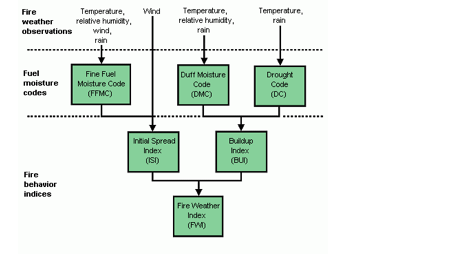
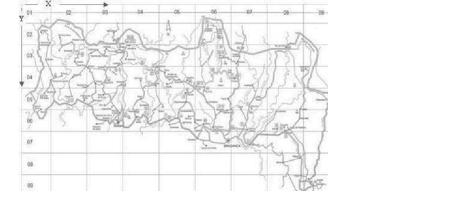
The objective is to use meteorological data from 2000 to 2003 to predict burn area. I pre-processed and feature engineered the dataset and got a total of 36 independent variables as inputs to improve the performance machine learning and better predict the outcome variable (burn area). I adopted RSME (Root Mean Square Error) to test the performance of 3 machine learning models
When observing the burned area, I noticed that most of them distributed close to zero. So, I applied a log base 10 transform to the burn area to reduce skewness and improve symmetry. I also did centering and removed 9 near zero variance features.
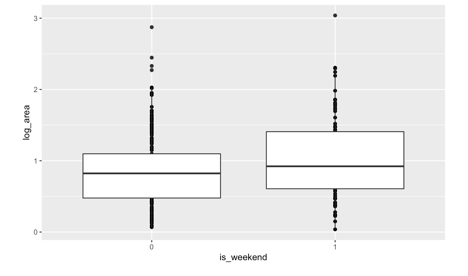
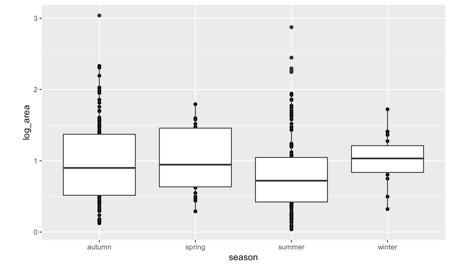
I made hypotheses that fires are more likely occur on weekends and affect by seasons. As we see from figure 3, burn areas tend to be larger during the weekends than the weekdays. Figure 4 indicates that forest fire burn area does have seasonality. I introduced 2 new variables: “is_weekend” and “season” into the dataset and converted these categorical variables into binary features.
I split the processed datasets into training and testing parts and applied the following regression model. Lasso model is the final model which has the lowest RMSE (Root Mean Square Error) of 0.6113552
- Forward regression
- Ridge regression
- Lasso regression
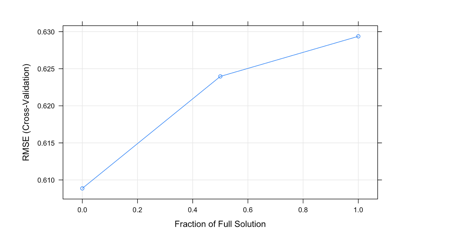
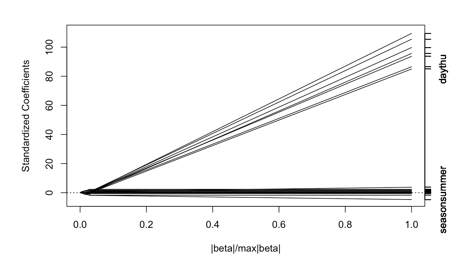
Overall, all three models indicate that the burned areas of forest fire are highly corelated to the time (weekend, season and month). Fires are more likely to happen on summer (July, August, September) and weekends due to the high traffic during that time. I suggest that there should be more forest rangers during the peak season. The national park should consider increasing the budget for propaganda fire prevention knowledge to visitors. The next step of the project is to include data of human activities into our analysis and develop more features to increase the model performance.