A simulated differential-drive robot in Gazebo, controlled remotely through a browser webpage and a gamepad, with live camera streaming and SLAM-based mapping. Built as a learning project to understand the ROS2 control stack, robot description (URDF/xacro), and the networking layer that connects a browser to a live robot session.
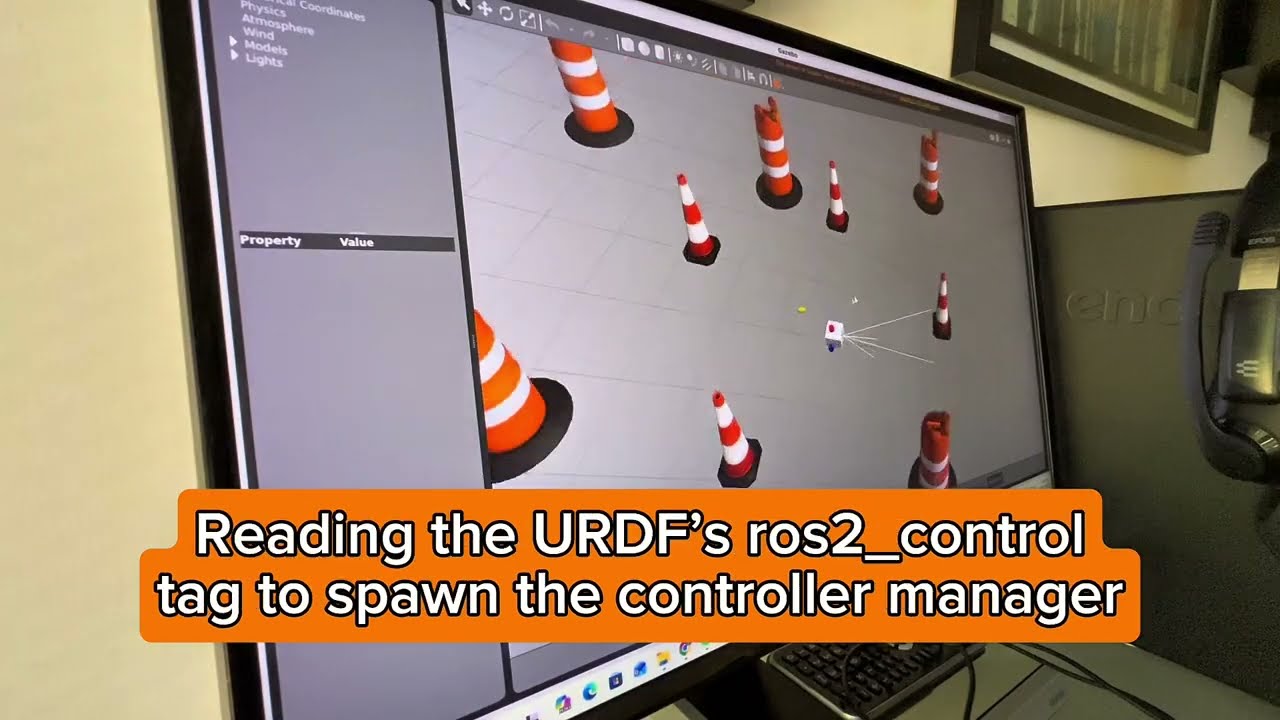
- boots up Gazebo, web video server, rosbridge server, joystick node, and webpage in sequence.
- Robot description: a modular URDF built from xacro macros (chassis, wheels, caster, LiDAR, camera), with inertial properties computed per-link rather than guessed.
- ros2_control architecture: a
DiffDriveControllerandJointStateBroadcasterrunning undergazebo_ros2_control, driven by a YAML-defined controller manager rather than hand-rolled motor code. - Sensor integration: simulated LiDAR (
/scan) and camera (/camera/image) plugins feeding into both SLAM and a live video stream. - SLAM:
slam_toolboxrunning in localization mode against the simulated LiDAR scan and odometry. - Networked teleoperation: a physical gamepad running natively in ROS2 sending velocity commands on
/cmd_vel, with the camera feed served separately viaweb_video_server.
Simulation and control stack — Gazebo hosts the robot model and the ros2_control stack (diff_cont + joint_broad), alongside the LiDAR and camera plugins. Sensor topics flow out to slam_toolbox (mapping), twist_mux (command arbitration), and RViz (visualization), all sharing a single TF tree from map down through odom, base_link, and the wheel/sensor frames.
Teleoperation network path — on a localhost machine:
Gamepad → teleop_twist_joy → /cmd_vel. The joy node reads raw gamepad input and teleop_twist_joy converts it into velocity commands. This runs natively in ROS2 on the same machine as Gazebo, so it needs no network bridge

ROS2, Gazebo, ros2_control, slam_toolbox, rosbridge_server, web_video_server, xacro/URDF, RViz2
Built while following Josh Newans's Articulated Robotics "Let's Build a Robot" series. Used as a structured way to learn the ROS2 ecosystem rather than as an original design. The architecture and launch sequence here reflect that series; my own work was implementing it, debugging the integration points, and understanding why each piece (controller manager, twist_mux priorities, the rosbridge/web_video_server split) exists.
- The SLAM config (
mapper_params_online_async.yaml) has a hardcoded map file path local to my machine — would need to be parameterized for anyone else to run this directly. - Teleoperation is localhost-only; remote control was attempted but blocked by WSL networking (see above).
- This is simulation-only — no physical robot was built for this iteration.