Condux is a source-available error monitoring platform with a built-in AI fix engine.
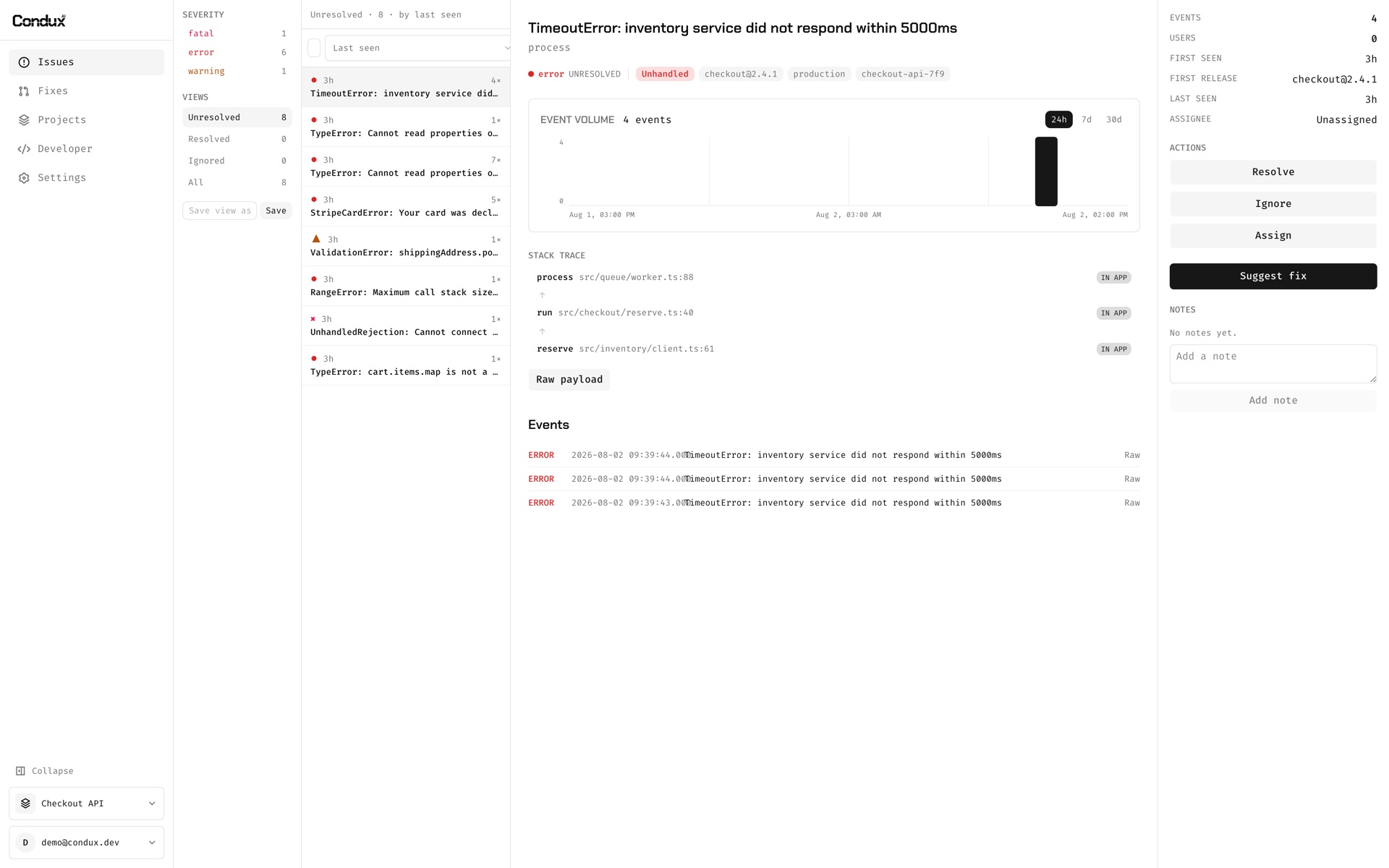
SDKs report errors to a stateless ingest relay, which authenticates the DSN, applies per-plan rate limits and quotas, and scrubs PII before buffering through Redpanda. A consumer fingerprints and groups events into issues, writes time series to ClickHouse and issue state to PostgreSQL. A Next.js dashboard reads that back as grouped issues with stack traces, breadcrumbs, tag facets and per-hour charts, and alerting fires on new and regressed issues to email, Slack, Discord and webhooks.
The fix engine takes an issue to a draft pull request. It assembles a scoped, scrubbed context from the stack trace and the project's code mappings, sends it to Claude or to a model the organisation supplies, and applies the returned changes on a new branch as a draft pull request. Fixes are never merged automatically.
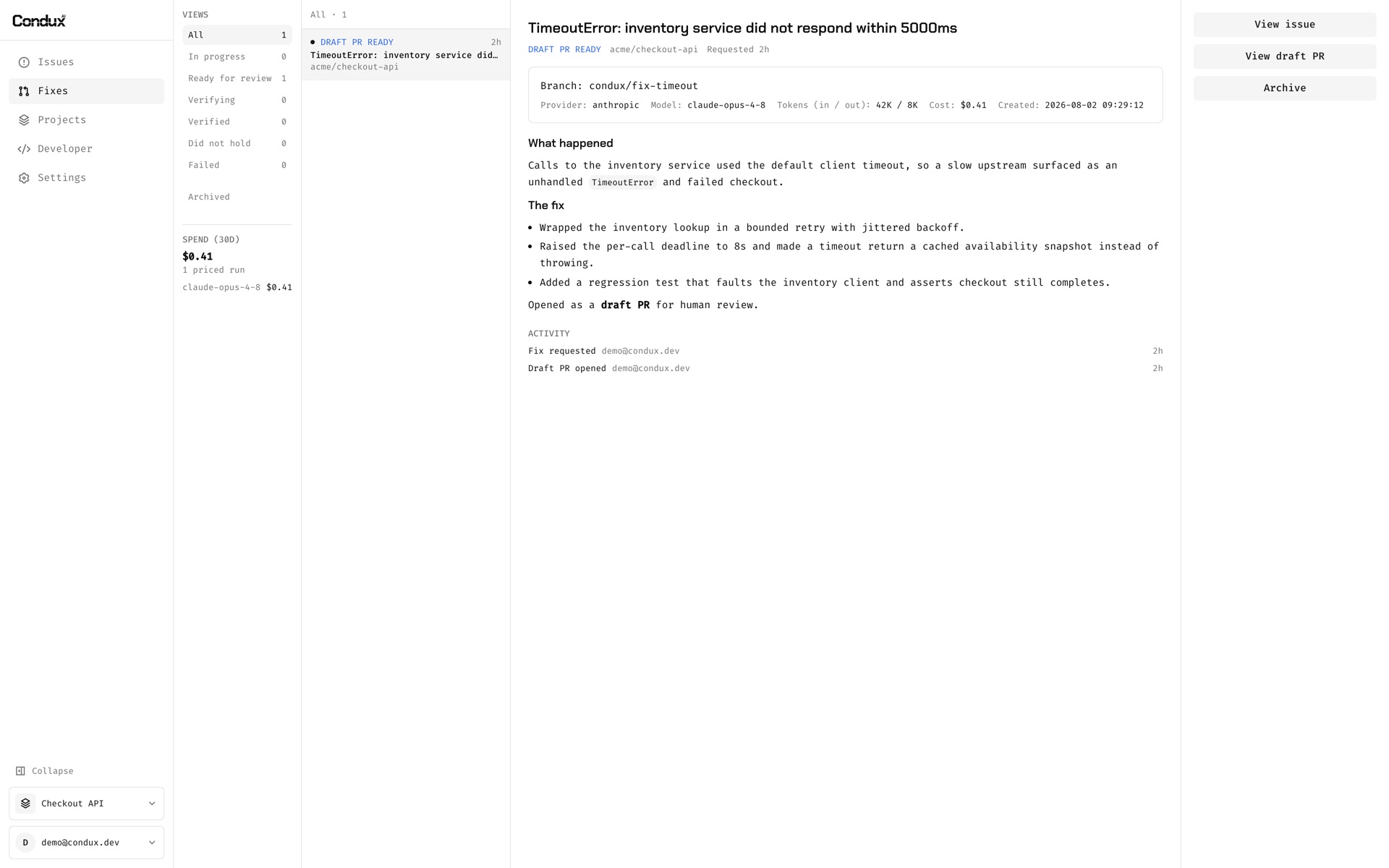
Repository access is a GitHub App with short-lived installation tokens; the model is not given the token. After a fix PR merges, a verification loop compares the issue against its subsequent event counts and resolves it once it stays silent for a configured window.
Open Dependabot findings on a connected repository can be turned into dependency-bump draft PRs through the same engine.
Each run is metered against the organisation's monthly allowance and a spend ceiling, with per-run cost derived from recorded model token usage.
Ingestion accepts the Sentry envelope and store formats, so an existing Sentry SDK reports to Condux by changing its DSN. OTLP/HTTP logs are also accepted, which lets an OpenTelemetry-instrumented application report without an SDK.
First-party SDKs are published for JavaScript/Node, browser, edge, Next.js, Python, Go, Ruby, PHP, JVM and .NET, with framework adapters for React, Express, Flask/Django/FastAPI, Rails, ASP.NET Core and Spring Boot. The SDKs are Apache-2.0; the server is FSL.
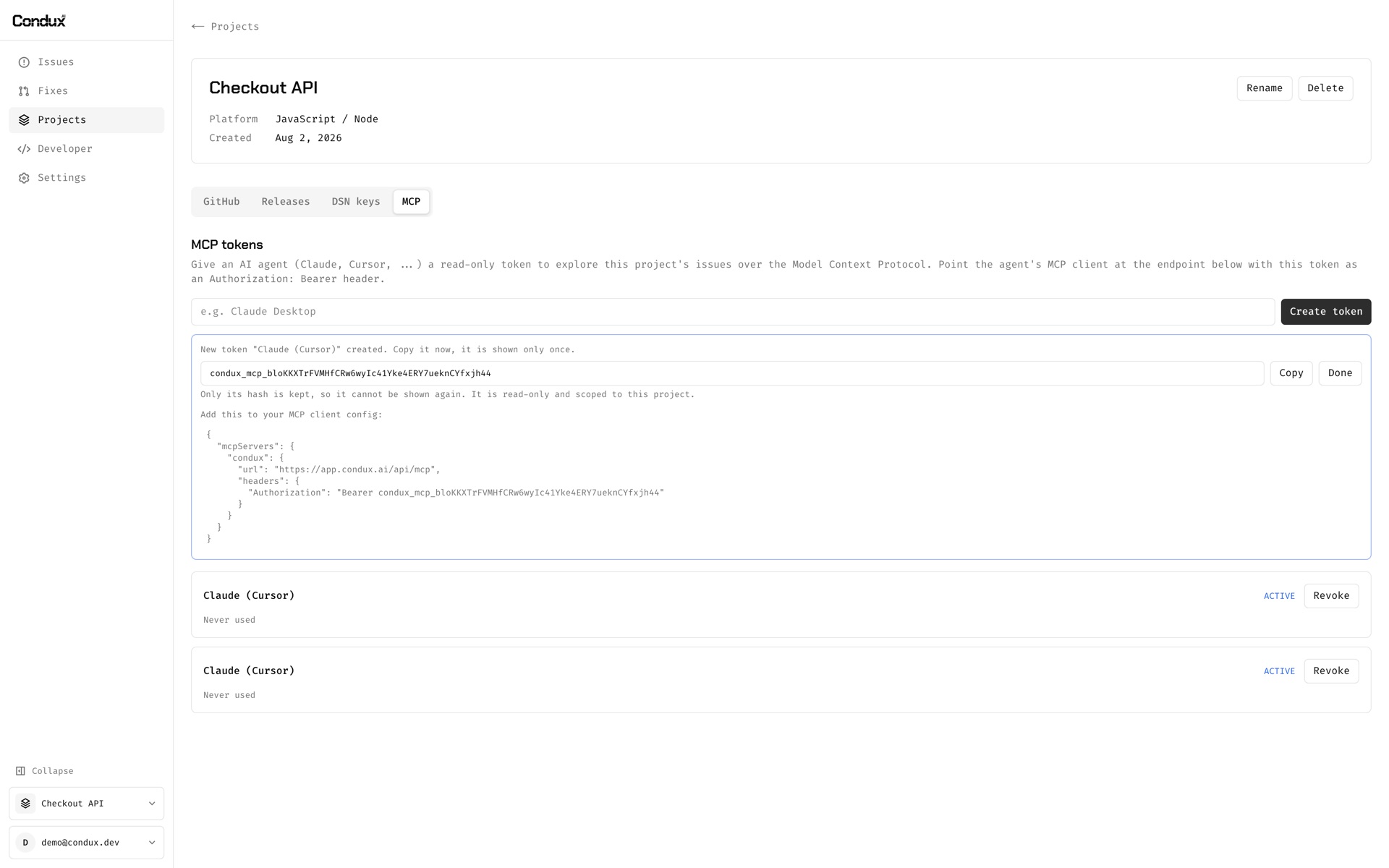
A read-only Model Context Protocol endpoint lets an AI agent debug against real production errors. Point Claude, Cursor or any MCP client at a project with a scoped token and it can list issues, read stack traces and page through occurrences. There are no write tools, and a token resolves to exactly one project.
.NET 10 services and a Next.js / React / TypeScript dashboard.
 SDKs ──envelope──▶ [Relay] ──▶ [Redpanda] ──▶ [Consumer] ──▶ ClickHouse (events, time series)
                                                          └──▶ PostgreSQL (issues, orgs, audit)
 Dashboard ──▶ [ControlPlane] ──▶ [Conductor] ──▶ draft PR
Valkey backs rate limiting and monthly quotas. The relay holds no state. Raw events expire per plan through a column-driven ClickHouse TTL rather than a scheduled job.
| Path | Contents |
|---|---|
backend/ |
.NET solution: Condux.Relay (ingest), Condux.ControlPlane (API), Condux.Consumer, Condux.Conductor (fix engine), Condux.Core (scrubbing, grouping, plans, quotas) |
web/ |
Next.js dashboard |
sdks/ |
Client SDKs and framework adapters |
packages/ |
Shared frontend packages |
proto/ |
Protobuf contracts |
migrations/ |
PostgreSQL and ClickHouse schema, numbered and idempotent |
contracts/ |
Exported OpenAPI document and Postman collection |
deploy/ |
Docker Compose stack and Helm chart |
examples/ |
Sample applications that report errors |
- .NET SDK 10.0 or later
- Node 22 or later, with pnpm
- Docker and Compose
cp deploy/.env.example deploy/.env
docker compose --env-file deploy/.env -f deploy/docker-compose.yml up -d
The dashboard listens on port 3000 and the API on 8080.
Building and testing from source:
cd backend && dotnet build Condux.sln -c Release
cd backend && dotnet test Condux.sln --filter "Category!=Integration"
cd web && pnpm install && pnpm build
Integration tests start real datastores through Testcontainers and bind the same ports as the Compose stack, so run them with that stack stopped.
deploy/docker-compose.yml runs the whole platform on a single host. deploy/charts/condux is a Helm
chart that deploys the services against externally managed PostgreSQL, ClickHouse and a Kafka-API
broker rather than running datastores in the cluster.
Report suspected vulnerabilities privately by email as described in SECURITY.md, rather
than in a public issue or pull request.
Condux is source-available under the Functional Source License (FSL-1.1-ALv2). It may be read, self-hosted and modified for any purpose other than offering a competing commercial service, and each release converts to Apache-2.0 two years after it is published.
See LICENSE for the terms and LICENSING.md for a plain-language summary.
The SDKs under sdks/ are Apache-2.0.