


This project explores two different approaches for detecting lane markings from road images/videos:
- Classical Computer Vision (OpenCV + Hough Transform)
- Deep Learning (ENet Semantic Segmentation)
The goal is to compare traditional image processing pipelines with modern deep learning models in the context of driver assistance and autonomous driving systems.
This approach uses traditional image processing techniques in OpenCV to detect lane lines without the need for training data.
It follows a step-by-step pipeline:
- Road frames are first converted from RGB to grayscale.
- This reduces computational complexity since color information is not necessary for edge-based lane detection.
- The Canny Edge Detector is applied to highlight strong intensity gradients in the frame.
- Lane markings usually have sharp contrast with the road surface, making them stand out as edges.
- Since lanes usually appear in the lower part of the frame, a polygonal mask is defined to focus only on the road area.
- This removes irrelevant details (sky, trees, vehicles, etc.) and reduces false detections.
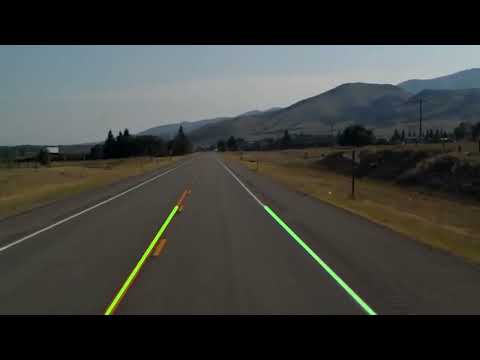
- The Probabilistic Hough Transform is applied on the detected edges to identify straight line segments.
- These line segments correspond to left and right lane boundaries.
- Post-processing like slope filtering is used to distinguish between left and right lanes.
A demo video showing this pipeline applied to real driving footage is included in the repository:


- Lightweight & Fast: Runs in real-time on CPU.
- Explainable: Each step of the pipeline is easy to visualize and debug.
- Sensitive to Noise: Shadows, road texture, and cracks can cause false edges.
- Poor Generalization: Struggles in rainy/night conditions.
- Assumes Straight Lanes: Curved or occluded lanes are often misdetected.
This approach leverages deep learning for lane detection by using the ENet (Efficient Neural Network) architecture for semantic segmentation.
Instead of detecting edges and lines explicitly, the model learns to classify each pixel in the image as either lane or background.
- Notebook Link: Binayak Dey
- A custom Road Lane Estimation dataset was created and labeled manually using Roboflow.
- The dataset includes:
- Input Images: Road scenes captured from a driver’s perspective
- Segmentation Masks: Pixel-level annotations where lane markings are highlighted
- ENet is a lightweight semantic segmentation model designed for real-time applications.
- Key features:
- Encoder-Decoder design: Encodes spatial features, then upsamples to produce segmentation masks
- Early downsampling: Reduces computation by aggressively shrinking feature maps early
- Bottleneck modules: Capture both local and global context efficiently
- Well-suited for real-time tasks like autonomous driving where speed matters.
- Framework: PyTorch
- Loss Function: Cross-Entropy Loss
- Optimizer: Adam
- Training/Validation split applied to ensure generalization
- Trained for multiple epochs on GPU until convergence
Full training code is available in the Kaggle notebook:
👉 Lane Detection Model (ENet) - Kaggle
- The trained ENet model outputs binary masks where lane pixels are highlighted.
- Post-processing overlays these masks on the original frame to visualize detected lanes.
Example visualization:

(Left: Input Image | Right: ENet Predicted Mask)
- Robust: Handles noise, shadows, and varying lighting better than classical methods
- Pixel-level precision: Can detect complex curved lanes and multiple markings
- Scalable: Performance improves with more labeled data
- Data hungry: Requires a labeled dataset for training
- Compute intensive: Training needs a GPU for efficiency
- Generalization challenges: May fail in unseen conditions unless dataset is diverse
- Name: Road Lane Estimation
- Source: Roboflow Dataset
- Note: you can download the dataset Dataset Link - Kaggle
- Framework: PyTorch
- Model: ENet
- Loss: Cross-Entropy Loss
- Optimizer: Adam
- Dataset split: Train / Validation
Training notebook:
👉 Lane Detection Model (ENet) - Kaggle
- Train and compare SCNN, SegNet, and ENet for lane segmentation
- Extend dataset to diverse conditions (night, rain, occlusion)
- Real-time integration with YOLOv8 object detection for a complete perception system
- Dataset labeled via Roboflow
- ENet architecture reference: "ENet: A Deep Neural Network Architecture for Real-Time Semantic Segmentation"