





Tiny typed dependency injection for Python that catches missing dependencies and cycles before your app starts — with zero runtime dependencies.
You wire one service graph at startup, validate it in a single call, then reuse it from FastAPI, Typer, workers, scripts, and tests. Application classes stay plain: normal constructors, normal type hints, no decorators.
pip install injexfrom injex import Container
class UserRepository:
def save(self, email: str) -> int:
return 42
class EmailSender:
def send_welcome(self, email: str) -> None:
print(f"Welcome, {email}")
class RegisterUser:
def __init__(self, repo: UserRepository, email_sender: EmailSender):
self.repo = repo
self.email_sender = email_sender
def execute(self, email: str) -> int:
user_id = self.repo.save(email)
self.email_sender.send_welcome(email)
return user_id
container = Container()
container.add_singleton(UserRepository)
container.add_singleton(EmailSender)
container.add_transient(RegisterUser)
container.assert_valid() # fail fast if the graph is incomplete
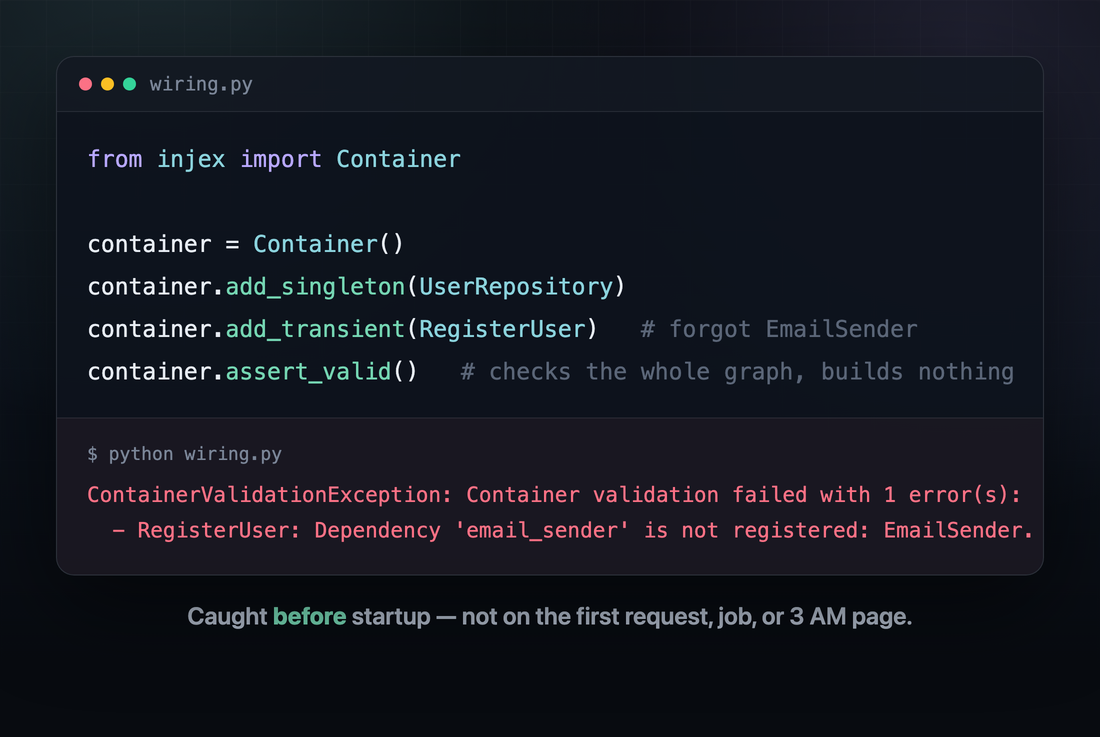
container.resolve(RegisterUser).execute("ada@example.com")Most small DI containers stop at "resolve a graph." Injex's distinctive feature is that it can check the whole graph without constructing anything, so missing registrations, missing annotations, and cycles surface at startup or in CI — not on the first request or background job.
errors = container.validate()       # list of problems, nothing constructed
container.assert_valid()            # or raise with all of them at once
That makes it safe to run as a startup guard even when real constructors open sockets or files.
container.add_singleton(ApiClient)     # one instance for the app lifetime
container.add_transient(UseCase)       # a new instance per resolve
container.add_scoped(RequestContext)   # one instance per scope (request/job)

# Swap a dependency inside a test, restored automatically on exit:
with container.override(EmailSender, instance=fake_sender):
    container.resolve(RegisterUser).execute("test@example.com")
See the tutorial for factories, named registrations,
resolve_all(), optional dependencies, and property injection.
call() invokes any function with its annotated parameters injected, while you
pass the rest — a request, parsed args, a message. It's the building block for
handlers and commands without turning them into classes:
def register_user(email: str, use_case: RegisterUser) -> int:
    return use_case.execute(email)

container.call(register_user, email="ada@example.com")  # use_case is injected
FastAPI — injex.ext.fastapi opens a scope per request and injects into routes
(pip install injex[fastapi]):
from injex.ext.fastapi import Provide, setup_injex

setup_injex(app, container)

@app.post("/users")
async def create(use_case: RegisterUser = Provide(RegisterUser)):
    return use_case.execute(...)
Typer / Click — injex.ext.cli injects services; the CLI framework only sees
the real arguments:
from injex.ext.cli import Inject, wire

@app.command()
@wire(container)
def register(email: str, use_case: RegisterUser = Inject()):
    use_case.execute(email)
Larger apps — mark classes with @injectable and register them in one call:
from injex import injectable

@injectable(lifestyle="singleton")
class ApiClient: ...

container.scan(myapp.services) # registers every @injectable defined there- A service layer reused by an API, CLI, worker, and tests, where copy-pasted wiring drifts out of sync.
- You want a missing or cyclic dependency to fail at startup, not at 3 AM.
- Tests should replace one real service with a fake without touching production wiring.
When not to: a handful of constructor calls in one entrypoint is clearer with plain manual wiring — reach for Injex when that wiring starts repeating.
Injex resolves async dependencies too. Register an async def factory or an
async-generator resource and resolve it through aresolve() / ascope():
async def db_session(settings: Settings):  # async-generator resource
    pool = await open_pool(settings.database_url)
    try:
        yield pool
    finally:
        await pool.aclose()  # finalized when the scope exits

container.add_scoped_factory(Pool, db_session)

async with container.ascope() as scope:
    pool = await scope.aresolve(Pool)
Resources are finalized LIFO via the standard library's AsyncExitStack (still
zero runtime deps). The sync resolve() raises AsyncResolutionRequiredException
if the graph needs async work, so you never silently get an un-awaited object. See
async resolution and the
FastAPI example.
Injex stays small on purpose. Its one deliberate non-goal:
- No config-provider DSL. Configuration is just another dependency: register a
settings object with
add_instance, or individual values as named registrations (add_instance(str, dsn, name="database_url"), injected withAnnotated[str, Named("database_url")]). Loading and coercing config from env/files is left to tools built for it (pydantic-settings).
Framework wiring it does do: injex.ext.fastapi
injects services into FastAPI routes, and container.call(fn, ...) injects into
any function — Typer/Click commands, workers, message handlers.
Injex compiles and caches a flat creator per service graph. On a small synthetic graph (singleton config + client, transient repository/service/use-case) it resolves faster than several popular containers on the same machine:
| Library | Median resolve time |
|---|---|
| manual wiring | 0.266 µs/op |
| Injex | 0.333 µs/op |
| dishka | 0.786 µs/op |
| Wireup, same scope | 0.872 µs/op |
| dependency-injector | 1.709 µs/op |
| lagom | 9.487 µs/op |
| punq | 56.982 µs/op |
This is synthetic and graph-specific — not a universal ranking. Reproduce it:
uv run --with punq --with lagom --with dependency-injector --with wireup --with dishka \
  python benchmarks/resolve_graph.py
See performance notes for the full table and method.
One validated graph at the composition root; every entrypoint resolves from it.
flowchart LR
  subgraph root["Composition root — one validated graph"]
    direction LR
    S[Settings] --> C[ApiClient]
    C --> R[UserRepository]
    C --> E[EmailSender]
    R --> U[RegisterUser]
    E --> U
  end
  root --> API[FastAPI]
  root --> CLI[Typer CLI]
  root --> WK[Worker]
  root --> TS[Tests]
| Feature | Injex | dependency-injector | punq | lagom |
|---|---|---|---|---|
| Zero runtime dependencies | ✅ | ❌ | ✅ | ✅ |
| Type-hint constructor injection | ✅ | ✅ | ✅ | ✅ |
| Singleton / transient / scoped | ✅ | ✅ | partial | ✅ |
| Named registrations | ✅ | ✅ | ❌ | ✅ |
| Property injection | ✅ | ❌ | ❌ | ❌ |
| Temporary test overrides | ✅ | ✅ | ❌ | ✅ |
| Graph validation without constructing services | ✅ | ❌ | ❌ | ❌ |
This table contrasts Injex with the minimal containers. For an honest head-to-head with the modern full-featured ones — dishka and Wireup — see compared to larger DI frameworks and the comparison guide.
| Method | Use when |
|---|---|
add_singleton/transient/scoped(T, Impl) |
Register a class for the chosen lifetime. |
add_*_factory(T, factory) |
Construction needs custom code; a generator factory becomes a resource with teardown. |
add_instance(T, instance) |
You already have the object. |
scan(module) |
Register every @injectable class in a module. |
resolve(T) / resolve_all(T) |
Resolve one, or all unnamed implementations. |
call(fn, **overrides) |
Invoke a function with its dependencies injected. |
create_scope() |
Start a request/job lifetime (with finalizes scoped resources). |
override(T, ...) |
Temporarily replace a dependency in tests. |
validate() / assert_valid() |
Check wiring before startup. |
aresolve(T) / ascope() / acall(fn) / aclose() |
Async equivalents (await factories, async resources). |
close() |
Finalize singleton resources at shutdown. |
- Docs site · Tutorial · API reference
- Validation guide · Comparison · vs FastAPI Depends
- Recipes · Migrating from a factories module · Performance
- Examples: clean architecture, FastAPI integration, CLI injection, config injection, async FastAPI, testing, scopes
Contributions are welcome when they keep the API small, tested, and dependency-free. Useful changes usually improve documentation, typing, examples, or narrow edge cases. See CONTRIBUTING.md.
Thanks to Muhammad Saqib Atif, mahek, oppnc, YuuGR1337, and ankitaparasher04 for improving Injex.