
An end-to-end toolkit for synthesizing decision data, training calibrated candidate scorers, evaluating them, and serving Jev-compatible inference for interactive web decisions.
Data synthesis · training + calibration · evaluation · Jev-compatible serving
Interactive demo · HF model · HF dataset · Dataset format · Chinese · Design · RLCD results
JevForge turns structured decisions into one reproducible pipeline. Give it a
state, a question, and a candidate set; it builds training records, trains and
calibrates a scorer, evaluates fixed splits, and serves a complete probability
distribution through a Jev-compatible API. choice, noul, and ordered
score questions all use the same decision path.
Its first proving ground is the interaction loop at the heart of Jev-style systems: choosing the next click, navigation target, form control, route, or escalation from the elements currently available on a page.

Results use fixed, website-disjoint test and OOD splits. The 0.8B and 0.6B models share the same data and evaluation protocol; Jev-1.13 is shown as a separate reference arm.
| Metric | Raw Qwen3.5-0.8B¹ | JevForge 0.8B | JevForge 0.6B | Jev-1.13 |
|---|---|---|---|---|
| Test choice top-1 | 0.235 | 0.579 | 0.439 | 0.543 |
| OOD choice top-1 | 0.340 | 0.637 | 0.500 | 0.610 |
| Test noul accuracy / Brier | — | 0.826 / 0.128 | 0.776 / 0.170 | 0.910 / 0.092 |
| OOD noul accuracy / Brier | — | 0.860 / 0.117 | 0.769 / 0.175 | 0.825 / 0.131 |
| Test / OOD score MAE | — | 0.367 / 0.390 | 0.488 / 0.481 | 0.348 / 0.463 |
¹ The raw-backbone row is a zero-shot scoring reference on the first 200 records of each frozen split; the trained and reference arms use their recorded full evaluation sets.
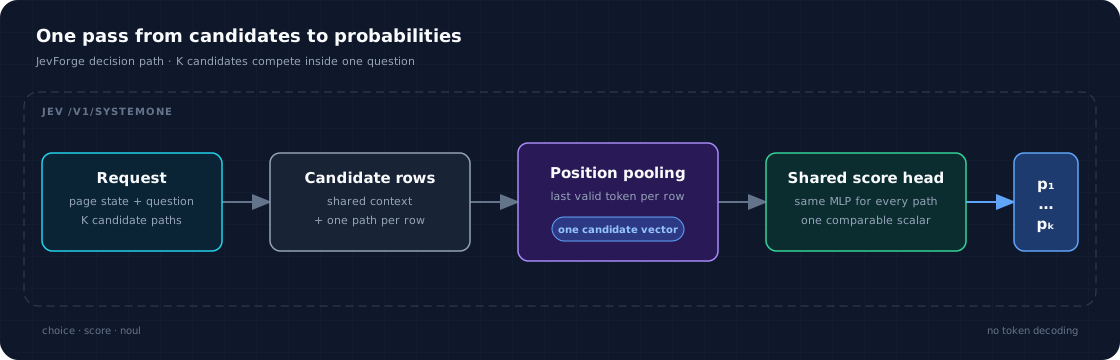
JevForge expands one question into K rows. Every row contains the same page state and question plus one candidate path. It pools the final valid token, applies the same two-layer GELU scorer to every candidate, then normalizes only the K logits belonging to that question. This keeps candidate scores comparable, preserves uncertainty, and avoids language-model decoding.
Backbone and checkpoint details are in MODEL_CARD.md.
On an Apple Silicon Mac, one command downloads the 0.8B checkpoint from Hugging Face, selects MPS, starts the local Jev-compatible API, and opens a live page. The page shows the model's measured latency and full candidate distribution before clicking the selected DOM element.
bash scripts/run_mac_demo.shpython -m venv .venv
source .venv/bin/activate
pip install -r requirements.txt
python -m jevforge.serve \
--checkpoint-dir checkpoints/JevForge-0.8B \
--port 8123curl localhost:8123/v1/systemone \
-H 'content-type: application/json' \
-d '{
"state": "Task: open privacy settings. Elements: [e1] Settings, [e2] Submit, [e3] Privacy",
"questions": {
"next": {
"type": "choice",
"instructions": "Which element should be used next?",
"criteria": {"e1": "Settings", "e2": "Submit", "e3": "Privacy"}
}
}
}'The recipe builds website-disjoint records from Mind2Web annotations, adds label distributions for missing decision fields, fine-tunes the pretrained 0.8B backbone with cross-entropy and Brier objectives, calibrates the resulting distribution, then evaluates on the frozen splits.
See Dataset format for the field mapping, complete JSONL example, split rules, and custom-domain data contract.
bash scripts/qwen35_08b_pipeline.shTraining metrics can also be tracked with Weights & Biases.
JevForge includes an initial calibrated-decision reinforcement learning path for browser choices. It combines grouped action sampling, browser-task utility, a proper Brier calibration objective, and KL anchoring to the supervised checkpoint. Gold-preserving hard-negative views can be added without changing the frozen dev, test, or OOD records.
| Full-split metric | Supervised 0.8B | Browser RLCD |
|---|---|---|
| Test choice top-1 | 0.5787 | 0.5863 |
| OOD choice top-1 | 0.6373 | 0.6477 |
| Test choice mass on valid actions | 0.4491 | 0.4881 |
| OOD choice mass on valid actions | 0.4790 | 0.5328 |
python -m jevforge.augment_browser \
  --records data/web_full \
  --output-dir data/web_browser_augmented \
  --views 1

RECORDS=data/web_browser_augmented \
RUN_NAME=qwen35-0.8b-rlcd-browser \
bash scripts/rlcd_qwen35_08b.sh
See the method notes, full ablation table, and W&B run.
jevforge/    schema, encoding, model, training, inference, serving, evaluation
scripts/     reproducible data, training, evaluation, and release commands
docs/        design notes and implementation details
examples/    small synthetic records that can be validated locally
The interactive site is maintained separately and deployed at jev-forge.vercel.app.
- End-to-end decision data, training, calibration, evaluation, and serving
- Jev-compatible
choice,noul, and orderedscoreinference - Website-disjoint evaluation and interactive decision replay
- Initial calibrated-decision reinforcement learning — grouped policy updates, proper probability scoring, reference KL, and browser augmentation.
- General structured decisions — extend to intent routing, tool/API selection, safety triage, document classification, and risk scoring.
- Controlled Qwen3.5-0.8B run — same fixed data and evaluation protocol, initialized from upstream pretrained weights and reported as its own arm.
- Code: MIT, see LICENSE.
- Model: JevForge-0.8B.
- Dataset: JevForge-Mind2Web.
- Provenance and upstream terms: THIRD_PARTY_NOTICES.md.
- Jev-1.13 is reported as a separate reference arm.
JevForge is a personal, independent research project exploring open structured-decision models and Jev-style interfaces.