detect
-
VespAI: a deep learning-based system for the detection of invasive hornets
TA O'Shea-Wheller, A Corbett, JL Osborne - Communications biology - 2024
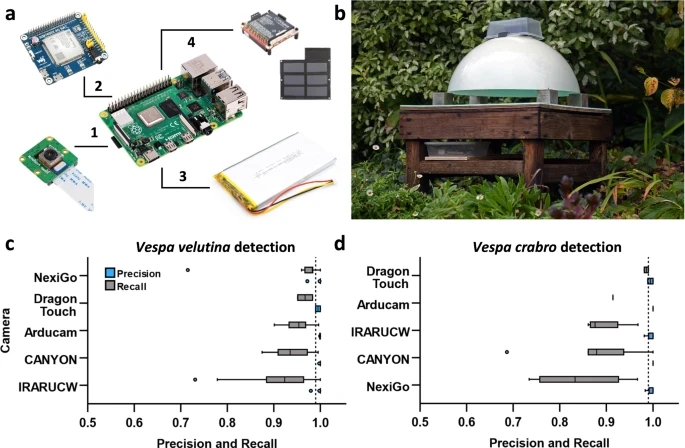
- Current reliance on public visual alerts for detection has low accuracy, prompting the exploration of deep learning technologies as a potential solution.
- The VespAI system combines a standardized monitoring station with deep YOLOv5s architecture and a ResNet backbone, achieving a mean precision-recall score of ≥0.99 for real-time hornet detection and image alerting.
- A prototype system has been successfully tested in the field, demonstrating its suitability for large-scale deployment and potential to enhance management strategies for invasive hornets.
-
Deep Learning-Based Portable Image Analysis System for Real-Time Detection of Vespa velutina
MS Jeon, Y Jeong, J Lee, SH Yu, S Kim, D Kim - Applied Sciences - 2023
- A portable real-time monitoring system was developed to detect V. velutina and notify users, emphasizing portability and ease of installation for various apiary locations.
- The system utilizes an improved YOLOv5s convolutional neural network trained on 1,960 high-resolution images, achieving high detection accuracy with a confidence threshold of ≥0.600.
- In field tests, the system detected 83.3% of V. velutina during hunting activities while monitoring three beehives, successfully alerting registered users via a mobile application.
-
C Herrera, M Williams, J Encarnação - Pest Management - 2023
- The machine learning model achieved an average accuracy for species classification of 80.1 ± 13.9% and 74.5 ± 7.0% for V. velutina. V. crabro had the highest level of misclassification, confused mainly with V. velutina and P. dominula.
- the wingbeat recordings from a flying insect sensor can be used with machine learning methods to differentiate V. velutina from six other Hymenoptera species in the laboratory and this knowledge could be used to help develop a tool for use in integrated invasive alien species management programs.
-
H Hall, M Bencsik, N Capela, JP Sousa - Computers and Electronics in Agriculture - 2025
- Honeybees and hornets are monitored at hives, using a camcorder and microphone.
- Their flight sounds differ and can be discriminated with machine learning.
- Two-dimensional-Fourier-transform analysis promotes the discrimination success.
- The hovering of hornets during predation is key to acoustic discrimination success.
-
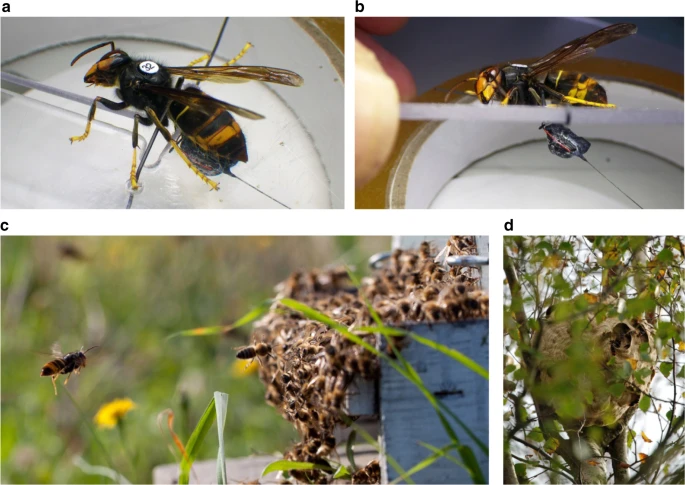
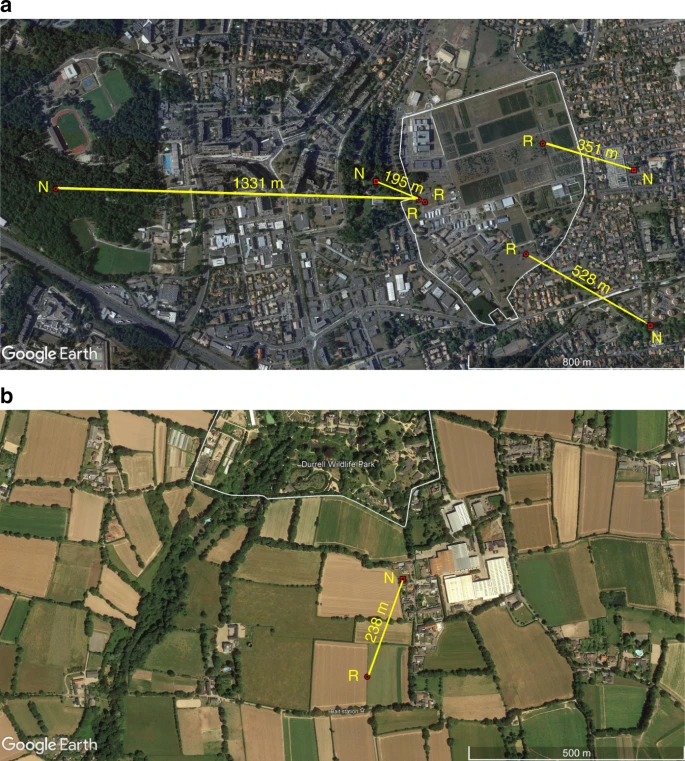
Searching for nests of the invasive Asian hornet (Vespa velutina) using radio-telemetry
PJ Kennedy, SM Ford, J Poidatz, D Thiéry - Communications Biology - 2018
-
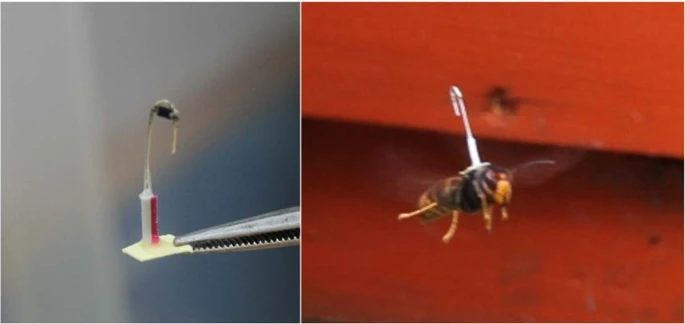
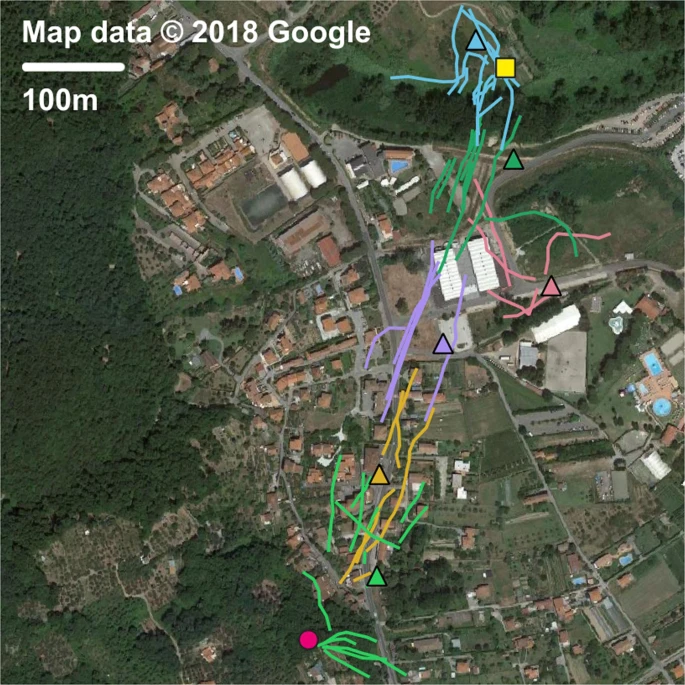
An Innovative Harmonic Radar to Track Flying Insects: the Case of Vespa velutina
R Maggiora, M Saccani, D Milanesio, M Porporato - Scientific reports - 2019 - nature.com
-
Y Jeong, MS Jeon, J Lee, SH Yu, S Kim, D Kim, KC Kim - Drones - 2023
- A system for the control of V. velutina nests using drones for detection and tracking the real-time location of the nests.

-
Towards the automatic localization of Vespa velutina nests using RFIDs
A Parmiggiani, J Slootmans, A Golfidis - Proceedings of São - 2024
- The project aims to enhance the nest localization of the Asian hornet (Vespa velutina) by using RFID technology to improve monitoring efficiency.
- Experiments showed that lightweight RFID coils attached to the hornets did not hinder their flight behavior, allowing for normal mobility.
- The RFID reader successfully detected the tagged hornets near scent jars, indicating that this method is a viable approach for simplifying nest localization in the field.