impact
-
F Cappa, A Cini, L Bortolotti, J Poidatz, R Cervo - 2021
- Hornets of the genus Vespa and honey bees engage in a coevolutionary arms race, characterized by numerous reciprocal adaptations between predator and prey.
- This balance is disrupted by the introduction of alien hornet species, such as Vespa velutina and Vespa mandarinia, into new regions like Europe and North America, adversely affecting Western honey bees and commercial beekeeping.
- It highlights the relative lack of coevolution and effective defenses of Western honey bees against these invasive hornet species.

-
Monitoring Study in Honeybee Colonies Stressed by the Invasive Hornet Vespa velutina
A Diéguez-Antón, MS Rodríguez-Flores - 2022
- In the months of July and August, the maximum number of hornets appeared in non-central hours of the day.
- In the months of September and October, the highest pressure in the apiary occurred in the central hours of the day, coinciding with temperatures between 15 °C and 25 °C and a relative humidity that was higher than 60%.
- The honeybee colony with the highest thermoregulatory capacity was the strongest and it was the key factor for the colony survival even when the hornet pressure was high too. Therefore, strengthening the hives and improving beehive health status is essential to avoid colonies decline.

-
Long-term Vespa velutina nigrithorax pressure: Honey bee risk survival to alien invasion
A Diéguez-Antón, O Escuredo, MC Seijo - Apidologie - 2025
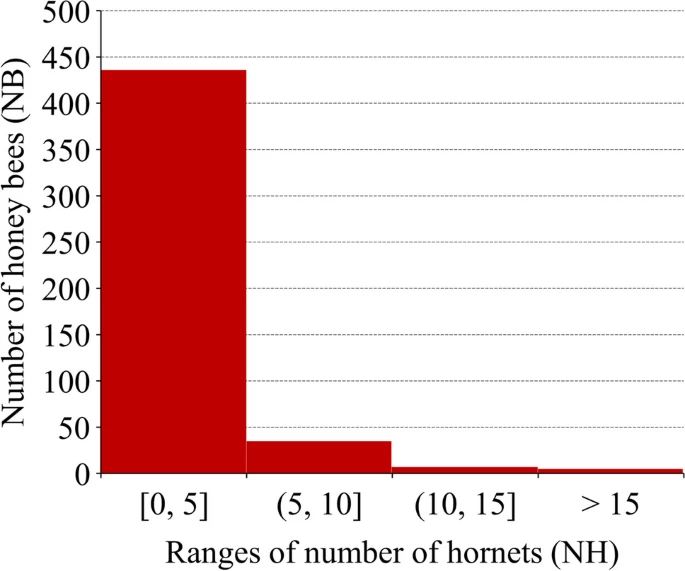
- Temperatures ranging from 17 to 26 °C were the most suitable for observing the higher number of hornets.
- The presence of five or more hornets posed a risk to the survival of the honey bee colonies.
-
M Leza, C Herrera, A Marques, P Roca - Science of the Total Environment - 2019
- Vespa velutina presence increases mRNA expression of oxidative stress-related genes.
- Catalase activity and lipid peroxidation in honeybees increase with the predator presence.
- The presence of Vespa velutina has a negative impact on honeybees' health.

-
TD Santiago - 2024
- On the immediate vicinity of the nests the hornets appear to prefer "Artificial areas" as well as "Agricultural land" revealing a strong affinity to areas with human settlements.
- Finally, honeybee populations appear to be strongly linked to the abundance of YLH nests.
- On the other hand, a relationship between the decline of honeybee colonies and the rise in hornet population was shown to be marginally significant.
-
Future range expansions of invasive wasps suggest their increasing impacts on global apiculture
X Zhang, P Nie, X Hu, J Feng - Insects - 2024
- Polistes chinensis and Vespa velutina nigrithorax had the highest range expansion ratios, so they warrant more urgent attention than the other species.
- Europe and the eastern part of the USA were future invasion hotspots for all major invasive wasp species, suggesting that apiculture might face more pronounced threats in these regions than in others. In conclusion, given their substantial range shifts, invasive wasps will likely have increasingly negative impacts on global apiculture in the future.
-
Honey bee social collapse arising from hornet attacks.
S Dong, G Gu, J Li, Z Wang, K Tan - Entomologia Generalis - 2023
- Collective defense mechanisms in species are typically effective against sympatric predators but not against allopatric ones, as seen with the honey bee (Apis mellifera), which lacks effective defenses against the allopatric hornet Vespa velutina auraria, unlike the sympatric A. cerana.
- This study investigates the decline of A. mellifera colonies in southwest China when attacked by native V. velutina auraria, revealing that A. mellifera ligustica significantly reduced foraging and experienced higher predation rates compared to the native A. cerana cerana.
- Attacks by hornets led to decreased queen egg production, fewer pupae, and fewer workers, resulting in colony death within a week, with queens reducing egg-laying despite stable worker numbers.
- The findings suggest that, in addition to direct predation, stress induced by hornet attacks may contribute to the decline of A. mellifera colonies, aligning with research indicating that such stress can negatively impact reproduction and overall fitness in various animal species.
-
Broad ecological threats of an invasive hornet revealed through a deep sequencing approach
S Pedersen, PJ Kennedy, TA O'Shea-Wheller - 2025
- A highly diverse range of invertebrates are predated on by Vespa velutina
- Considerable spatiotemporal dietary variation implies a highly flexible predator
- Apis mellifera is the most frequently predated species
- The functional groups most likely at risk are wild pollinators and decomposers

-
Assessing predation pressure of Vespa velutina on local fauna through DNA metabarcoding
C Herrera, M Leza, JA Jurado‐Rivera - Journal of Zoology
-
Flower-visiting by the invasive hornet Vespa velutina nigrithorax (Hymenoptera: Vespidae)
T Ueno - Int. J. Chem. Environ. Biol. Sci - 2015
- it was frequently found that V. velutina nigrithorax flew and hovered around a patch of flowers to predate hymenopteran bees and dipteran flies.
- Field observations and mark-recapture experiments suggested that V. velutina nigrithorax played a role in pollinating at least some plant species.
-
Predator and pollinator? An invasive hornet alters the pollination dynamics of a native plant
SV Rojas-Nossa, TA O'Shea-Wheller, J Poidatz - Basic and Applied Ecology - 2023
- Despite being a frequent floral visitor and the most common nectar forager in areas of high abundance, V. velutina proved to be an inferior pollinator compared to native species, resulting in decreased reproductive success for H. hibernica.

-
Introduced Vespa velutina does not replace native Vespa crabro and Vespula species
L Carisio, J Cerri, S Lioy, E Bianchi, S Bertolino - 2020
-
YR Lueje, MA Jácome, MJ Servia - Agriculture, Ecosystems & Environment - 2024
- The invasive hornet Vespa velutina can notably reduce crop yield of small vineyards.
- Anti-hail netting prevents grape yield losses by hornets and birds.
- Netting might alter grape ripening and the bunch fungal diseases of some cultivars.
- Economic costs and mechanization needs might reduce acceptance of netting.
- Vineyard abandonment is a potential outcome of V. velutina invasion.

-
J Poidatz, K Monceau, O Bonnard - Ecology and Evolution - 2018
- Foraging range was thus estimated ca. 1,000 m around the nest.
-
The economic cost of control of the invasive yellow-legged Asian hornet
M Barbet-Massin, JM Salles, F Courchamp - NeoBiota - 2020
- This study provides the first estimate of control costs, revealing that nest destruction in France alone cost €23 million between 2006 and 2015, with yearly costs projected to rise to €11.9 million in France, €9.0 million in Italy, and €8.6 million in the UK as the species expands.
-
AI García-Arias, MA Ferreira-Golpe - Agraria y Recursos - 2024
- As part of the European Atlantic POSitiVE project, we conducted a survey of 151 beekeeping units in 2021 on the practices associated with its control in Galicia.
- Taking the data to the whole population (complex sample), we have estimated that the costs of control are between the 14 % and the 21 % of the production value.