Gravity Clock is an embedded project based on the STC8 microcontroller.
It uses gravity switches to detect the orientation of the clock and automatically controls countdown timers, alarms, and sleep/wake behavior.
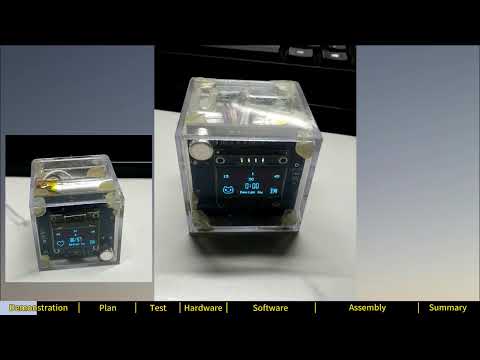
-
Orientation detection
1.Uses 2 gravity switches to detect 4 different directions.
2.Each direction has its own countdown timer. -
Countdown timer
1.When the device is tilted to a direction, the corresponding countdown starts.
2.Countdown values can be set individually for each direction using buttons. -
Alarm
1.When a countdown reaches zero, an alarm sounds.
2.After the alarm ends, the device automatically enters sleep mode. -
Sleep/Wake function
1.Device sleeps after alarm finishes to save power.
2.Shaking the device or tilting it to a new direction wakes it up and resumes the current direction's countdown. -
EEPROM storage
1.Countdown times for each direction can be set with buttons.
2.Values are stored in EEPROM to retain settings after power-off. -
OLED display
1.Shows countdown time for each direction.
2.Supports 4-direction display, adapts to current orientation.
Beeper
- Uses a passive beeper for alarm notifications.
- Microcontroller: STC8 Series MCU
- Gravity Switches: 2 units (detect 4 directions)
- Buzzer: For alarm notifications (passive)
- Buttons: For setting countdown times
- OLED display: 64*128 Optional, shows current countdown and status (I2C protocol)

-
Written in C for STC8 microcontroller.
-
The software is designed with a layered architecture and follows a state machine approach.
-
Layered design: Separates low-level device drivers, system abstraction APIs, and high-level control logic for clarity and modularity.
-
State machine: The main loop executes business logic based on the current state
-
Software architecture is organized into three layers:
- Device Driver Layer: Handles direct register access and peripheral interactions.
- System Abstraction Layer: Provides higher-level APIs for timers, I2C, UART, GPIO, etc.
- Control Logic Layer: Implements the main application logic and state machine.
-
Software execution follows a state-driven main loop, where each state executes its corresponding business logic sequentially.

This project is open-source under the MIT License. You are free to use, modify, and distribute it with attribution.